
TL;DR:
- Artisanal furniture is handcrafted with repairable joinery, ensuring durability and longevity.
- It uses quality materials like hardwoods with proper drying and hand finishes for lasting wear.
- Long-term cost and environmental impact favor artisanal pieces due to their lifespan and repairability.
Most homeowners assume custom furniture simply means paying more for the same factory-made piece with a different label. That assumption costs people years of satisfaction and thousands of dollars in repeat purchases. True artisanal furniture is something else entirely. It is built by skilled hands, shaped by material knowledge, and designed to outlast every trend. For Maryland homeowners and interior designers searching for entryway solutions that genuinely perform and impress, understanding what separates artisanal craftsmanship from mass production is the first and most important step.
Table of Contents
- Defining artisanal furniture: Beyond mass production
- The artisanal process: From concept to hand-finished piece
- Hallmarks of quality: Materials, benchmarks, and durability
- Longevity, sustainability, and the cost-per-year advantage
- A designer’s take: Why entryways deserve bespoke craftsmanship
- Elevate your Maryland entryway with true artisanal furniture
- Frequently asked questions
Key Takeaways
| Point | Details |
|---|---|
| Handcrafted quality | Artisanal furniture is made by skilled makers who focus on every detail. |
| Long-term value | Quality materials and solid construction ensure each piece lasts for years and reduces replacement costs. |
| Custom fit, unique look | You get furniture tailored to your space and style, not off-the-shelf repetition. |
| Sustainable investment | Choosing artisanal pieces supports sustainability through longevity and less waste. |
Defining artisanal furniture: Beyond mass production
Artisanal furniture is furniture that is completely or substantially handcrafted, typically by a named maker or a small workshop with deep material expertise. This is not the same as “semi-custom,” where a factory piece gets a color swap or a different hardware pull. And it is definitely not mass production with a premium price tag.
The differences run deeper than most buyers realize. Here is what actually sets artisanal pieces apart:
- Individuality: Each piece is made for a specific space and client, not a demographic average.
- Material expertise: Artisan makers select wood for its grain, density, and behavior, not just its price point.
- Repairable joinery: Mortise-and-tenon, dovetail, and other traditional joints can be disassembled and repaired. Staples and glue blocks cannot.
- Attention to detail: Hand-planed surfaces, fitted drawer slides, and finished interior surfaces reflect a standard that machines skip.
- Maker accountability: A small workshop stands behind every piece. A factory does not.
One of the most misunderstood aspects of artisanal furniture is the role of tools. Pure hand-tool work offers the highest level of authenticity, while hybrid approaches that use hand-operated machines allow skilled makers to scale without sacrificing quality. Neither is inferior if the maker understands what they are doing. What matters most is repairable joinery, because that is what determines whether a piece lasts 10 years or 100.
“The difference between artisanal and mass-produced furniture is not just aesthetic. It is structural. Repairable joinery means the piece can be restored rather than replaced, which changes everything about its long-term value.”
For Maryland entryways specifically, this matters because entryways take real daily punishment. Coats, boots, bags, and constant traffic demand furniture built to absorb use without failing.
The artisanal process: From concept to hand-finished piece
Knowing that artisanal furniture is handcrafted is one thing. Understanding how it actually comes together is what builds real appreciation for the investment.
Here is how a quality artisanal entryway piece moves from idea to finished product:
- Design consultation: The maker works with you to understand your space, storage needs, and aesthetic preferences.
- Wood selection: Kiln-dried hardwoods at 6-12% moisture are chosen for stability. Wet or improperly dried wood will warp, crack, and fail.
- Milling: Boards are flattened, straightened, and dimensioned by hand or with hand-operated machines.
- Joinery cutting: Mortises, tenons, dovetails, and other joints are cut with precision. This is where skill separates good from great.
- Dry assembly: The piece is assembled without glue first to check fit and alignment.
- Glue-up and clamping: Joints are glued and clamped in sequence, often over several hours.
- Sanding and finishing: Multiple stages of hand-sanding prepare the surface, followed by hand-applied finish coats.
Moisture content is not a minor detail. Wood at 6-12% moisture is stable for interior Maryland conditions. Wood above that range will shrink as it dries inside your home, stressing joints and causing visible gaps. This is why buying from a maker who controls their material from the start matters so much.
“Hand-finished” means the maker applies finish by hand, often in multiple coats with light sanding between each. It is labor-intensive and produces a depth and feel that spray-applied factory finishes cannot replicate.
Pro Tip: When evaluating a furniture maker, ask specifically about their joinery methods and how many finishing stages they apply. Vague answers are a red flag. A confident craftsman will walk you through every step.
| Piece type | Typical timeline | Estimated labor hours |
|---|---|---|
| Entry bench | 2-3 weeks | 20-35 hours |
| Mud locker (single) | 3-5 weeks | 40-60 hours |
| Full entryway system | 6-10 weeks | 80-140 hours |
| Custom storage cabinet | 4-6 weeks | 50-80 hours |
Hallmarks of quality: Materials, benchmarks, and durability
Once you understand the process, you need a way to evaluate what you are actually buying. The furniture industry has real benchmarks, and knowing them protects you from paying artisanal prices for mass-market quality.
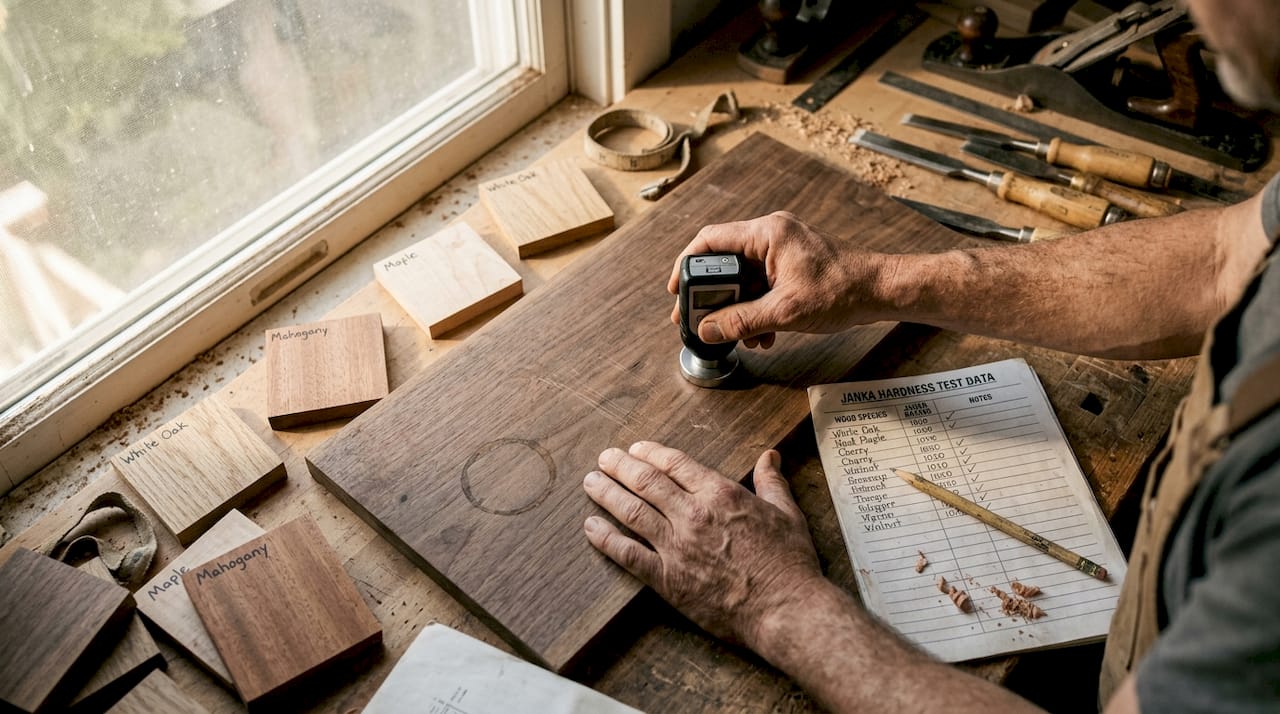
Wood hardness is measured on the Janka scale. Janka hardness above 950-1000 lbf is the threshold for entryway furniture that will hold up. Walnut comes in at 1010 lbf and oak at 1360 lbf. Softer woods dent and scratch under daily use. If a maker cannot tell you the Janka rating of their primary wood species, that is a problem.
For upholstered pieces like entry benches, foam density between 1.8 and 2.5 lb per cubic foot ensures the seat holds its shape over years of use. And if fabric is involved, upholstery fabric benchmarks measured in Wyzenbeek rubs tell you how long the material will last. Entryway pieces should meet at least 15,000 to 30,000 rubs. For choosing entryway fabrics, prioritize tightly woven, high-rub-count materials that resist abrasion from outerwear.
Here is a quick comparison of artisan versus mass-market materials:
| Feature | Artisanal | Mass-market |
|---|---|---|
| Wood species | Named hardwoods, Janka >950 | Generic “wood” or MDF |
| Joinery | Mortise-tenon, dovetail | Staples, cam locks, glue |
| Finish | Hand-applied, multi-stage | Spray lacquer, single coat |
| Foam density | 1.8-2.5 lb/ft³ | Often under 1.5 lb/ft³ |
| Repairability | High | Near zero |
When shopping for artisanal entryway furniture, check for these specifics:
- Named wood species with a stated Janka rating
- Visible or described joinery method
- Multi-stage hand-applied finish
- Maker’s warranty or repair policy
- Foam and fabric specs if upholstered
- BIFMA or ISO compliance for structural standards
These are not luxury extras. They are the baseline for furniture that earns its price.
Longevity, sustainability, and the cost-per-year advantage
Here is the number that changes how most people think about artisanal furniture: cost per year of use.
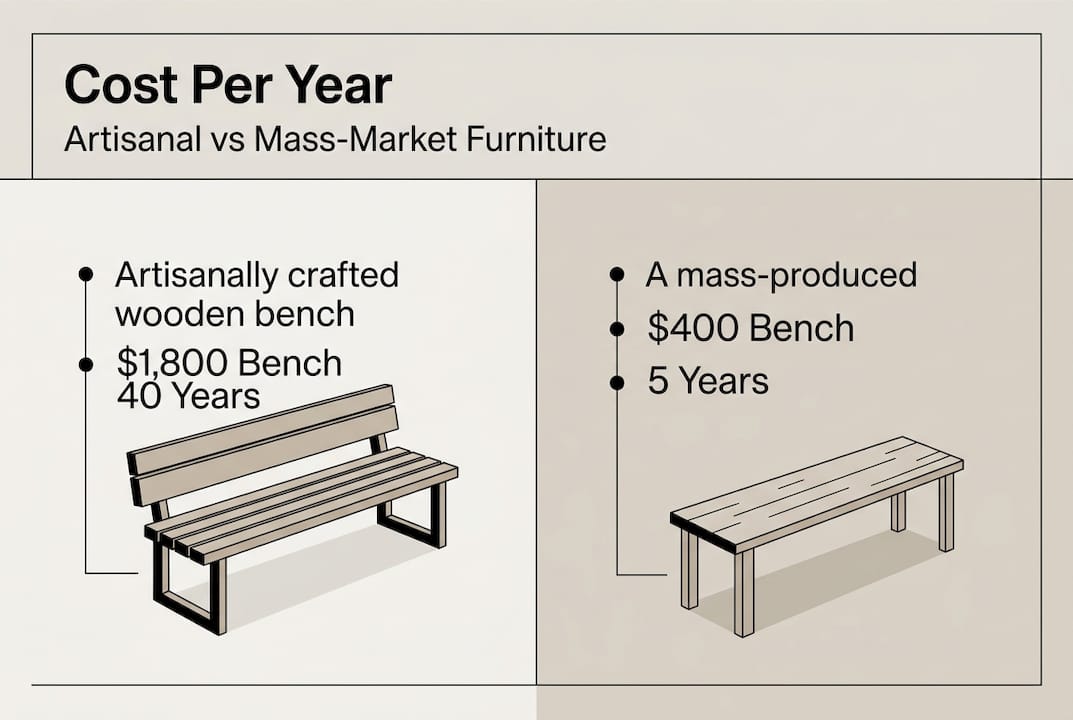
A mass-market entry bench at $400 that lasts 5 years costs $80 per year. An artisanal bench at $1,800 that lasts 40 years costs $45 per year. The “expensive” piece is actually the better financial decision, and that does not even account for the replacement hassle, the landfill contribution, or the declining quality of what you replace it with.
Life cycle analysis confirms that heavier, better-built furniture has a higher upfront environmental impact but a significantly lower total lifecycle impact due to longevity. Pre-production (material sourcing and manufacturing) dominates the environmental footprint of any piece. Buying once and keeping it for generations is the most sustainable choice available.
Repairable joinery is the structural reason artisanal furniture lasts so long. When a joint loosens after decades of use, a craftsman can disassemble, clean, re-glue, and reassemble it. That is not possible with cam locks or stapled corners. Artisanal furniture’s lower long-term cost comes directly from this repairability, not from any marketing claim.
“Most buyers compare sticker prices. Smart buyers compare cost per year of use. Artisanal furniture almost always wins that calculation.”
Sustainability also extends to sourcing. Small workshops typically buy from regional mills, use offcuts creatively, and avoid the toxic adhesives common in particleboard furniture. For Maryland homeowners who care about where their materials come from, this matters.
Pro Tip: Before comparing prices between artisanal and mass-market options, divide each price by its realistic lifespan in years. The result will almost always reframe which piece is actually the better value.
A designer’s take: Why entryways deserve bespoke craftsmanship
After more than 20 years building custom entryway furniture for Maryland homes, we hold a strong view: the entryway is the most underinvested room in most houses, and it is the one that matters most.
Your entryway is the first thing guests experience and the last thing you see before you leave. It sets the tone for everything inside. A cheap, wobbly bench or a generic coat rack communicates something about the home whether you intend it to or not.
What we have seen consistently is that a single well-built bespoke piece transforms not just the look of an entry but its function. One client in Annapolis replaced a big-box storage bench with a custom mud locker fitted to their exact wall dimensions. The entryway went from chaotic to calm. Coats had a place. Shoes had a place. The kids actually used it because it worked.
Maryland homes range from Federal-style row houses in Baltimore to sprawling craftsman colonials in Howard County. No mass-market piece fits all of them well. Bespoke craftsmanship does, because it is built around your specific space, not an average one. That is not a luxury argument. That is a practical one.
Elevate your Maryland entryway with true artisanal furniture
Reading about artisanal craftsmanship is one thing. Seeing it in person, touching the joinery, and working with a maker who understands your specific home is another experience entirely.
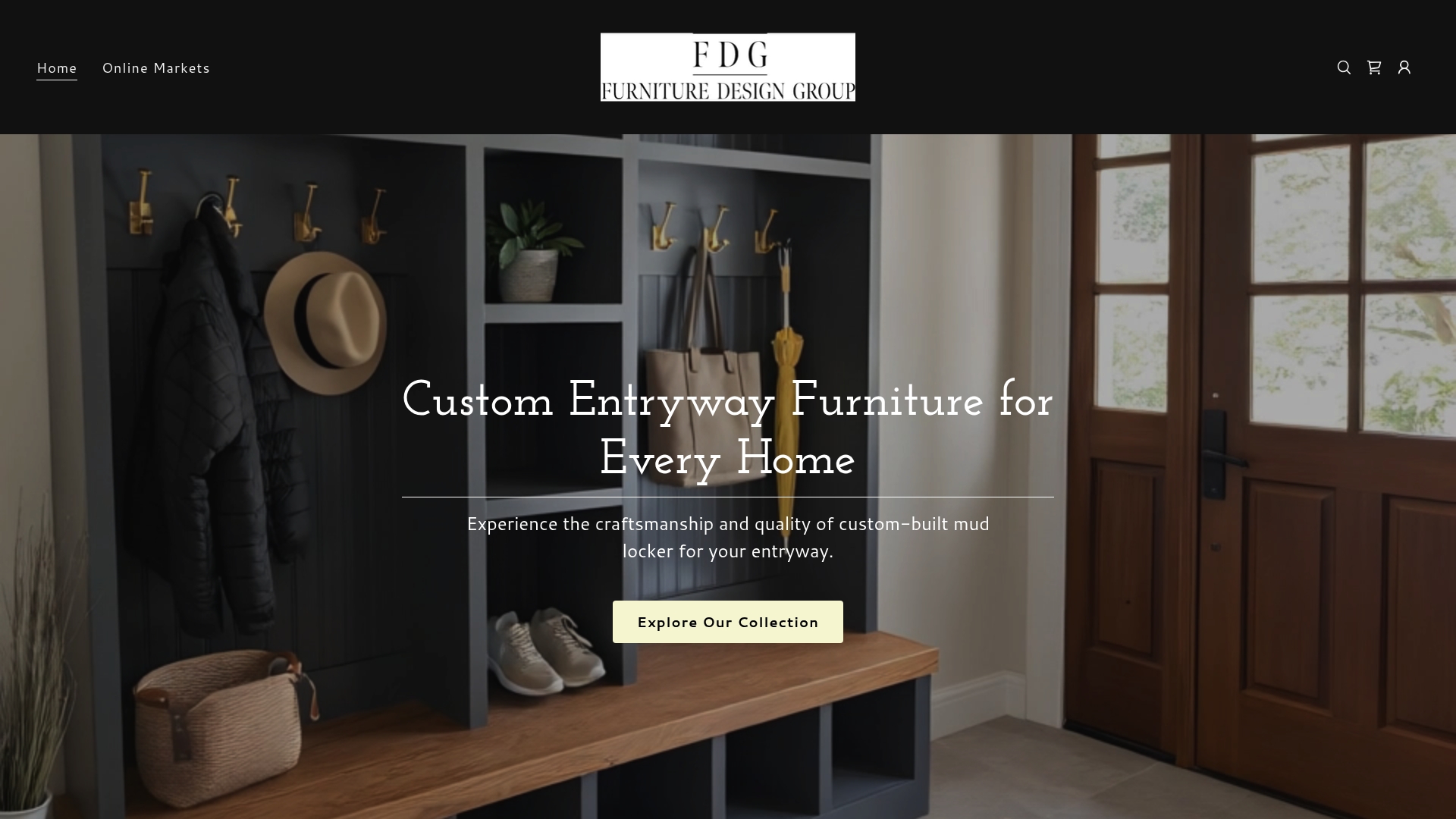
At Furniture Design Group, we have spent over two decades building custom entryway furniture for Maryland homeowners and interior designers who want something that lasts. From mud lockers to full entryway systems, every piece is designed around your space and built by hand. Explore our custom furniture masterpieces to see what bespoke craftsmanship looks like in practice, then reach out to start a conversation about your project. Your entryway deserves better than average.
Frequently asked questions
What makes artisanal furniture different from mass-market pieces?
Artisanal furniture is primarily handcrafted using quality hardwoods and repairable joinery, offering durability and customization that factory-made alternatives simply cannot match.
Why does moisture content in wood matter for artisanal furniture?
Wood dried to 6-12% moisture content stays stable indoors, minimizing warping or cracking that is especially common in Maryland’s humid summers and dry winters.
How can I tell if artisanal entryway furniture will last?
Look for named wood species with a Janka hardness above 950 lbf, ask about joinery methods, and confirm the maker offers a repair or restoration policy.
Is artisanal furniture more sustainable than mass-produced pieces?
Over its full life, artisanal furniture typically has a lower environmental impact because lifecycle analysis shows longevity dramatically reduces total footprint compared to frequently replaced mass-market pieces.