
TL;DR:
- Authentic artisanal entryway furniture features durable joinery like dovetails and mortise-tenon joints, ensuring longevity. It is crafted from solid hardwoods such as oak, walnut, or maple, suitable for Maryland’s humid climate, unlike veneered composites. Investing in handmade pieces offers superior durability, repairability, and timeless appeal, making them a valuable legacy over mass-produced alternatives.
Shopping for custom entryway furniture in Maryland means navigating a market flooded with pieces that look handcrafted but fall apart within years. Knowing a real artisanal furniture features list before you walk into any showroom changes everything. Mass-produced furniture mimics the aesthetic of artisan work, but the structural differences are significant and measurable. Your entryway takes more daily punishment than almost any room in your home — coats, shoes, humidity from the front door, seasonal mud. Getting this purchase right means understanding exactly which handcrafted furniture characteristics separate a 30-year piece from a 5-year one.
Table of Contents
- Essential joinery techniques in the artisanal furniture features list
- Material selection: solid hardwoods over veneers and composites
- Superior drawer construction and hardware details
- Finishes and surface treatment that elevate artisanal pieces
- Craft production timeline and customization benefits for Maryland buyers
- Comparison of artisanal vs mass-produced furniture for entryway use
- Rethinking value: why artisanal entryway furniture is worth the investment
- Discover custom artisanal furniture solutions in Maryland
- Frequently asked questions
Essential joinery techniques in the artisanal furniture features list
Joinery is where you separate genuine craftsmanship from clever marketing. It’s the skeleton of any furniture piece, and it’s rarely visible — which is exactly why mass producers cut corners there first.
Dovetail joints are the clearest signal of artisan drawer quality. Quality artisanal furniture features dovetail joints in 100% of high-end drawer boxes, and hand-cut versions show slightly irregular spacing. That irregularity is not a flaw. It’s proof a human made it. Machine-cut dovetails are perfectly uniform — look closely and you’ll see the difference immediately.
Mortise and tenon joints are the standard for load-bearing frames. Benches, table bases, and entryway locker frames all depend on this joint for long-term resistance to racking, which is the side-to-side force every piece of furniture endures over years of use. Mortise and tenon joinery works across decades, not seasons, offering structural integrity that pocket screws simply cannot replicate.
When reviewing any piece, look for these signs of quality joinery:
- Hand-cut dovetails with slight spacing variations in drawer boxes
- Mortise and tenon connections at all major frame joints
- Dowels or biscuits used as secondary support, not as the primary joint
- No exposed pocket-hole screws on visible or structural surfaces
- Minimal glue spots on exterior surfaces (interior glue on joints is fine and expected)
You can spot true artisanal furniture features by simply pulling a drawer out completely and turning it upside down. If you see a wooden box with interlocking fingers at the corners, that’s a dovetail. If you see staples, that’s your answer right there.
Pro Tip: Run your finger along the inside rear corner of any drawer. A solid wood back joined with a dovetail feels tight and angular. A stapled drawer back feels slightly rough and flexible. That five-second test tells you everything.
Understanding the types of joinery in artisanal furniture helps you ask better questions when talking with any craftsman or furniture maker.
Material selection: solid hardwoods over veneers and composites
Next to joinery, the choice of wood material is the most important factor in any detailed furniture feature list. This matters even more in Maryland, where summer humidity regularly climbs above 70% and seasonal changes put real stress on wood.
Artisanal furniture uses solid timber like oak, walnut, or mahogany throughout, avoiding veneered particleboard which fails after 5 to 10 years. That failure is not gradual. It tends to be sudden — a swollen drawer that won’t close, a veneer edge peeling at a corner, a joint separating because the substrate absorbed moisture and expanded unevenly.
Hardwoods like oak, walnut, and maple score 1,000+ on the Janka hardness scale and resist moisture damage far better than engineered woods. Proper kiln-drying brings moisture content down to 6 to 8 percent before the wood is worked, which prevents warping once the piece is in your home.
| Wood species | Janka hardness | Best use in entryway furniture | Maryland climate performance |
|---|---|---|---|
| White oak | 1,360 | Frames, doors, shelving | Excellent — handles humidity well |
| Black walnut | 1,010 | Accents, drawer fronts | Very good — stable, beautiful patina |
| Hard maple | 1,450 | Drawer boxes, structural parts | Excellent — dense and moisture resistant |
| Cherry | 950 | Panels, decorative elements | Good — deepens in color over time |
| Veneered MDF | N/A | Not recommended | Poor — swells and delaminates |
When choosing solid hardwood materials, check that the grain flows consistently across the piece. Glued laminated sections made from short off-cuts are prone to splitting along those seams over time, especially near hinges and drawer slides.
Pro Tip: Ask the maker directly: “Is this piece solid hardwood throughout, or are any panels veneered?” A confident artisan answers immediately and specifically. Vague answers about “quality wood construction” are a red flag.
Superior drawer construction and hardware details
Entryway furniture works hard. Drawers open and close daily, often with wet or muddy hands, under the weight of keys, mail, dog leashes, and whatever else lands there first. Artisan drawer construction reflects this reality.
How artisanal drawers are built:
- Sides are joined to the front using sliding dovetails or full dovetail joinery
- The drawer bottom is recessed into a groove cut into all four sides
- The bottom panel is solid hardwood or high-grade Baltic birch plywood (never particleboard)
- Full-extension undermount slides are installed for smooth, complete access
- Soft-close mechanisms are built into the slides to prevent slamming
Handcrafted furniture features sliding dovetail joinery and full-extension soft-close undermount slides for smooth, reliable operation. The difference in daily use is immediately noticeable. A well-built drawer glides with one finger and closes itself silently in the last inch of travel.
Drawer bottoms set into grooves with thin plywood rather than stapled cardboard resist racking for 30+ years. This matters specifically in entryway pieces where bottom drawers often get kicked closed.
| Feature | Artisanal | Mass-produced |
|---|---|---|
| Drawer joinery | Hand-cut dovetail | Stapled or doweled |
| Drawer bottom | Plywood in groove | Cardboard or thin MDF |
| Slides | Soft-close undermount | Basic epoxy-coated side slides |
| Hardware | Solid brass or bronze | Zinc alloy or hollow metal |
| Finish on interior | Sanded smooth, sometimes oiled | Raw, rough, unfinished |
You can examine artisan drawer and hardware details in person at a showroom by simply opening every drawer fully and shaking it gently. Zero wobble and a whisper-quiet close are what you’re looking for.
Pro Tip: Check the hardware alignment. Artisan-built pieces have pulls and knobs set with precision. If a pull is even slightly off-center or sits unevenly, that’s a sign of rushed production, not careful handwork.
Finishes and surface treatment that elevate artisanal pieces
The finish is the first thing you touch and the last thing applied. It’s also where many buyers get fooled. A thick, high-gloss factory lacquer can make mediocre wood look striking in a showroom under bright lights. Three years later, it starts crazing and peeling.
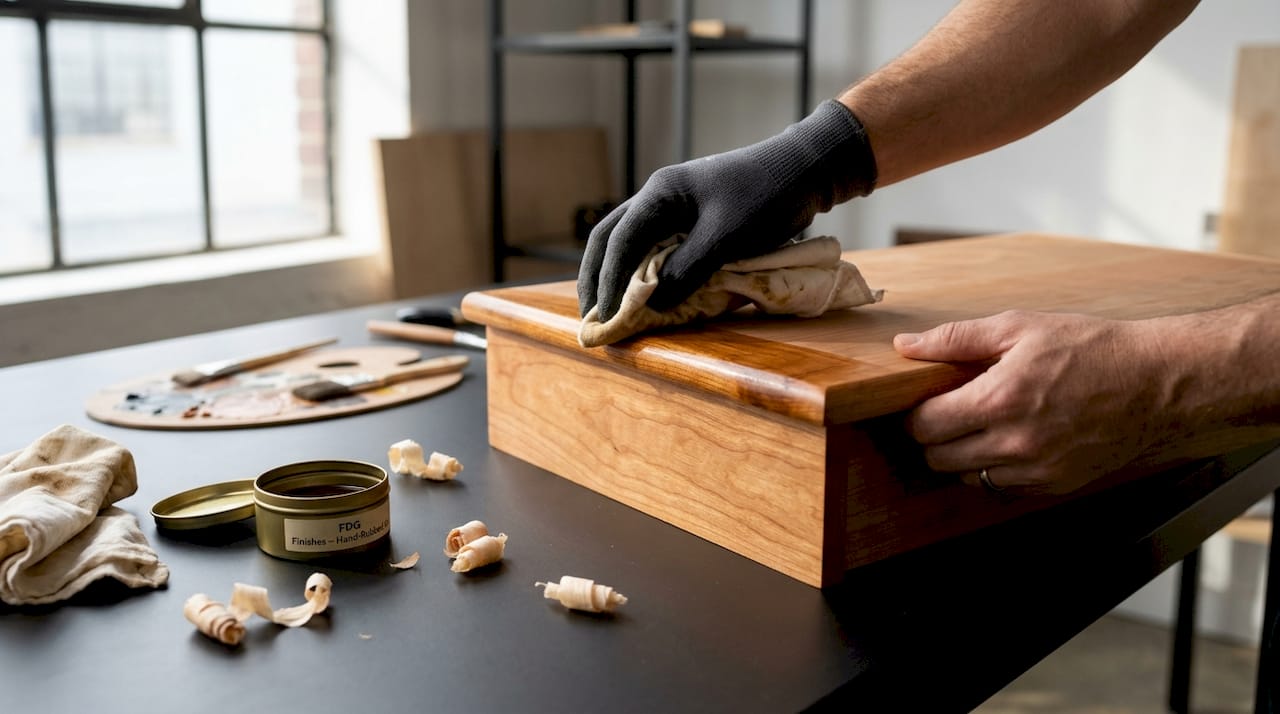
Hand-rubbed linseed oil finishes allow natural aging of cherry and walnut, emphasizing grain texture over glossy plastic coatings. The difference you feel with your hand is real. Natural oil-finished wood feels like wood. Factory lacquer feels like touching a photo of wood.
Hand-applied oil and varnish finishes have a subtle sheen variation that catches light differently at different angles. That’s the hallmark of a hand-rubbed application. Factory spray finishes look uniform because they are uniform.
What to look for in artisan finishes:
- Natural sheen variation across the surface, not a perfectly uniform gloss
- Tactile grain texture you can feel under your fingertips
- Finished interior surfaces inside drawers, on shelf undersides, and on the back panel
- No drips, runs, or buildup in corners or along edges
- Evidence of hand-sanding through the grain direction and subtle sanding marks
“A true artisan finishes the parts no one sees as carefully as the parts everyone does. That discipline shows up in how the piece holds together over decades.”
The back panel of a cabinet is a useful test. Mass producers leave it raw. A craftsman proud of their work applies at least a sealing coat everywhere.
Pro Tip: For Maryland entryways, ask specifically for a hard-wax oil finish. It handles humidity better than most alternatives, and you can spot-refinish scratches without refinishing the entire piece.
Craft production timeline and customization benefits for Maryland buyers
Understanding timelines helps you plan. Custom artisanal furniture is not a weekend purchase. It’s a considered decision with a real production schedule behind it.
Typical custom production steps:
- Initial consultation and design discussion (1 to 2 weeks)
- Material selection and sourcing (1 to 2 weeks)
- Wood acclimation at the shop (1 to 2 weeks)
- Construction and joinery work (4 to 6 weeks)
- Finishing, hardware installation, and quality check (2 to 3 weeks)
- Delivery and installation (scheduled at completion)
Custom solid wood artisanal pieces carry lead times of 10 to 12 weeks, reflecting their handcrafted attention to detail. That timeline is a feature, not a problem. It means one craftsman or a small team is building your specific piece with your specific dimensions and specifications.
Craft production emphasizes small-scale skilled work with genuine flexibility to adapt designs to client needs. For Maryland homeowners, that means you can spec an entryway mud locker to fit an unusual hallway width, request a specific wood species that matches existing trim, or choose hardware that coordinates with other fixtures in the home.
The artisanal furniture qualities that come through customization include:
- Exact dimensions to fit your specific entryway
- Wood species and finish matched to your home’s existing palette
- Hardware style from traditional to contemporary
- Interior configuration tailored to your storage needs (hooks, cubbies, drawers, shelving)
- Structural adaptations for uneven floors or angled walls
Connecting with a custom artisanal furniture timeline specialist early means your piece arrives exactly when your project needs it.
Comparison of artisanal vs mass-produced furniture for entryway use
A direct look at the numbers and features makes the choice clear.
| Category | Artisanal | Mass-produced |
|---|---|---|
| Material | Solid hardwood throughout | Veneered MDF or particleboard |
| Joinery | Dovetail, mortise and tenon | Staples, pocket screws, glue |
| Finish | Hand-applied oil or wax | Spray lacquer or vinyl wrap |
| Lifespan | 30 to 50+ years | 5 to 10 years |
| Repairability | Fully repairable | Often irreparable when damaged |
| Climate resistance | High (kiln-dried, natural finish) | Low (moisture causes swelling) |
| Environmental impact | Sustainable timber, low VOC finishes | High VOC, non-recyclable composites |
| Custom options | Full customization available | Fixed sizes and configurations |
Solid timber ages well and is repairable unlike veneered particleboard prone to irreversible failure. That repairability alone justifies the investment for a high-traffic space like an entryway.
Key unique furniture features that favor artisanal entryway pieces in Maryland:
- Climate resistance built into kiln-dried solid wood
- Structural repairability when joints loosen after decades of use
- Aesthetic improvement over time as wood develops natural patina
- Heirloom potential to pass pieces down rather than replace them
High-end furniture stands on design lineage and durable construction, not short-term trends. An artisan-built mud locker designed for your Maryland entryway in 2026 will still look and function beautifully in 2056.
Rethinking value: why artisanal entryway furniture is worth the investment
Here’s the part most furniture articles avoid saying plainly. The price gap between artisanal and mass-produced entryway furniture feels significant upfront. Over a 20-year period, it isn’t.
After more than two decades of working with Maryland homeowners, we’ve watched clients replace mass-produced entryway benches and storage units two and three times in the same period that one artisan-built piece keeps performing. When you divide the total cost by the years of use, artisan furniture is almost always the more economical choice. It’s just that the math happens slowly.
Maryland’s climate is genuinely challenging for furniture. Coastal humidity in summer, dry indoor heat in winter. That 30 to 40 percent relative humidity swing is exactly the condition that causes veneer edges to lift and particleboard to swell. Solid kiln-dried hardwood with a natural finish moves slightly with the seasons, as it’s designed to, and returns without damage. Engineered wood does not.
There’s another dimension buyers rarely consider. Artisans finish the inside back panel of a cabinet. They smooth the underside of a shelf. They care about the parts you’ll almost never see. That is not just craftsmanship pride — it’s quality control that shows up in how joints hold, how the piece breathes, and how it ages. When you buy artisanal, you’re buying that discipline.
Investing in a well-made entryway piece through an artisanal furniture investment perspective is also a legacy decision. These are pieces you pass down. They carry the story of your home. Mass-produced furniture has no such story — it gets donated or discarded when it fails.
Discover custom artisanal furniture solutions in Maryland
If this artisanal furniture features list has clarified what you’re looking for, the next step is finding a maker who delivers all of it consistently.
At Furniture Design Group, we’ve spent over 20 years crafting custom entryway furniture for Maryland homeowners who want exactly what we’ve described here: solid hardwood joinery, natural hand-applied finishes, soft-close hardware, and fully personalized dimensions. Every piece is built to order, built to last, and built for Maryland’s specific climate conditions. Explore our custom furniture services by Furniture Design Group to start a conversation about your project, or see custom furniture examples from our gallery to get a feel for what’s possible. We’re ready when you are.
Frequently asked questions
What are the key joinery features to look for in artisanal furniture?
Look for dovetail joints in drawer boxes and mortise-and-tenon connections at all major frame joints, as both indicate traditional, durable craftsmanship. Dovetail joints in 100% of high-end drawer boxes are the benchmark for genuine artisan quality.
Why is solid hardwood better than veneered particleboard?
Solid hardwoods develop a richer patina with age and can be sanded and refinished when scratched, while veneered particleboard chips, swells, and delaminates with no repair path. Artisanal furniture uses solid timber precisely because it outlasts engineered alternatives by decades.
How long does it typically take to get custom artisanal furniture?
Plan for 10 to 12 weeks from your initial consultation to delivery, which accounts for material sourcing, wood acclimation, construction, and finishing. Custom solid wood pieces require that timeline to be done correctly.
What finish types are best for high-quality wood furniture?
Hand-applied oil or hard-wax oil finishes are the best choice, particularly for Maryland’s climate, because they penetrate the wood rather than sitting on top as a film. Linseed oil finishes allow natural aging and can be spot-repaired without refinishing the entire piece.
How can I maintain artisanal furniture to preserve its quality?
Apply a fresh coat of hard-wax oil every 6 to 12 months using a cloth in the direction of the grain, and address any loosening joints early before they develop into structural problems. Hard-wax oil refinishing every 6 to 12 months maintains the finish’s protective qualities without building up a thick surface layer.