
TL;DR:
- Choosing durable, moisture-resistant materials like Hard Maple and White Oak ensures entryway furniture withstands Maryland’s daily wear and humidity. Proper material selection depends on household traffic, moisture exposure, and desired aesthetics to create long-lasting, functional, and beautiful entryway pieces. Artisanal craftsmanship tailored to your lifestyle guarantees furniture that ages gracefully instead of needing frequent replacement.
Your entryway takes more punishment than any other room in the house. Muddy boots, wet umbrellas, backpacks dropped with a thud, and Maryland’s famously humid summers all conspire to wear down furniture that looked stunning in the showroom. Choosing the wrong material means refinishing or replacing pieces far sooner than you planned. Choosing the right one means a piece that holds its beauty and function for decades. This guide walks you through exactly what separates a smart material choice from a costly mistake, using real criteria that matter for Maryland homes.
Table of Contents
- What to look for in entryway furniture materials
- Top wood choices for custom entryway furniture
- How top materials compare for Maryland entryways
- Choosing the right material for your space and lifestyle
- Why our approach to entryway materials goes beyond trends
- Bring custom entryway craftsmanship to your Maryland home
- Frequently asked questions
Key Takeaways
| Point | Details |
|---|---|
| Fit materials to lifestyle | Choose woods like Hard Maple or White Oak for high-traffic Maryland entryways that handle family and guest demands. |
| Prioritize durability | Superior hardness and moisture resistance should lead your selection process for lasting entryway furniture. |
| Don’t overlook care | Proper maintenance keeps artisan-crafted entryway pieces looking beautiful for decades. |
| Balance beauty and utility | Luxury materials such as Walnut excel as accents, but opt for practical woods on heavy-use surfaces. |
What to look for in entryway furniture materials
Before you fall in love with a wood grain or a finish color, you need a clear set of criteria. The entryway is not the living room. It is a transition zone where outdoor conditions meet interior spaces, and the furniture there needs to handle both worlds.
The four pillars of a strong entryway material:
- Durability: How well does the material resist scratches, dents, and the everyday abuse of keys, bags, and shoes landing on its surface? The Janka hardness scale, which measures the force required to embed a steel ball halfway into a piece of wood, is a reliable starting point. Higher Janka ratings mean better dent resistance.
- Moisture resistance: Maryland summers bring genuine humidity, and entryways near doors catch splashes and tracked-in rain regularly. Some woods absorb and release moisture without warping; others don’t handle the fluctuation well.
- Ease of maintenance: A piece you can wipe down in thirty seconds beats one that requires special cleaners or frequent refinishing, especially in a busy household.
- Visual harmony: The entryway sets the tone for the rest of your home. Material choice affects not just how a piece looks on day one, but how it ages and whether that aging feels graceful or just worn.
When it comes to hardness alone, Hard Maple’s 1450 lbf Janka rating places it among the top performers for resisting the kind of wear that entryways dish out daily. That is not just a number on paper. It translates directly to a surface that handles bags dropped from shoulder height, keys tossed carelessly, and the scrape of shoe soles without showing obvious battle scars.
Understanding how to evaluate custom furniture materials before you commit saves you from expensive regret down the road.
“The best entryway furniture material is not necessarily the prettiest one in the store. It is the one that still looks great after three thousand daily uses.” This is the standard we hold our own pieces to at Furniture Design Group.
Pro Tip: Ask your furniture maker to show you a sample piece that has been in regular use for at least two years. Real-world wear tells you far more than a freshly sanded showroom sample.
Top wood choices for custom entryway furniture
Solid wood remains the gold standard for custom entryway furniture because it can be refinished, repaired, and personalized in ways that engineered or composite materials simply cannot match. Three species consistently rise to the top for Maryland homeowners: Hard Maple, White Oak, and Walnut.
Hard Maple
Hard Maple is the workhorse of the group. Its tight grain and smooth finish make it ideal for custom pieces that need to hold up under serious daily use. The wood takes stain and paint beautifully, which means it adapts to a wide range of interior styles, from bright Shaker aesthetics to deep, moody contemporary looks.
The tradeoffs are worth knowing. Hard Maple is one of the denser domestic hardwoods, which makes it slightly harder to work with by hand. For artisans using traditional joinery techniques, it demands sharper tools and greater skill. That effort shows up in the finished product as precision that you can feel in every drawer pull and cabinet door.
White Oak
White Oak has surged in popularity for good reason, especially in Maryland homes close to the Chesapeake or in areas with notable seasonal humidity swings. Its tyloses, a natural cellular structure that closes off the wood’s pores, give it significantly better moisture resistance than Red Oak despite both species registering comparable Janka hardness scores. This is not a minor detail for Maryland homeowners.
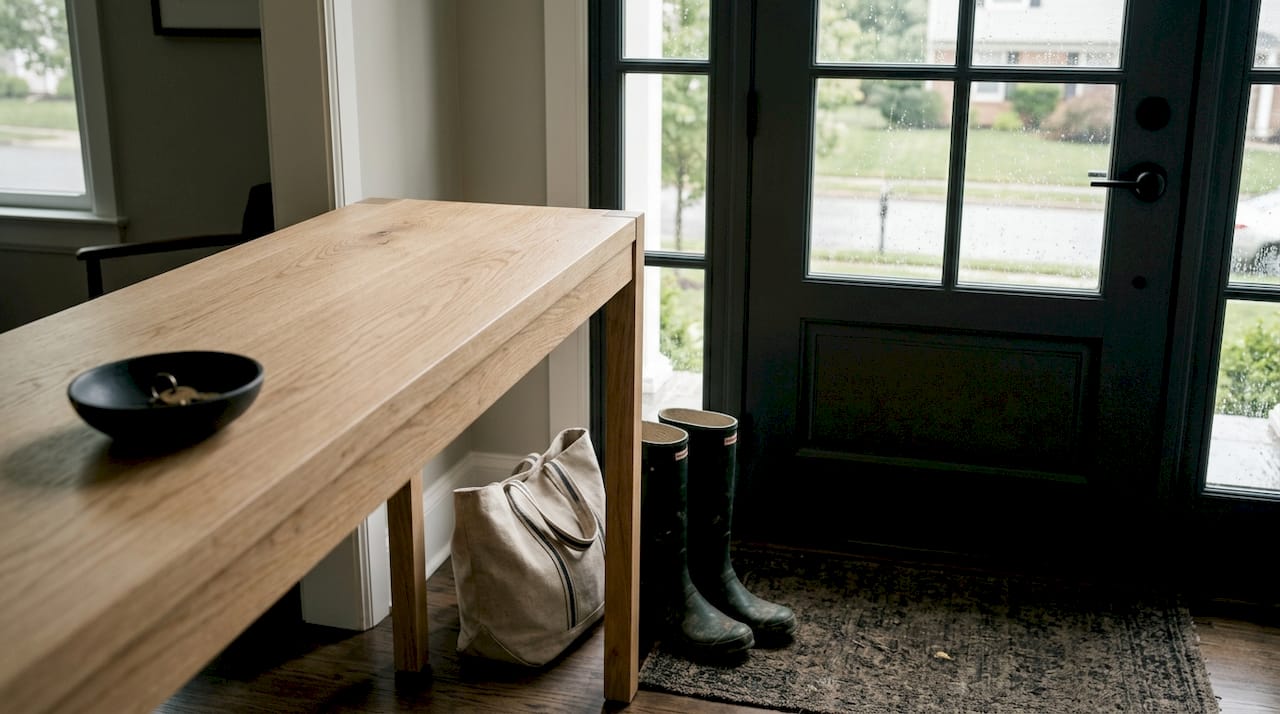
White Oak outperforms Red Oak in entryway settings precisely because humidity resistance prevents warping, swelling, and the kind of seasonal movement that loosens joints over years of use. It also carries a distinctive ray fleck pattern in quartersawn cuts that adds visual character without requiring staining. Many of our clients find the natural color of White Oak fits seamlessly into modern farmhouse and transitional interiors that are popular throughout the Baltimore and Annapolis areas.
Pro Tip: If your entryway door opens directly to the outside without a storm door buffer, White Oak is almost always the smarter choice over Red Oak, regardless of how the two look side by side.
Walnut
Walnut is the luxury option in this group. Its rich chocolate tones and striking grain patterns make it genuinely beautiful. However, the wood has a Janka rating around 1010 lbf, which is lower than both Hard Maple and White Oak. This matters in high-traffic entryways where denting and scratching are real daily risks.
Walnut shines when used strategically: as a design accent panel alongside a harder primary wood, as an upper shelf away from direct impact zones, or in lower-traffic secondary entryways. Skilled artisans can combine Walnut’s aesthetic appeal with the structural durability of a harder species, giving you the look of a luxury showpiece with the bones to last. The key for custom furniture craftsmanship is knowing when to feature each wood and when to let it play a supporting role.
Key comparison at a glance:
- Hard Maple: Highest hardness, takes paint and stain well, best for maximum durability
- White Oak: Best moisture resistance, beautiful natural grain, ideal for humid zones
- Walnut: Richest appearance, lower hardness, best used as an accent or lighter-duty piece
Good furniture care tips can extend the life of any of these species significantly, but choosing the right species from the start is what keeps maintenance manageable over the long run.
How top materials compare for Maryland entryways
Side-by-side comparisons cut through opinion and give you a cleaner way to match material to need. Here is how these three species stack up across the criteria that matter most for Maryland homes.
| Feature | Hard Maple | White Oak | Walnut |
|---|---|---|---|
| Janka hardness (lbf) | 1450 | 1290 | 1010 |
| Moisture resistance | Moderate | Excellent | Moderate |
| Dent resistance | Excellent | Very good | Good |
| Finish options | Paint, stain, natural | Natural, light stain | Natural, oil finish |
| Relative price | Moderate | Moderate to high | High |
| Best for | High-traffic entryways | Humid or coastal areas | Design-focused spaces |
| Artisan workability | Moderate (requires skill) | Good | Excellent |
What this table tells you in plain terms:
- If your household has kids, dogs, and a door that opens fifteen times a day, Hard Maple gives you the best defense against visible wear.
- If you live near water, in a Baltimore rowhouse without a vestibule, or anywhere that seasonal humidity swings are noticeable, White Oak’s moisture resistance is not optional, it is practical insurance.
- If you are designing a formal entryway in a lower-traffic home or want to make a genuine visual statement, Walnut rewards the investment.
It is also worth noting that price differences between these species have narrowed in recent years as demand for White Oak and Walnut has grown. The real cost difference often comes from the labor involved in custom artisan construction rather than raw material pricing.
Choosing the right material for your space and lifestyle
All the technical data in the world only helps when you apply it to your actual life. Here is a practical decision path for Maryland homeowners working through this choice.
-
Count the daily users. A family of five with school-age children needs a different material than a couple in an empty nest. More users, more traffic, more impact events. Hard Maple is the default recommendation when daily use is genuinely heavy.
-
Assess your moisture exposure. Does your entryway have a covered porch that buffers rain, or does the door open straight to the elements? Is your home near water or in a low-lying area that holds humidity? The more moisture exposure you have, the more White Oak’s cellular structure matters.
-
Identify your primary use case. Is the entryway furniture mainly for coat and bag storage? Mud locker functionality? A console table for keys and mail? The function shapes the ideal species. Load-bearing, frequently opened cabinetry benefits more from Hard Maple’s hardness, while a display console or bench seat is where Walnut earns its place.
-
Think about your finish preference. Hard Maple is one of the best woods for painted finishes, which is ideal if you want a clean, bright look or need the furniture to match millwork exactly. White Oak and Walnut both look stunning with natural oil or clear-coat finishes that let the grain speak for itself.
-
Plan for refinishing. All solid wood can be refinished, but some species are more forgiving during the process. Ask your furniture maker about the expected refinishing cycle for your chosen wood given your household’s use level.
The real-world data on White Oak confirms what we see in our own workshop: moisture resistance over Red Oak is a meaningful advantage in the Mid-Atlantic climate, not a marketing talking point.
For a custom entryway design that truly fits your home, the material decision is the starting point, not an afterthought.
Why our approach to entryway materials goes beyond trends
Here is an honest opinion after more than twenty years of building custom entryway furniture for Maryland homeowners: the biggest mistake people make is choosing a material because it looks good in photos online.
Instagram and Pinterest are full of Walnut entryways with warm lighting and no backpacks in sight. Those images are beautiful. They are also not representative of real life. When clients come to us asking for Walnut because it’s trending, we have a direct conversation about what their entryway actually does on a Tuesday morning before school.
“Harder is always better” is the opposite myth. We meet homeowners who want the hardest possible wood regardless of context. In a purely decorative setting, extreme hardness can actually work against you because very dense woods are less forgiving during installation and can be more expensive to repair correctly if damage does occur.
The honest truth is that material selection should follow lifestyle, not the other way around. We have built Hard Maple mud lockers for large families in suburban Maryland that still look sharp after a decade of real use. We have also built Walnut accent benches for couples whose entryway sees maybe ten entries per day, and those pieces are genuinely stunning investments that age beautifully.
The nuance between species matters enormously in practice. The fact that White Oak outperforms Red Oak for moisture resistance is the kind of detail that home improvement stores often gloss over because both look similar on a price tag.
Our artisanal craftsmanship approach means we build pieces designed for how you actually live, not how a mood board suggests you should. That distinction produces furniture that gets better with age instead of furniture that gets replaced.
Bring custom entryway craftsmanship to your Maryland home
Choosing the right material is only half the equation. The other half is having it shaped, joined, and finished by hands that know how to coax the best out of every board.
At Furniture Design Group, we work with Maryland homeowners to translate material knowledge into custom entryway furniture built for real life. Whether you are drawn to the durability of Hard Maple, the moisture resilience of White Oak, or the elegance of Walnut, we help you make the call that fits your home, your family, and your long-term vision. Browse our custom furniture gallery to see what is possible, or visit the Furniture Design Group home to get in touch and schedule a conversation. When you are ready to start a custom furniture project, we are here to guide every step from material selection to final installation.
Frequently asked questions
What makes Hard Maple a good option for entryway furniture?
Hard Maple’s 1450 lbf hardness gives it exceptional resistance to dents and scratches, which is exactly what high-traffic entryways demand. Its tight grain also allows for clean, smooth finishes that hold up well over years of heavy use.
Is White Oak really better than Red Oak for humid climates like Maryland?
Yes, and the reason is structural rather than just cosmetic. White Oak’s superior moisture resistance comes from its tyloses, a natural cellular feature that seals its pores, making it far less likely to warp or swell in Maryland’s humid conditions.
Are luxury woods like Walnut practical for everyday entryway use?
Walnut is best suited for accent pieces or lower-traffic entryways rather than as the primary surface in a busy household. Its lower Janka rating means it shows wear more readily under constant heavy impact.
What’s the most important factor when choosing entryway furniture material?
Durability and moisture resistance should lead the decision, particularly in Maryland’s climate. A material that resists both daily dents and humidity swings will serve you far longer than one chosen purely for its initial visual appeal.