
TL;DR:
- Custom cabinetry provides Maryland homeowners with a precise, durable, and visually seamless solution tailored to irregular and historic spaces. It utilizes high-quality joinery and materials that ensure longevity, fitting, and integration with existing design details. Investing in custom cabinetry enhances home value, functionality, and craftsmanship perception, often making it a smarter choice than off-the-shelf options.
Walk into a home improvement store and you’ll find row after row of prefabricated cabinets promising to solve your storage and design problems. But if you own a Maryland colonial, a historic rowhouse, or any home with character, you already know the frustration of forcing standard solutions into non-standard spaces. Gaps along plaster walls, mismatched trims, and awkward filler strips are the telltale signs that off-the-shelf just didn’t cut it. This guide breaks down exactly why custom cabinetry delivers real value, what makes it technically superior, and how to apply it wisely in your own home.
Table of Contents
- Why custom cabinetry matters in Maryland homes
- What makes custom cabinetry different?
- Custom vs. off-the-shelf cabinetry: Key differences
- Practical applications: Entryway and specialty cabinetry
- Why the investment in custom cabinetry pays off
- Explore custom cabinetry with Furniture Design Group
- Frequently asked questions
Key Takeaways
| Point | Details |
|---|---|
| Tailored fit for unique homes | Custom cabinetry adapts to Maryland’s distinctive architecture, overcoming uneven walls and unique layouts. |
| Superior craftsmanship | Advanced joinery techniques ensure custom cabinets offer unmatched strength and lasting beauty. |
| Better value over time | Investing in custom cabinetry delivers long-term satisfaction and strengthens home resale appeal. |
| Design freedom | Custom solutions support any desired style, matching existing trims, colors, or specialized features. |
Why custom cabinetry matters in Maryland homes
Maryland’s housing stock is genuinely diverse. You’ll find 18th-century Annapolis townhouses sitting a few miles from mid-century ramblers and brand-new construction. Each era of building brought its own standards, materials, and quirks. The result is a landscape where no two entryways, kitchens, or mudrooms are quite the same.
Standard prefabricated cabinets are built to serve the majority, not your specific home. They come in fixed increments, typically 3-inch width increases, with depths and heights that assume modern drywall construction and plumb, square walls. Maryland’s older homes often have neither. Plaster walls can bow inward or outward by half an inch or more. Door frames may be wider or taller than anything a big-box store stocks. Floor levels can shift by an inch or two across a single room due to decades of settling.
“Refacing or built-in updates in older or historic homes often require tailoring to irregular walls and non-standard construction details that prefabricated kits simply cannot accommodate.”
When you force standard cabinets into these spaces, you end up with:
- Visible gaps between cabinet sides and walls that require caulk or ugly filler strips
- Doors that won’t swing fully open because of protruding baseboards or molding
- Mismatched trim profiles that clash with original millwork
- Reduced storage because the cabinet depth doesn’t match the available alcove
- Structural concerns when cabinets can’t anchor properly into uneven framing
Custom cabinetry solves all of these problems by starting from your actual measurements, not from a factory template. Our tailored cabinetry solutions at Furniture Design Group begin with a detailed site assessment so that every piece fits as if the home were built around it.
What makes custom cabinetry different?
Most homeowners assume that custom cabinetry just means “more expensive.” The real difference runs much deeper than price. It starts with how the joints are made.
Joinery is the backbone of any cabinet. Mass-produced cabinets typically rely on staples, nails, cam locks, and wood glue to hold their cases together. These methods work adequately when a cabinet sits on a level floor and bears light loads. But they fail over time, especially in high-traffic entryways where doors slam, hooks get yanked, and benches bear real body weight. Custom cabinetry built with dovetail and mortise-and-tenon joinery uses mechanical interlocking joints that resist the separation forces that eventually pull factory cabinets apart. These are not just aesthetic choices. They are structural decisions that determine how long your investment lasts.
Here is how the two approaches compare across the most important categories:
| Feature | Custom cabinetry | Prefabricated cabinetry |
|---|---|---|
| Joinery | Dovetail, mortise-and-tenon | Staples, cam locks, nails |
| Fit | Exact to your measurements | Fixed increments, filler required |
| Materials | Solid wood, plywood, chosen by owner | Particleboard, MDF core standard |
| Finish options | Unlimited | Limited catalog |
| Hardware | Specified and custom installed | Generic, limited range |
| Longevity | 20 to 40 years with care | 7 to 15 years average |
| Adaptability | Built for your space | Built for average spaces |
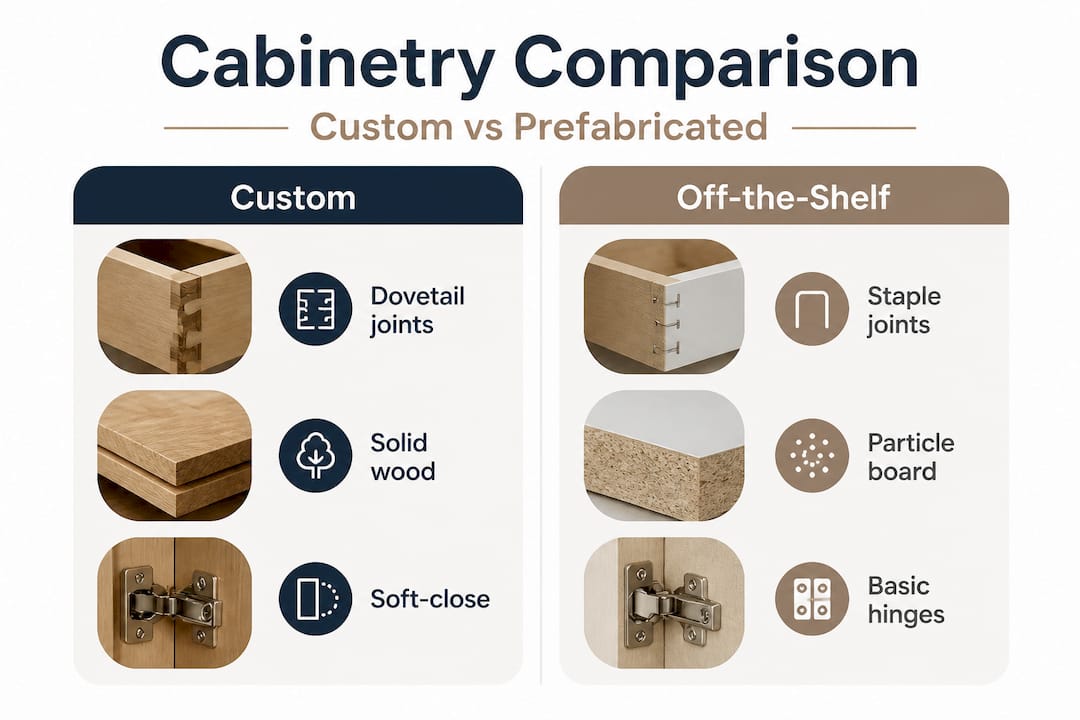
Beyond joinery, the material choices in custom furniture craftsmanship make a measurable difference. Solid wood and quality plywood hold screws far better than particleboard, which means hinges, drawer slides, and hardware stay secure for decades. Hand-applied finishes also penetrate and protect differently than factory spray coatings. They can be matched precisely to existing millwork, stained to complement original wood floors, or painted to a specific color that your designer specifies.
Pro Tip: Always ask about the secondary wood used inside the cabinet box. High-quality custom builders use hardwood plywood for the interior carcass, not just the face frame. This detail separates lasting quality from surface-level beauty. You can see this level of attention in the way we approach creating custom cabinetry at every stage of the process.
Custom hardware is another underestimated factor. Soft-close hinges, drawer slides rated for specific weight loads, and integrated locks or charging stations are all options that a custom builder can incorporate from the beginning. With prefabricated units, retrofit hardware additions often look and function awkwardly because the cabinet was never designed to accommodate them.
Custom vs. off-the-shelf cabinetry: Key differences
Knowing the technical differences is one thing. Knowing when those differences actually matter for your project is another. Let’s look at this practically.
Cookie-cutter kits may not fit and can require custom matching of trims and profiles that cost more in labor and materials than simply commissioning a custom piece from the start. This is a reality that surprises many homeowners who shop for savings up front only to spend more correcting problems during or after installation.
Here is a side-by-side look at where each approach genuinely wins:
| Situation | Best choice | Why |
|---|---|---|
| New construction, standard dimensions | Prefabricated | Cost-effective when dimensions match |
| Historic or irregular space | Custom | Only option for a seamless fit |
| High-traffic entryway or mudroom | Custom | Durability and tailored function |
| Rental property refresh | Prefabricated | Lower cost, acceptable for short-term |
| Period-style home | Custom | Matches existing trim and profiles |
| Unique storage needs | Custom | Can integrate benches, lockers, and hooks |
Use this numbered process to assess which approach fits your project:
- Measure your space with precision. Note any walls that are out of plumb, floors that slope, or trim profiles that would need to be matched. If you count more than two irregularities, custom is probably the right direction.
- Define your functional requirements. Do you need integrated seating, specific hook heights for children and adults, or hidden charging points? The more specific your needs, the more custom cabinetry earns its cost.
- Research the long-term math. Calculate the cost of prefabricated units plus filler strips, modification labor, and a likely replacement in 10 years. Compare that to a custom installation built to last 30 years.
- Consider resale value. Buyers in Maryland’s competitive real estate market notice quality millwork. A beautifully fitted entryway or kitchen communicates craftsmanship throughout the home.
- Get a site visit. A skilled custom builder who walks your space will identify issues a showroom salesperson never will. Visit our design gallery to see examples of problem spaces that became standout design features.
Practical applications: Entryway and specialty cabinetry
The entryway is one of the highest-traffic, highest-impact spaces in any home. It’s where coats get thrown, muddy boots land, backpacks accumulate, and keys disappear. Yet most entryways get only a coat rack and a mat. Custom cabinetry transforms this space into something that actually works.
The most popular custom features we build for Maryland entryways include:
- Integrated benches with lift-top storage for seasonal items and sports equipment
- Individual lockers sized and labeled for each family member, eliminating the pile-on effect
- Open shelving at variable heights so everyone from toddlers to adults can reach their own belongings
- Matching moldings that flow seamlessly from the entryway into the main living spaces
- Built-in hooks mounted at structural points in the cabinet, not just drywall, so they hold real weight over time
- Concealed charging stations built into lower shelving so devices charge without cords cluttering the space
Maryland homes present specific structural challenges that make professional templating essential. Non-standard layouts from additions and settlement in older homes can complicate cabinet planning dramatically. A rear addition built in 1970 may sit on a slightly different floor plane than the original 1920 structure. Walls shared between sections may have double framing. These details only emerge when a craftsman physically inspects the space before fabricating anything.
Common pitfalls to avoid in entryway cabinetry projects:
- Underestimating moisture. Entryways in Maryland’s humid summers and wet winters need finishes and materials that handle humidity changes without warping or peeling.
- Ignoring traffic patterns. Cabinet doors that swing into a door path or narrow hallway create daily frustration. Door placement should be mapped on a floor plan before fabrication.
- Skipping the template step. Building from measurements alone misses subtle details. A physical template made on-site catches wall irregularities before the wood is ever cut.
Pro Tip: Request a full-scale cardboard or MDF template of your planned cabinetry before the final build begins. Placing the template in your actual space reveals clearance issues, aesthetic proportions, and functional quirks that blueprints never show. Our team handles this as a standard part of our entryway storage solutions process, because a perfect fit starts long before the first cut.
Why the investment in custom cabinetry pays off
Here is something we’ve learned after more than 20 years building custom furniture for Maryland homes: the people who choose prefabricated cabinetry to save money almost always come back. Not because they planned to. But because the gaps started bothering them, or the drawer slides gave out after five years, or the finish peeled and they couldn’t match it to anything in production anymore.
The conventional wisdom says custom cabinetry is a luxury. We’d argue it’s the opposite of a luxury. A luxury is something you buy for pleasure but don’t really need. Custom cabinetry is something you buy because nothing else actually solves the problem in front of you.
Maryland homeowners who invest in custom work often tell us the same thing: they wish they had done it sooner. The daily experience of storage that actually fits, doors that close cleanly, and finishes that complement the rest of the home adds up in ways that are hard to quantify but immediately felt. That kind of satisfaction doesn’t happen with a prefabricated kit wedged into a corner and caulked around the edges.
There’s also a real estate argument. Buyers in strong Maryland markets recognize quality millwork. A custom-fitted entryway or mudroom signals craftsmanship throughout the home and justifies stronger offers. Mass-market cabinetry, especially when visibly modified to fit, can actually raise questions about the quality of other work done in the home.
The deeper point is this: custom cabinetry becomes part of your home’s identity. Like the furniture masterpieces we’ve built over two decades, a beautifully crafted piece of built-in cabinetry doesn’t feel like furniture you bought. It feels like your home was always meant to have it there. That’s the difference between a purchased product and a crafted solution.
Explore custom cabinetry with Furniture Design Group
At Furniture Design Group, we’ve spent over 20 years solving exactly the kinds of problems this article describes. We specialize in custom cabinetry and entryway furniture for Maryland homes, and we understand the quirks, the history, and the standards that make each project unique.
Whether you’re starting from scratch in a new home or finally fixing a frustrating entryway that never worked right, our team is ready to help. Browse our custom cabinetry services to understand what’s possible, then explore our past custom projects to see how we’ve transformed real Maryland spaces. When you’re ready, reach out directly and let’s talk about what your home actually needs.
Frequently asked questions
Why is custom cabinetry better for historic or irregular Maryland homes?
Custom cabinetry can be tailored to fit unique dimensions, uneven walls, and non-standard trims commonly found in older Maryland homes, where prefabricated kits simply cannot accommodate irregular plaster and non-standard construction details.
What joinery techniques make custom cabinetry last longer?
Quality custom cabinetry uses dovetail and mortise-and-tenon joinery, which creates mechanical interlocks that resist separation forces far better than the staples and cam locks found in mass-produced units.
Can custom cabinetry solutions match my existing interior design?
Yes, custom cabinets are built to match your home’s specific style, finish, molding profiles, and hardware, so the final result looks like it was always part of the original architecture rather than something added later.
Is custom cabinetry worth the extra investment?
Custom pieces last significantly longer, fit without costly modifications, and can increase your home’s resale value by demonstrating quality craftsmanship throughout, making the long-term cost per year of use highly competitive with prefabricated alternatives.