
Your entryway sets the tone for everything that follows inside your home, yet most people treat it as an afterthought. That instinct to organize and impress guests at the front door is actually centuries old. Hall stands were invented in the 19th century specifically for Victorian front halls, designed to store guests’ hats, coats, and umbrellas in one elegant piece. Understanding where these pieces came from changes how you think about choosing or commissioning entryway furniture today.
Table of Contents
- From necessity to status: The birth of entryway furniture
- Hall stands and hall trees: The golden era of entryway solutions
- Materials, craftsmanship, and personalization: Yesterday and today
- Why entryway furniture endures: Influence on modern design
- Choosing your ideal entryway furniture: Practical advice
- Bring history and craftsmanship into your Maryland home
- Frequently asked questions
Key Takeaways
| Point | Details |
|---|---|
| Victorian origins | Entryway furniture began as status symbols in spacious 19th-century homes. |
| Craftsmanship matters | Quality materials and construction remain essential for durability and style. |
| Modern applications | Custom entryway pieces blend historical inspiration with today’s functional needs. |
| High investment value | Antique and custom entryway furniture often hold or increase in value with attention to detail. |
From necessity to status: The birth of entryway furniture
To understand modern entryway furniture, we must first see why these pieces mattered so much to their earliest owners. Victorian homes were grand in ambition but surprisingly short on storage. There were no built-in closets, no mudrooms, and no coat hooks screwed into drywall. Everything a guest arrived with had to land somewhere visible, and that somewhere needed to look intentional.
The hall stand was the answer. It emerged as a freestanding unit that handled coats, hats, umbrellas, and walking sticks in one place. But it quickly became far more than a storage solution.
“The hall tree solved a real problem in large Victorian homes, especially after the Civil War, but it also announced something about the family who owned it. By the 1920s, built-in closets and smaller homes made them largely unnecessary.”
Hall trees symbolized status and declined by the 1920s as architecture changed. The families who owned the most ornate pieces were signaling wealth, taste, and hospitality all at once. That combination of function and social meaning is exactly what drives demand for custom entryway furniture today.
Hall stands and hall trees: The golden era of entryway solutions
Now that we see the roots of entryway furniture, let’s explore what made hall stands and hall trees iconic in the 19th century. The two terms are often used interchangeably, but there is a subtle difference worth knowing. A hall stand typically focuses on vertical storage, with hooks and an umbrella tray as its core features. A hall tree usually adds a bench and sometimes a mirror, making it a more complete entryway station.
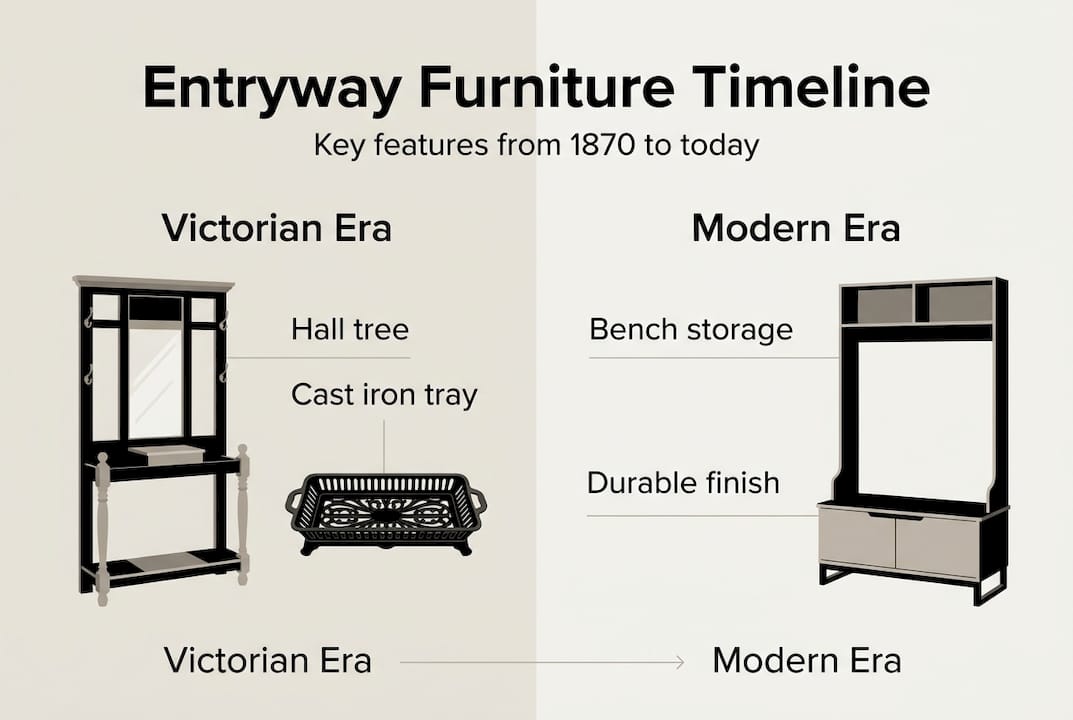
Hall trees peaked in popularity during the 1870s among middle and upper-class homes, featuring hooks, umbrella stands, mirrors, benches, and shelves. Here is how those original features compare to what you find in modern custom designs:
| Victorian feature | Modern equivalent |
|---|---|
| Cast iron umbrella drip tray | Removable boot tray or drainage mat |
| Beveled mirror panel | Integrated full-length or accent mirror |
| Carved wooden coat hooks | Brushed metal or custom wood peg hooks |
| Upholstered bench seat | Built-in bench with hidden storage |
| Open shelving for hats | Cubbies or closed cabinet storage |
| Marble accent top | Quartz, butcher block, or reclaimed wood top |
The core needs have not changed much. You still want a place to hang coats, drop bags, store shoes, and check your appearance before heading out. What has changed is the expectation of personalization.
Key features homeowners and designers look for in entryway furniture today:
- Adjustable hooks that accommodate everything from light scarves to heavy winter coats
- Bench seating at a comfortable height for putting on and removing shoes
- Integrated storage like drawers, cubbies, or cabinets to hide clutter
- Mirror placement that works for the actual dimensions of the space
- Finish options that coordinate with the rest of the home’s interior
Materials, craftsmanship, and personalization: Yesterday and today
Features alone don’t define lasting furniture. Let’s look under the surface at what truly distinguishes quality entryway pieces. Victorian craftsmen worked almost exclusively with premium hardwoods. Oak, walnut, and mahogany were the standards, often paired with marble tops and ornate hand carvings. Family crests, floral motifs, and inlay work turned each piece into something unique to the household.
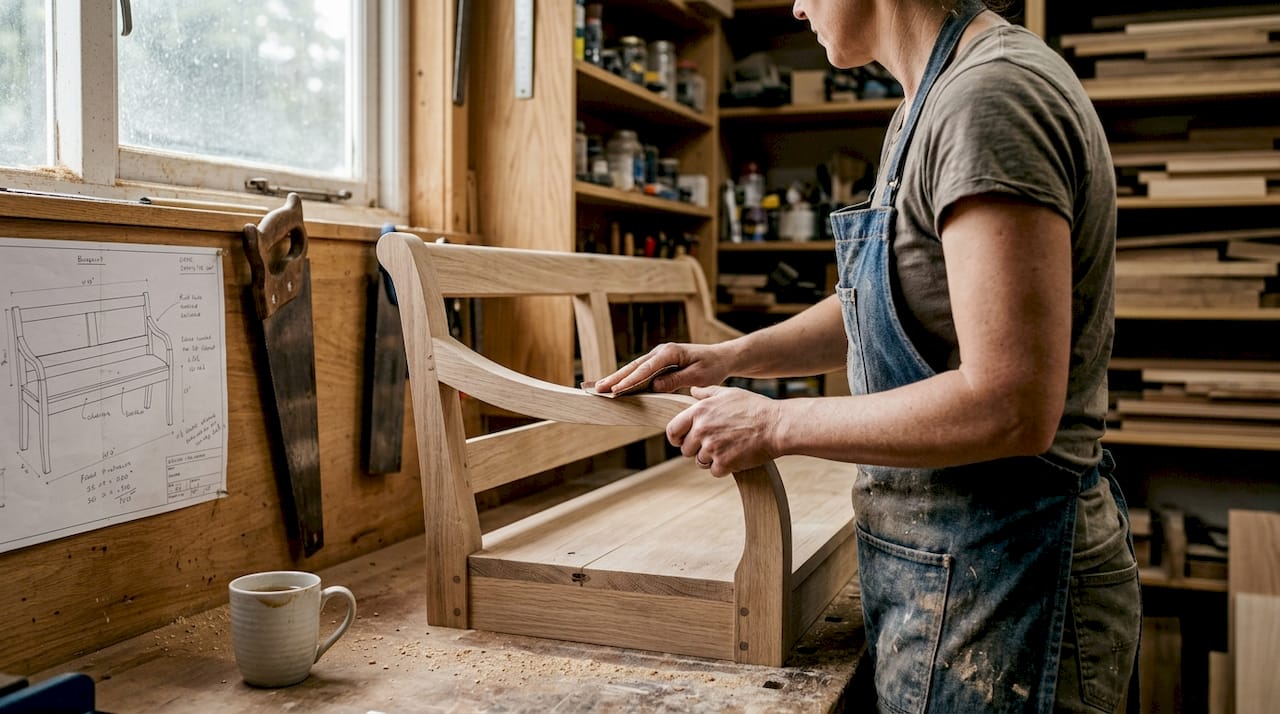
That level of personalization was not accidental. It was the whole point. A hall tree carved with your family’s symbols was a statement that no catalog piece could replicate.
Modern custom furniture carries that same spirit forward with updated materials and construction methods. Here is how the two eras compare:
Victorian materials:
- Solid oak, walnut, and mahogany
- Marble and stone accent surfaces
- Cast iron hardware and hooks
- Hand-applied oil and wax finishes
- Carved decorative motifs
Today’s custom solutions:
- Solid hardwoods with stable, kiln-dried construction
- Quartz, butcher block, or reclaimed wood surfaces
- Brushed brass, matte black, or custom-finish hardware
- Durable lacquer and conversion varnish finishes
- CNC-assisted or hand-carved personalized details
The biggest shift is in joinery and finish durability. Victorian pieces were built for formal homes with lower daily traffic. Today’s entryways take a beating, with kids, pets, muddy boots, and heavy bags coming through every day.
Pro Tip: When evaluating any custom entryway piece, ask specifically about the joinery method and finish type. Mortise-and-tenon joinery and conversion varnish finishes are the benchmarks for home furnishing quality that will hold up for decades.
Why entryway furniture endures: Influence on modern design
With a foundation in materials and quality, let’s see how Victorian ideas continue to inspire and what that means for your entryway. The market for antique hall trees tells a clear story about perceived value. Antique hall trees sell for $1,000 to over $10,000 depending on condition and carving quality. That price range reflects what people are willing to pay for craftsmanship and character.
Modern Maryland homeowners are drawing from the same well. They want entryway furniture that feels personal, looks intentional, and works hard every single day.
| Feature | Antique hall tree | Contemporary custom piece |
|---|---|---|
| Materials | Solid hardwood, marble | Solid hardwood, quartz, reclaimed wood |
| Personalization | Family crests, carved motifs | Custom dimensions, finishes, hardware |
| Durability | Built for formal use | Built for high-traffic daily use |
| Storage | Hooks, bench, umbrella tray | Cubbies, drawers, integrated bench |
| Style | Ornate Victorian | Transitional, modern farmhouse, classic |
| Price range | $1,000 to $10,000+ | Varies by scope and materials |
The overlap is striking. Both eras prioritize solid wood, personalization, and a piece that makes a statement the moment someone walks through the door.
Pro Tip: Before you start shopping or commissioning, write down three things: how many people use the entryway daily, what items need to be stored, and what style already exists in the adjoining rooms. That clarity will save you time and money.
Choosing your ideal entryway furniture: Practical advice
The lessons of history and quality converge in your choices today. Here is how to approach your next entryway project with confidence.
Modern custom joinery prioritizes stability for high-traffic spaces, which means the planning process matters as much as the final product. Follow these steps to get it right:
- Measure your space accurately. Note the width, height, and depth available, and identify any obstacles like light switches, doors that swing open, or baseboards that affect placement.
- List every item that needs a home. Coats, bags, shoes, keys, dog leashes, umbrellas, and sports gear all have different storage requirements. Be honest about your household’s actual habits.
- Choose your primary material. Solid hardwood is the gold standard for durability and appearance. If budget is a factor, look for pieces with solid wood frames and quality plywood panels rather than particleboard.
- Decide on a finish that fits your lifestyle. Lighter finishes show dust more easily but brighten small spaces. Darker finishes hide wear but can make narrow entryways feel smaller.
- Work with a local Maryland craftsman. A local maker can visit your space, understand your home’s existing style, and build something that fits perfectly rather than almost perfectly.
- Ask about lead time and customization limits. Custom work takes time. Plan for six to twelve weeks if you want a fully bespoke piece, and communicate your must-have features upfront.
The difference between a piece you love for a year and one you love for thirty years usually comes down to how carefully you planned before the first board was cut.
Bring history and craftsmanship into your Maryland home
If you want expert help bringing the spirit of classic designs into your entryway, the next step is easy. At Furniture Design Group, we have spent over 20 years building custom entryway furniture for Maryland homeowners and interior designers who refuse to settle for off-the-shelf solutions.
Every piece we build starts with a conversation about your space, your family, and the style you want to live with every day. Whether you are drawn to the clean lines of a modern hall tree or the warmth of a traditional entryway bench with cubbies, we craft it to fit your exact dimensions and finish preferences. Explore our custom entryway solutions and reach out to start your project. We would love to show you what is possible.
Frequently asked questions
What is the difference between a hall stand and a hall tree?
A hall stand focuses primarily on vertical hooks and umbrella storage, while a hall tree typically adds a bench and mirror, making it a more complete entryway unit. Both serve as multifunctional entryway furniture, but the hall tree offers more seating and surface options.
Why did hall trees go out of style after the 1920s?
Built-in closets and smaller entryways in post-1920s homes made freestanding hall trees largely redundant. As homes became more compact, dedicated entryway furniture gave way to integrated storage solutions.
What materials are best for high-quality entryway furniture today?
Solid hardwoods like oak, walnut, and mahogany remain the top choices for beauty and long-term durability in busy entryways. Pairing them with quality hardware and a durable finish makes the biggest difference in how well a piece holds up.
Are antique hall trees valuable?
Yes. Well-preserved antique hall trees regularly sell for $1,000 to $10,000+, with price driven by the quality of carving, the wood species, and overall condition. Pieces with unique family crests or exceptional craftsmanship command the highest prices.