
TL;DR:
- Effective entryway organization relies on zoning, limited shoe storage, and vertical space use.
- Custom-built furniture offers better fit, durability, and adaptability than mass-market options.
- Regular maintenance and seasonal rotation keep the space functional and clutter-free year-round.
Your entryway takes more abuse than any other room in your home. Shoes pile up, backpacks land on the floor, and coats drape over whatever is closest. For Maryland homeowners, this problem gets amplified by four distinct seasons, muddy springs, and snowy winters that drag debris straight through the front door. A disorganized entryway doesn’t just look bad — it slows your whole household down every single morning. The good news is that with the right organization principles and quality furniture built for your specific space, you can turn that chaotic first room into one that works hard and looks great every single day.
Table of Contents
- Set the foundation: Key criteria for entryway organization
- Best entryway organization solutions: Storage, zones, and custom touches
- Comparing entryway setups: Find the right fit for your household
- Maintenance and rotation: Keep your entryway functional year-round
- Our take: The real secret to entryway organization Maryland homeowners overlook
- Ready for a beautiful, organized entryway? Let’s create it together
- Frequently asked questions
Key Takeaways
| Point | Details |
|---|---|
| Smart zoning matters | Dividing your entryway into task-specific zones streamlines routines and reduces mess. |
| Custom solutions excel | Custom-crafted furniture and organization systems adapt to your family’s unique needs. |
| Routine maintenance is essential | Seasonal rotation and quick decluttering keep your entryway appealing and functional. |
| Small touches make a difference | Simple tricks like kid-height hooks and labeled baskets tackle everyday clutter. |
Set the foundation: Key criteria for entryway organization
Before you buy a single basket or hook, you need a clear framework. Effective entryway organization comes down to three core principles: zoning, limited shoe storage, and vertical space use. Get these right and everything else falls into place naturally.
Zoning means dividing your entryway into dedicated areas for specific items. One zone handles shoes. Another handles outerwear. A third handles daily essentials like keys, bags, and mail. When every item has a home, clutter stops accumulating because there is nowhere for it to hide. Zoning for key functions, shoe limits, and vertical storage are the priorities that separate a functional entryway from a frustrating one.
Shoe storage is where most households go wrong. The instinct is to accommodate every pair the family owns, but that creates a permanent pile. Limit visible storage to two or three pairs per person. Rotate the rest into a closet or storage bench with a lid. This single rule eliminates the most common source of entryway chaos.
Vertical space is the most underused resource in any entryway. Hooks mounted at multiple heights, tall cabinets, and shelving that reaches toward the ceiling all give you more storage without eating into your floor space. Maryland homes, especially older colonial and craftsman styles, often have narrow entryways where going up is the only real option.
Here are the most common mistakes that undermine even well-intentioned entryway setups:
- Treating the entryway as overflow storage for the whole house
- Buying furniture that is too large or too small for the actual footprint
- Skipping a dedicated drop zone for keys, mail, and daily carry items
- Ignoring airflow, which leads to odors from wet shoes and coats
- Choosing decorative pieces over functional ones and then wondering why nothing works
Scale matters more than most homeowners realize. A bench that is six inches too wide can block traffic flow and make the whole space feel cramped. Measure your entryway carefully before committing to any furniture. If your layout is awkward, that is exactly when custom furniture masterpieces built to your exact dimensions outperform anything you can buy off a shelf.
“The best entryway setup is one your family will actually use consistently, not one that looks perfect in a catalog.”
Pro Tip: Tape out the footprint of any furniture piece on your floor with painter’s tape before purchasing. Walk through it for a day. You will immediately know if the scale is right.
Best entryway organization solutions: Storage, zones, and custom touches
With the major criteria established, let’s explore which organization products and custom features deliver both function and style.
The most effective entryway systems combine several elements working together rather than relying on one single piece. Here is a proven sequence for building out your entryway from the ground up:
- Start with seating. A bench with under-seat storage gives you a place to put on shoes and a place to store them. This is the anchor of any good entryway.
- Add hooks at multiple heights. Adult-height hooks handle coats and bags. Lower hooks at kid height mean children can actually hang up their own gear without help.
- Install cubbies or open shelving. These create visual zones and make it easy to grab what you need without digging through a pile.
- Bring in labeled baskets. Baskets inside cubbies add a layer of organization and make it easy to sort items by person or category.
- Create a dedicated drop zone. A small shelf or tray near the door for keys, sunglasses, and mail prevents the daily “where did I put it” scramble.
Labeled storage and family-focused zones reduce chaos, especially when you combine cubbies with baskets so each family member has a clearly defined space.
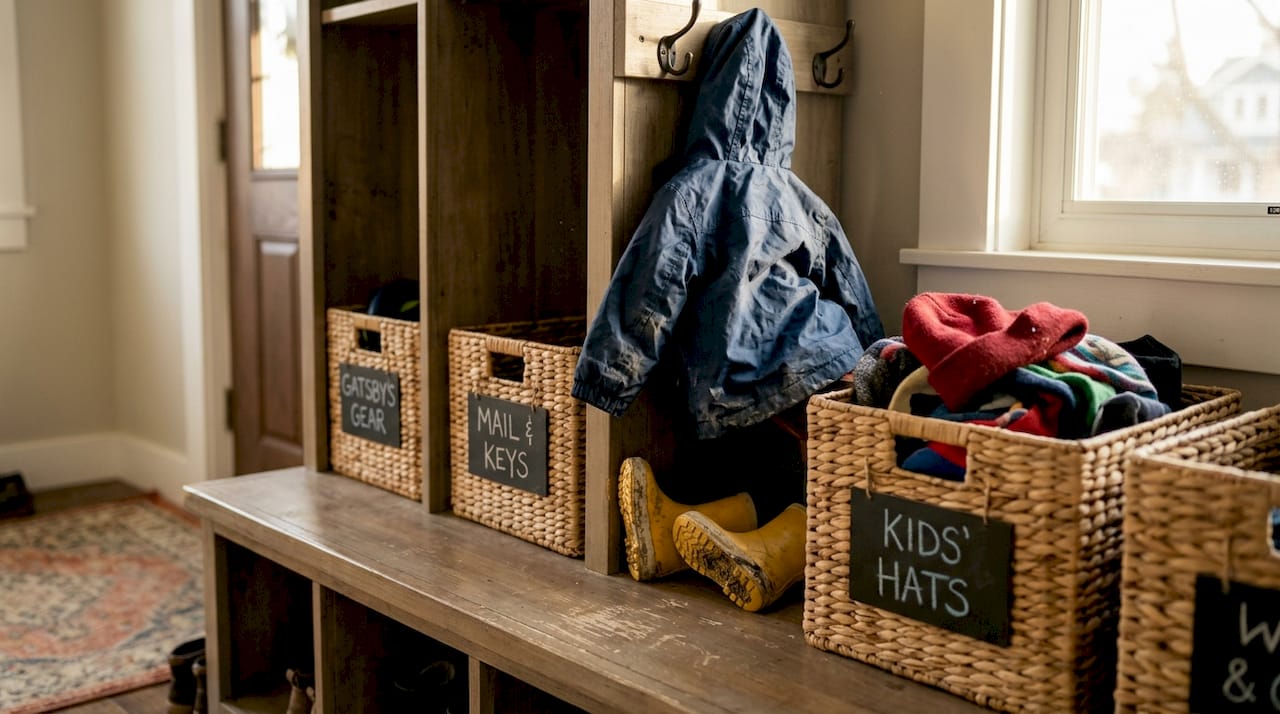
For families with kids, customization makes a real difference. Adjustable hook heights, name labels on cubbies, and color-coded baskets all reduce the mental load of staying organized. Children are far more likely to put things away when the system is designed for them, not just for adults.
Pro Tip: Use a small chalkboard label on each basket so you can relabel as your family’s needs change. What works for a toddler’s gear looks very different from what a teenager needs.
Here is a quick comparison of common storage solutions by function:
| Storage type | Best for | Durability | Customizable |
|---|---|---|---|
| Open cubbies | Shoes, bags, daily items | High | Yes |
| Labeled baskets | Seasonal gear, small items | Medium | Yes |
| Cabinet with doors | Hiding clutter, clean look | High | Yes |
| Hooks and rails | Coats, bags, leashes | High | Moderate |
| Built-in bench | Seating plus shoe storage | Very high | Yes |
For efficient storage options that go beyond the basics, think about modular systems that can be reconfigured as your household grows or changes. The best entryway setups grow with your family rather than becoming obsolete in five years. Custom entryway craftsmanship makes that long-term flexibility possible by building exactly what your space and lifestyle require.
Comparing entryway setups: Find the right fit for your household
Having explored individual products and features, it’s time to see how the most popular entryway setups compare side by side.
Not every solution fits every household. The three main categories Maryland homeowners choose from are custom-built furniture, modular systems, and mass-market organizers. Each has a place, but the differences in long-term value are significant.
| Setup type | Cost | Fit for awkward spaces | Longevity | Style options |
|---|---|---|---|---|
| Custom-built furniture | Higher upfront | Excellent | 20+ years | Unlimited |
| Modular systems | Mid-range | Good | 5 to 10 years | Limited |
| Mass-market organizers | Low | Poor | 2 to 5 years | Very limited |
Custom cabinetry addresses awkward layouts and persistent clutter better than basic storage because it is designed around your specific space rather than a generic footprint. If your entryway has an angled wall, a low ceiling, or an unusual door swing, a mass-market unit simply will not fit properly.
Here is an honest breakdown of each approach:
Custom-built furniture
- Built to your exact dimensions, so no wasted space
- Materials and finishes chosen to match your home’s style
- Lasts decades with proper care
- Higher initial investment, but lower replacement cost over time
Modular systems
- More flexible than mass-market options
- Can be rearranged as needs change
- Quality varies widely by brand
- May not fit unusual spaces without gaps or awkward workarounds
Mass-market organizers
- Fast and affordable to acquire
- Limited size options often mean a poor fit
- Typically made from particleboard, which degrades quickly in high-traffic, high-moisture entryways
- Often replaced within a few years, making them less economical long-term
For Maryland homeowners dealing with four seasons of outdoor gear, the durability factor is not a small consideration. Wet boots, heavy coats, and constant daily use will expose the weaknesses in low-quality furniture quickly. Explore Furniture Design Group resources to see how custom solutions hold up over time compared to off-the-shelf alternatives.
Understanding the full entryway storage process before committing to a setup helps you avoid costly mistakes and choose a system that genuinely fits your household’s routines.
Maintenance and rotation: Keep your entryway functional year-round
Choosing the right setup is only half the battle. Effective upkeep ensures that your entryway remains stylish and practical all year.
Even the best entryway furniture becomes a clutter trap without a consistent maintenance routine. The good news is that a few simple habits keep everything running smoothly without turning organization into a second job.
- Do a monthly sweep. Walk through your entryway once a month and remove anything that does not belong there. Items that have migrated from other rooms go back. Shoes beyond the limit go into rotation storage.
- Switch gear seasonally. In Maryland, this means swapping heavy winter coats and boots for lighter spring jackets and rain gear every few months. Seasonal storage rotation and ventilation prevent mold and keep your system from becoming overloaded.
- Wipe down surfaces weekly. Mud, salt, and moisture are constant in Maryland entryways. A quick wipe of benches, shelves, and cabinet fronts prevents buildup and protects your furniture’s finish.
- Check hooks and hardware quarterly. Screws loosen over time under the weight of heavy coats and bags. A quick tighten takes two minutes and prevents damage to walls and furniture.
- Reassess the system annually. Kids grow. Routines change. What worked perfectly last year may need a small adjustment this year. Build in an annual review to make sure the layout still matches how your family actually uses the space.
Pro Tip: Keep a small basket near the entryway specifically for items that need to go back to other rooms. Empty it weekly. This one habit prevents the entryway from becoming a dumping ground for the whole house.
Ventilation is often overlooked but genuinely important. Wet shoes and damp coats left in an enclosed space create odors and, over time, mold. If your entryway has a closet, leave the door cracked. If you have a bench with enclosed storage, choose one with ventilation slots or leave it slightly open after wet weather. Proper care of your furniture also protects your investment. Custom furniture care tips from experienced craftsmen can help you maintain the quality of solid wood pieces for decades.
For households that rotate gear heavily through the seasons, having a clear rotating organization system makes the transition smoother and keeps your entryway from becoming a seasonal overflow zone.
Our take: The real secret to entryway organization Maryland homeowners overlook
After more than 20 years of building custom entryway furniture for Maryland families, we have noticed a pattern. Homeowners spend a lot of time researching hooks, baskets, and organizers. They read every list and watch every video. Then they buy a generic unit, wedge it into a space it was never designed for, and wonder why the clutter comes back within a month.
The real issue is not the products. It is the approach. Generic organizers are designed for a hypothetical average home. Your home is not average. Your entryway has its own dimensions, its own traffic patterns, and its own family using it every day.
Made-to-measure entryway pieces built specifically for your space eliminate the compromises that make generic systems fail. When a bench fits perfectly, when hooks are exactly where your family reaches naturally, and when the storage matches what you actually own, the system works without effort. That is the difference between furniture that looks good on day one and furniture that keeps working on year ten.
Investing in custom craftsmanship is not about luxury. It is about long-term simplicity.
Ready for a beautiful, organized entryway? Let’s create it together
If you’re ready to turn expert tips into a practical, custom solution, here is how Furniture Design Group can help.
At Furniture Design Group, we have spent over 20 years helping Maryland homeowners solve exactly the challenges covered in this article. We design and build custom entryway organization furniture that fits your space, matches your style, and holds up to real family life. From mud lockers to built-in benches and full entryway systems, every piece is crafted by hand using quality materials selected for durability and beauty.
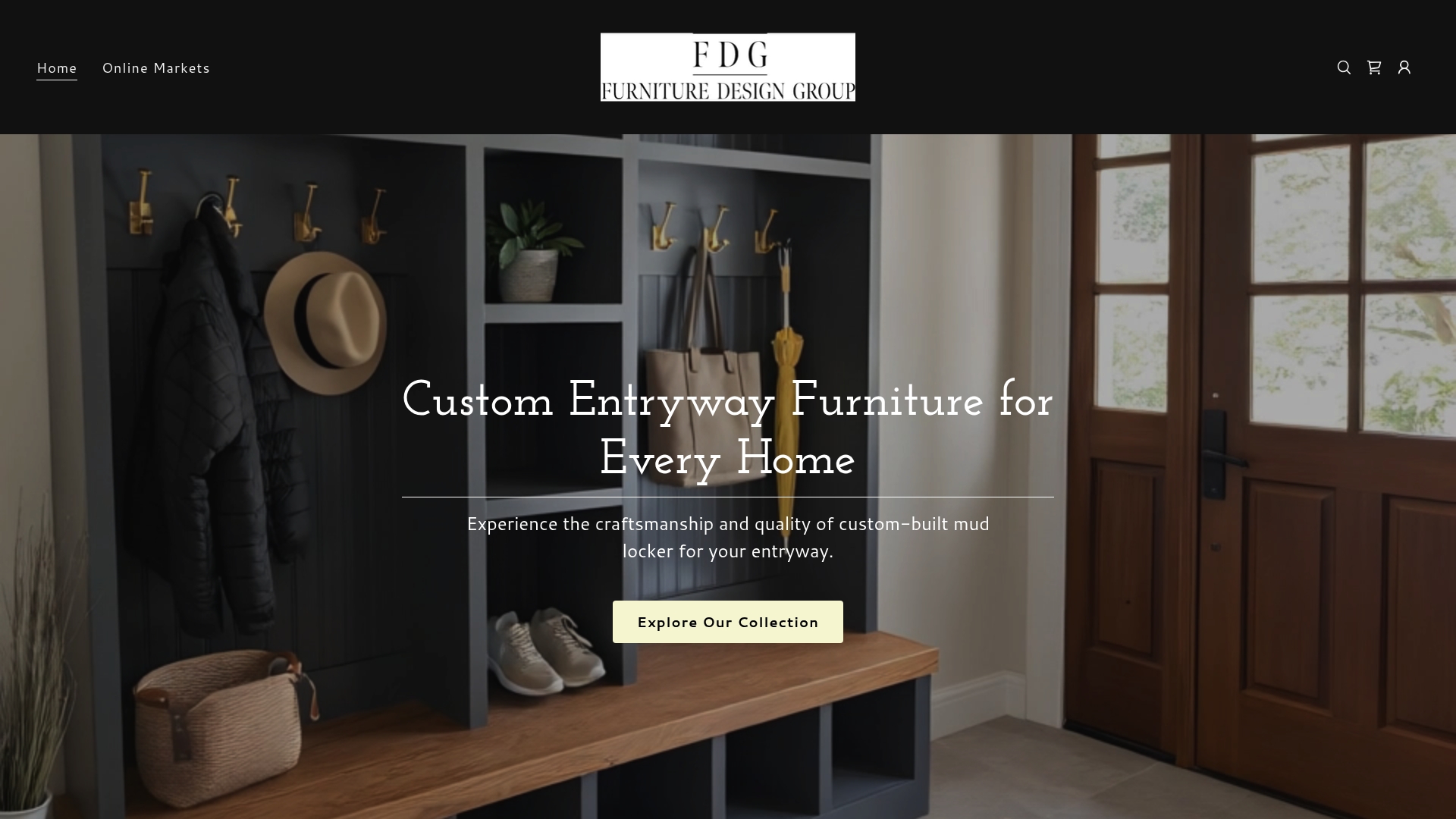
Visit our showroom, browse our past projects, or reach out directly to start a conversation about your entryway. We would love to help you build something that works as hard as your family does.
Frequently asked questions
What is the easiest way to keep entryway clutter under control?
Set up clear zones, limit shoes to 2 to 3 pairs per person, and use labeled baskets for quick sorting. Consistent daily habits matter more than any single product.
How do I organize an entryway for kids and pets?
Install kid-height hooks and labeled zones so children can manage their own gear, and add a dedicated spot near the door for leashes and pet supplies.
How often should I declutter or rotate entryway items?
Switch out gear seasonally and do a quick monthly declutter sweep to remove items that have drifted in from other rooms. This keeps the system from getting overwhelmed.
What materials hold up best for entryway furniture?
Solid wood and powder-coated metal provide the best durability for benches, hooks, and cubbies in high-traffic, high-moisture entryways. Avoid particleboard in spaces exposed to wet shoes and seasonal moisture.
Should I buy a ready-made organizer or invest in custom furniture?
Custom cabinetry is the best fix for complex or awkward spaces, while ready-made units can work for simple layouts or short-term needs. Over time, custom furniture typically costs less because it does not need to be replaced every few years.