
TL;DR:
- Proper furniture joinery ensures durability, especially in Maryland’s humid climate.
- Mortise-and-tenon and dovetail joints provide high strength for load-bearing entryway pieces.
- Reinforcing joints and choosing suitable hardwoods extend furniture lifespan over time.
Most homeowners assume that a sturdy-looking piece of furniture is held together by screws, nails, and a generous layer of wood glue. That assumption costs people money every few years when their entryway bench wobbles, their coat rack leans, or their drawer faces pull away from the box. The truth is that the real backbone of any quality furniture piece lies in its joinery, the precise wood-to-wood mechanical connections that determine how long a piece lasts and how good it looks doing it. Maryland’s notoriously humid summers and dry winters make this choice even more critical. Here is exactly what you need to know.
Table of Contents
- Understanding furniture joinery: What makes a joint strong?
- The major joinery techniques explained
- Comparing joinery strength, looks, and longevity
- Choosing the right joinery for Maryland entryway furniture
- The expert perspective: Beyond textbook joinery
- Bring expert joinery and lasting style into your home
- Frequently asked questions
Key Takeaways
| Point | Details |
|---|---|
| Joinery defines durability | The way wood is joined determines how long custom entryway furniture lasts. |
| Top techniques for Maryland | Mortise-and-tenon and dovetails excel in humid Maryland homes and entryways. |
| Choose joints for function | Select joinery based on strength needs—tension, shear, and climate impacts. |
| Avoid weak shortcuts | Don’t rely solely on glue or pocket holes for load-bearing parts. |
| Consult experts for custom designs | Collaborating with a skilled furniture maker ensures lasting, stylish pieces. |
Understanding furniture joinery: What makes a joint strong?
Joinery is the craft of connecting two pieces of wood without relying entirely on fasteners or adhesive. The wood itself does most of the mechanical work. A good joint distributes stress across a large surface area, resists movement in multiple directions, and keeps its integrity even when the wood expands and contracts with seasonal moisture changes.
There are three types of strength that matter when you are buying or commissioning entryway furniture. Tension strength is the ability to resist being pulled apart, critical for drawer fronts and bench legs. Racking or twisting strength is the ability to resist diagonal forces, which is what keeps a coat rack from leaning sideways under the weight of wet winter coats. Shear strength is the ability to resist sliding forces along the joint face, which is what keeps a shelf from sagging under heavy boots or boxes.
When it comes to custom furniture joinery, understanding these three forces changes how you evaluate any piece of furniture. You stop looking only at the finish and start examining the corners, the legs, and the drawer boxes.
“The mortise-and-tenon joint is one of the strongest traditional joints, using a tenon fitted into a mortise for high mechanical strength and a large glue surface area, making it ideal for furniture frames like tables, beds, and chairs.”
Maryland’s climate adds an extra layer of complexity. Relative humidity in the Baltimore and Washington metro areas swings from below 30% in winter to above 80% in summer. Wood swells and contracts with every cycle. Joints that rely only on glue or mechanical fasteners loosen over time. Proper joinery accounts for this movement by locking wood fibers together mechanically, which is why entryway furniture durability starts with the joint, not the finish.
The major joinery techniques explained
Now that you understand why joinery matters, here is a clear breakdown of each major technique, what it does well, and where it belongs in your entryway furniture.
1. Mortise-and-tenon: A rectangular peg (the tenon) fits snugly into a matching pocket (the mortise). This joint delivers the highest mechanical strength for frames, legs, and structural connections. It handles all three force types well and is the first choice for entryway bench frames and coat rack posts.
2. Dovetail: Interlocking wedge-shaped “tails” and “pins” lock together mechanically. Dovetail joints provide excellent interlocking strength against tension and pulling forces, and they are the gold standard for drawer boxes and fine furniture corners. They also have a decorative appeal that reveals the craftsmanship inside the piece.
3. Dowel: Cylindrical wooden pins align and connect two boards. Dowel joints use cylindrical dowels for alignment and strength, offering medium strength that is better than pocket holes in shear and tension per lab tests. They are fast and precise but rely more on glue than pure mechanical interlock.
4. Biscuit: Oval compressed-wood wafers fit into matched slots cut into both board edges. Biscuit joints insert oval biscuits into slots for alignment and edge joining, providing high strength for tabletops and cabinetry with medium complexity. They are excellent for joining wide panels side by side.
5. Pocket hole: A drill bores a pocket at an angle, and a specialized screw draws two boards together. Fast and widely used, pocket hole joints work fine for cabinet face frames and non-load-bearing panels. They are weaker than mechanical joints under sustained stress, which matters in entryways.
6. Box (finger) joint: Straight interlocking fingers, like a squared-off dovetail, create strong mechanical connections for drawer boxes and decorative boxes. They lack the angled wedge of a true dovetail but still deliver solid resistance in multiple directions.
7. Dado and rabbet: A routed channel (dado) or an L-shaped notch (rabbet) captures the edge or end of a second board. These joints are the backbone of shelving and cabinet construction, holding shelves in place against shear forces without additional hardware.
Here is a step-by-step way to choose the right joint for your situation:
- Identify the force the connection will face (tension, racking, shear, or a combination).
- Decide whether aesthetics matter at that specific joint (dovetails are beautiful; pocket holes hide inside).
- Consider whether the joint will be reinforced with glue, dowels, or both.
- Factor in Maryland’s humidity and choose accordingly (mechanical joints outperform fastener-only connections over time).
- Match the joint to the wood species: harder woods like oak and maple hold tenons and dovetails better than softer pine.
| Joint type | Strength | Aesthetics | Complexity | Best use in entryway |
|---|---|---|---|---|
| Mortise-and-tenon | Very high | Hidden | High | Bench frames, coat rack posts |
| Dovetail | Very high | Decorative | High | Drawer boxes, corner joints |
| Dowel | Medium | Hidden | Medium | Panel alignment, face frames |
| Biscuit | Medium-high | Hidden | Medium | Wide panel edge joins |
| Pocket hole | Medium | Hidden | Low | Cabinet face frames, light panels |
| Box/finger | High | Decorative | Medium | Drawer boxes, storage cubbies |
| Dado/rabbet | Medium-high | Hidden | Low-medium | Shelves, cabinet bottoms |
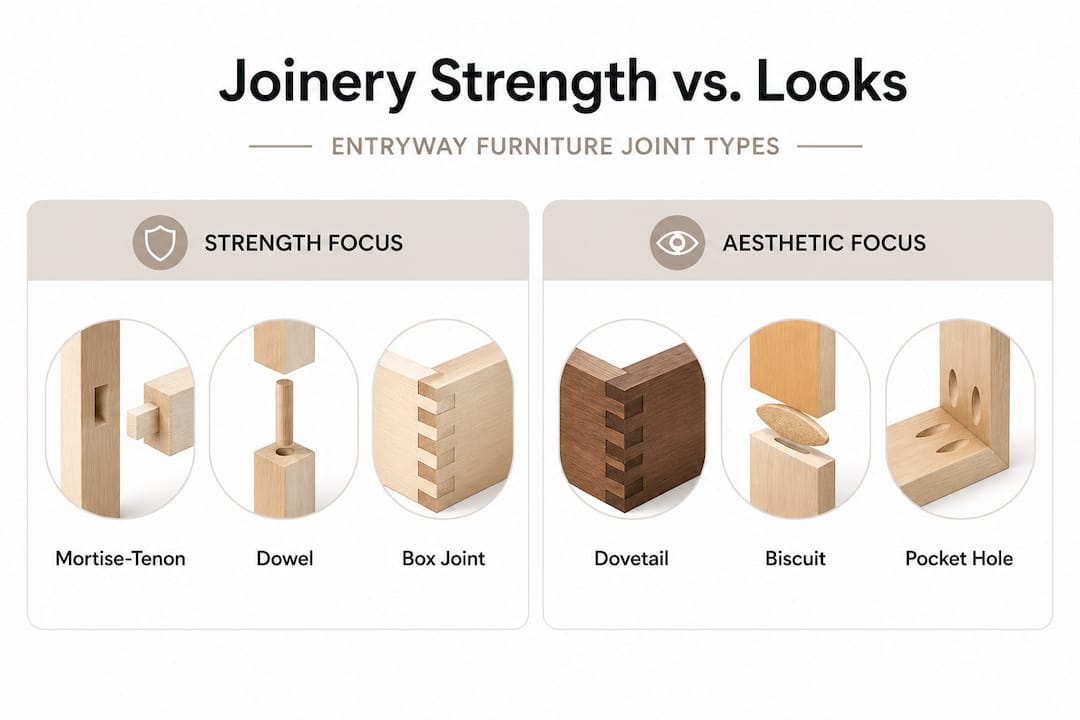
You can see joinery examples of these techniques applied to real entryway pieces, which helps make the comparison concrete rather than theoretical.
Pro Tip: Avoid using pocket holes as the primary connection for any load-bearing entryway component. They work well as a secondary fastener paired with a mechanical joint, but on their own they simply are not built for the repeated stress of a bench that holds 200 pounds of gear and people.
Comparing joinery strength, looks, and longevity
With the main techniques on the table, the natural next question is: how do they actually perform side by side over years of use in a real Maryland home?
The honest answer is that no single joint is universally strongest. Dovetails excel at resisting tension (pulling apart), while mortise-and-tenon outperforms every other joint in racking and twisting resistance. A well-designed furniture piece uses both, each in the right place.
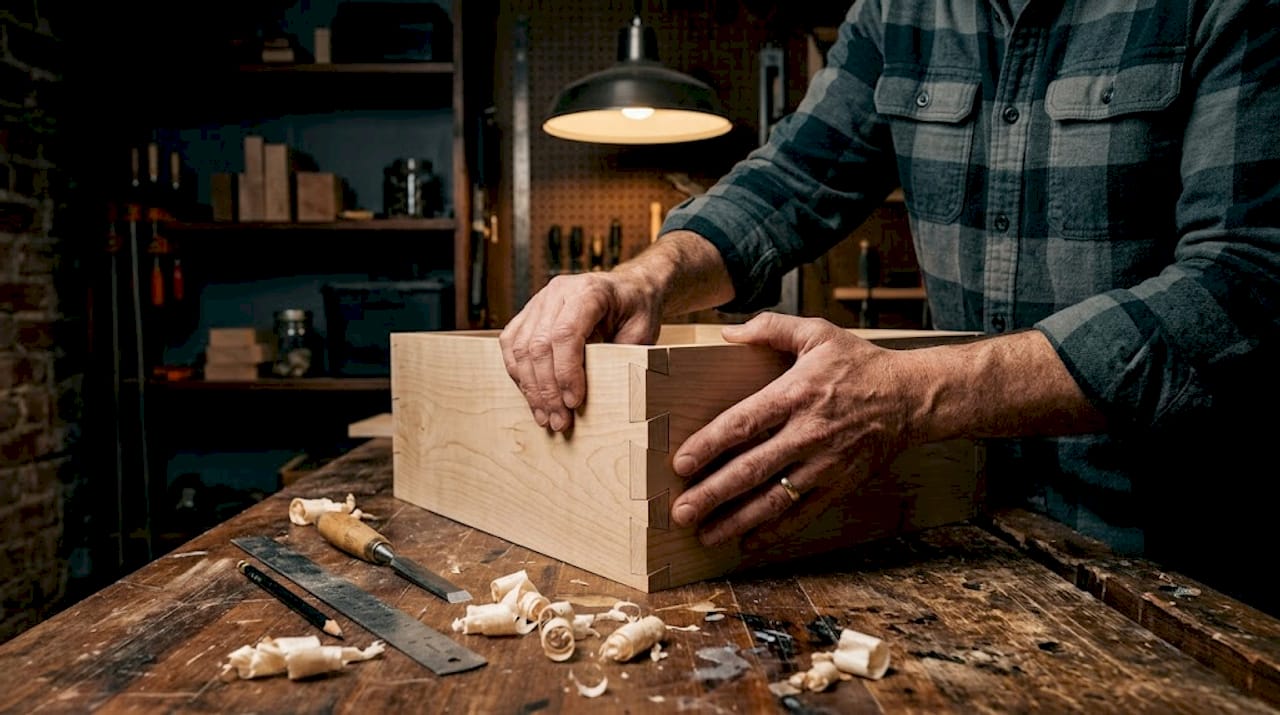
Longevity adds another dimension. Moisture cycling reduces stiffness in mortise-tenon joints over time, but reinforcements like secondary dowels or high-quality waterproof glue can mitigate those effects significantly. This is not a reason to avoid mortise-and-tenon joints. It is a reason to make sure your furniture maker reinforces them properly, especially in Maryland’s climate.
Here is where homeowners commonly go wrong in joint selection:
- Choosing a joint based on price alone. Faster joints cost less to cut but underperform in years two through ten.
- Ignoring the wood species. A tight dovetail in soft pine will loosen faster than the same joint cut in white oak.
- Assuming all glue is equal. Standard PVA glue loses strength in high-moisture environments. Yellow woodworking glue or polyurethane adhesive holds better through humidity swings.
- Overlooking reinforcement. A mortise-and-tenon joint without a drawbore pin or secondary dowel is good. One with reinforcement is excellent.
- Focusing only on visible joints. Interior connections in drawer boxes and cabinet carcasses take constant stress. Skimping there shows up within a few years.
When you look at craftsmanship details on a piece we build, you will see these reinforcement decisions documented. Transparency about internal construction is one way a skilled furniture maker demonstrates genuine quality rather than just talking about it.
The climate variable deserves its own moment. Maryland homes in areas like Annapolis, Bethesda, or the Eastern Shore face some of the most demanding moisture cycles on the East Coast. In those conditions, a piece with reinforced mechanical joints in a stable hardwood will outlast a comparable piece using fastener-based joinery by a decade or more. That is not an estimate. It reflects how wood behaves under repeated expansion and contraction cycles.
Choosing the right joinery for Maryland entryway furniture
Your entryway is the hardest-working space in your home. Wet coats come in. Heavy bags drop. Kids sit on benches in muddy boots. Every single day, your entryway furniture absorbs impact, weight, and moisture-laden air. The joinery inside that furniture either holds up or it quietly begins to fail.
Here is how to think about joint selection for the three most common entryway furniture pieces:
Entryway benches: The frame needs mortise-and-tenon at every leg-to-rail connection. The seat support needs dado or rabbet joints. If there is a drawer under the seat, that drawer box should be dovetailed. A bench built this way will comfortably support 300-plus pounds and still look solid fifteen years from now.
Coat racks and locker panels: Upright panels connected to top and bottom rails benefit from reinforced mortise-and-tenon. Hooks go into solid wood at these connection points. A coat rack where the hook is anchored only into a glued butt joint will pull away from the wall eventually, no matter how good the wall anchor is.
Shoe cabinets and storage cubbies: Interior shelving uses dado joints. Door frames use mortise-and-tenon or strong dowel joints. Drawers use dovetail or box joints. For custom entryway durability, this combination handles both the mechanical load and the decorative expectation.
Quick Maryland-specific joinery recommendations:
- Use white oak or hard maple as your primary wood. Both are stable and hold mechanical joints tightly.
- Specify reinforced mortise-and-tenon for all structural frame connections.
- Require dovetail joints on all drawer boxes.
- Ask about the glue type used: polyurethane or epoxy-based adhesives perform best in humid environments.
- Avoid furniture built primarily with pocket screws and glue for load-bearing connections.
- Request that joints are cut to fit snugly before glue is applied. A loose joint with extra glue is always weaker than a precise fit.
Pro Tip: When talking to a furniture maker, ask them directly, “How do you reinforce your mortise-and-tenon joints?” A craftsperson with real experience will answer quickly and specifically. Someone cutting corners will give you a vague answer or redirect the conversation.
The expert perspective: Beyond textbook joinery
After more than 20 years building entryway furniture for Maryland homeowners, we have learned something that no textbook captures cleanly: the joint type is only about half the story.
Conventional wisdom in woodworking says to pick the strongest joint for the application and call it done. But real furniture durability comes from a triangle of decisions: joint type, wood species, and the quality of the fit. A mortise-and-tenon cut loosely in a soft wood with standard PVA glue will perform worse than a precisely fitted dowel joint in white oak with polyurethane adhesive. The label on the technique matters less than the execution.
Maryland’s environment exposes weak points that a controlled workshop never reveals. We have seen entryway pieces come through our showroom from other makers that looked beautiful on day one and were visibly racking by year three. In almost every case, the failure point was not the joint type. It was the fit tolerance, the wood choice, or the glue selection. The joint type was fine on paper.
What sets genuinely lasting furniture apart is the maker’s willingness to slow down at every connection point, test the fit before glue, choose species appropriate to the climate, and reinforce wherever the piece will face repeated stress. That is not something you can shortcut. It is also not something that shows up in a photograph or a spec sheet. You see it in how a piece feels after five years of daily use in a busy household.
The homeowners who end up happiest with their entryway furniture are the ones who ask the right questions before they buy, not after. They ask about joints, wood species, glue types, and reinforcement. They treat furniture like the long-term investment it actually is.
Bring expert joinery and lasting style into your home
Understanding joinery gives you the knowledge to recognize quality furniture before you commit to a purchase. Now the question is where to find a maker who actually builds this way consistently.

Furniture Design Group has spent over 20 years building custom entryway furniture for Maryland homeowners using the exact techniques covered in this article. Every bench, locker, and storage piece we create uses reinforced mechanical joinery, carefully selected hardwoods, and adhesives chosen for Maryland’s climate. You can explore specific examples and see how these decisions translate into finished pieces by visiting creating custom furniture masterpieces. If you are ready to talk through a custom design for your entryway, reach out directly through our website to start the conversation.
Frequently asked questions
Which joinery technique is best for entryway benches in Maryland?
Mortise-and-tenon joints are the top recommendation for entryway benches because they deliver high mechanical strength and hold up well through Maryland’s humidity cycles. Reinforcing them with secondary dowels or drawbore pins extends their longevity even further.
Are pocket hole joints suitable for drawers?
Pocket hole joints are fast and acceptable for light-duty assembly, but they are weaker than dovetails for long-term drawer durability, especially under the repeated pulling and loading that entryway drawers experience daily.
How does Maryland’s humidity affect furniture joinery?
Moisture cycling gradually reduces joint stiffness over time, which is why reinforced mortise-and-tenon connections, dovetail joints, and stable hardwoods like white oak perform significantly better in Maryland homes than fastener-based alternatives.
What joints are recommended for load-bearing entryway furniture?
Mortise-and-tenon and dovetail joints are the standard for load-bearing entryway furniture because they rely on mechanical interlock rather than fasteners alone; prioritize these joints for any frame or structural connection that will carry consistent weight.