
TL;DR:
- Quality furniture craftsmanship is demonstrated through standardized verification, precise joinery, deliberate material choices, and reliable hardware. Dovetail joints exemplify skilled construction with their structural strength, requiring accurate execution and material awareness. Adhering to unified standards like AWI 2026 ensures consistency and expert craftsmanship across all woodworking projects.
Quality craftsmanship in furniture is defined as the precise application of skill, material knowledge, and design accuracy to produce pieces that are both durable and visually refined. The industry benchmark for this standard is the Architectural Woodwork Institute’s Quality Certification Program, which verifies fabrication, finishing, and installation against measurable criteria. Recognizing examples of quality craftsmanship requires understanding what separates a well-built piece from a merely attractive one. Dovetail joinery, certified woodworking processes, and deliberate material selection are the signals that distinguish furniture built to last from furniture built to sell. This article breaks down each of those signals with specific examples and expert insight.
1. AWI Quality Certification Program as a craftsmanship benchmark
The AWI Quality Certification Program (QCP) is the most recognized third-party verification system for architectural woodworking quality in North America. It certifies that a woodworking firm meets established grade criteria through shop inspections, testing, and field verification. This shifts quality from a marketing claim to a documented, repeatable outcome.
QCP certification covers three core areas:
- Fabrication quality: Dimensional accuracy, joinery precision, and substrate selection per AWI grade standards
- Finishing quality: Surface preparation, coating application, and sheen consistency across all components
- Installation quality: Fit, alignment, and field adjustments meeting defined tolerances
For homeowners and interior designers, requesting QCP-verified work removes the guesswork. Certified woodworkers gain direct credibility and competitive positioning because their quality is tied to inspection results, not self-reported claims. That distinction matters enormously when you are commissioning a custom mud locker or entryway built-in that needs to perform for decades.
Pro Tip: When evaluating a custom furniture maker, ask directly whether they follow AWI grade standards. A maker who references Premium, Custom, or Economy grades by name understands the specification system and is far more likely to deliver consistent results.
2. Why dovetail joints are the defining example of fine craftsmanship
Dovetail joinery is the single most recognized symbol of high-quality furniture construction, and the reason is structural, not decorative. The interlocking trapezoidal pins and tails create a mechanical bond that resists pulling apart under tension, making it the preferred joint for drawer boxes, case corners, and any connection subject to repeated stress.
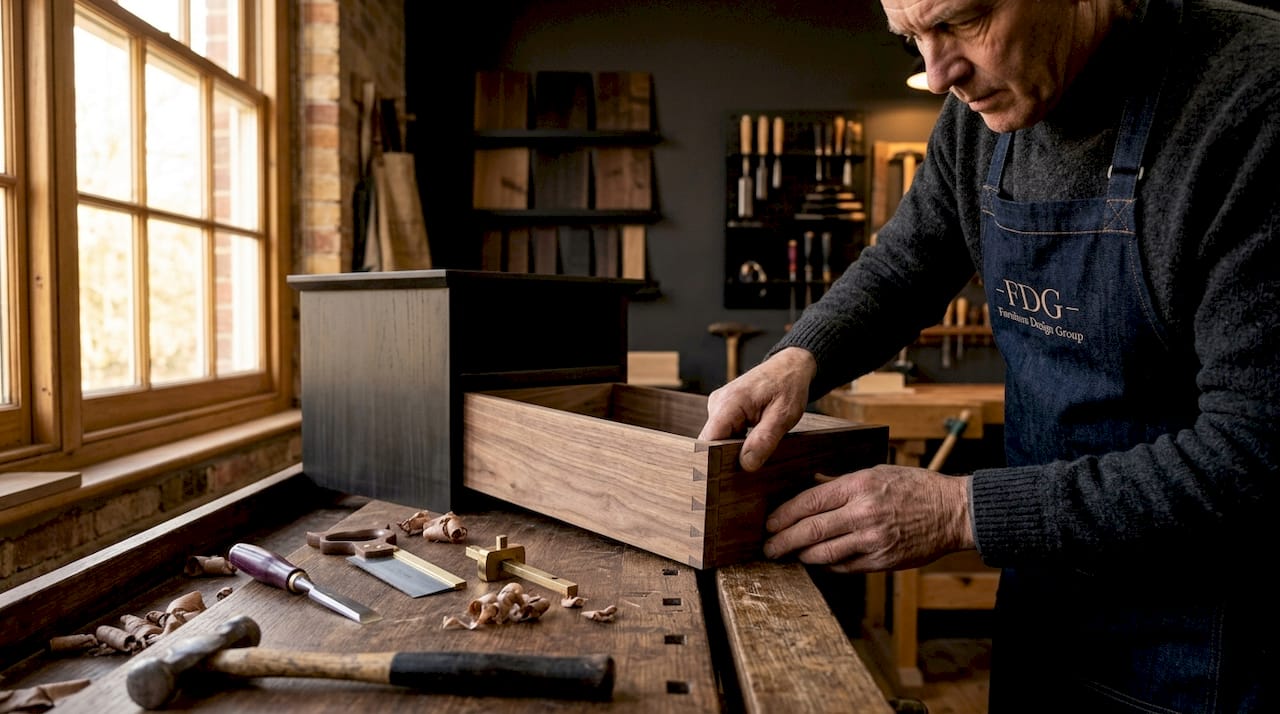
The strength advantage is measurable. Dovetail joints reach tensile strengths of 2,043 N for 3D-printed PLA versions and 933 N for injection-molded PA fasteners, demonstrating that fabrication method and material choice directly determine structural performance. That data confirms what experienced woodworkers already know: the joint form alone does not guarantee quality. Execution does.
Here are the key reasons dovetail joinery signals craftsmanship:
- Mechanical resistance: The geometry locks against tensile force without relying solely on adhesive
- Visible precision: Tight, gap-free pins and tails require accurate layout and controlled cutting
- Material awareness: Quality makers cut dovetails with the wood grain direction in mind to prevent splitting
- Assembly discipline: Glue-induced swelling can freeze a joint mid-assembly; skilled craftsmen plan the sequence and work quickly to prevent fit failure
“The gluing dynamics of softwood dovetails require the maker to account for wood movement during assembly. Quality is not just in the cut. It is in the plan.” — Paul Sellers
Pro Tip: Match joinery type to the load the furniture will carry. Dovetails excel in tensile resistance for drawer pulls and case corners. For structural shear or compression loads, mortise-and-tenon or box joints are more appropriate choices.
3. Studio Hooton’s approach to material selection and proportion
Neil Stevenson of Studio Hooton argues that quality relates to careful detailing and appropriate material selection far more than to expensive or complicated designs. This is one of the most practically useful insights in contemporary furniture craftsmanship. A piece built from well-chosen secondary wood with perfect proportions will outlast and outperform a piece built from exotic materials with poor joinery.
The principles Stevenson applies translate directly into what you should look for in any bespoke furnishing:
- Accuracy over ornamentation: Tight tolerances, flush surfaces, and consistent reveals signal more skill than decorative carving
- Material appropriateness: The right wood species for the application. Quartersawn white oak for stability in wide panels, hard maple for drawer boxes that need wear resistance
- Proportion and scale: A piece that fits its space without dominating it reflects design intelligence, not just technical ability
- Slow deliberate execution: Rushed furniture shows in the details. Grain mismatches at joints, uneven finish at inside corners, and inconsistent hardware reveals are all signs of compressed timelines
Historically significant furniture that exemplifies these principles includes Shaker case pieces, which use secondary woods like pine for drawer bottoms and backs while reserving cherry or maple for primary surfaces. That material hierarchy is a craftsmanship decision, not a cost-cutting one. It reflects an understanding of how each component performs under use. When you see that kind of thinking in a custom piece, you are looking at genuine skill.
4. AWI Standards 2026 and consistent quality across woodworking projects
In 2026, AWI published a consolidated 433-page standard combining 14 previously separate woodworking standards into a single reference. This matters for anyone commissioning custom furniture because it means quality criteria for casework, millwork, finishing, and installation now share a unified framework. Consistency across a project becomes easier to specify and verify.
Standards create objective benchmarks for shop inspections, training, and field verification, replacing subjective assessments with defined tolerances and acceptance criteria. For a homeowner or designer, that means you can reference specific grade requirements in a contract rather than relying on vague language like “high quality.”
| Quality dimension | What AWI Standards define |
|---|---|
| Fabrication tolerances | Acceptable dimensional variation in cut parts and assembled components |
| Finish characteristics | Sheen level, surface smoothness, and coating adhesion requirements |
| Casework installation | Plumb, level, and reveal tolerances for installed cabinetry and built-ins |
| Material acceptance | Allowable defects in lumber, panel products, and veneers by grade |
| Joinery requirements | Minimum joint specifications by application and load category |
The practical value of this framework is repeatability. A woodworker who builds to AWI Premium grade on one project can reproduce that standard on the next because the criteria are written down, not carried in memory. That predictability is what separates a professional shop from a talented hobbyist.
5. Hardware selection as a signal of craftsmanship quality
Hardware is where many otherwise well-built pieces fail. Soft-close drawer slides, full-extension undermount runners, and solid brass hinges are not luxury additions. They are functional requirements for furniture that will be used daily. Choosing hardware that matches the door or drawer weight is a precision decision that directly affects how a piece feels in use.
The gap between furniture that feels expensive and furniture that merely looks expensive almost always comes down to hardware and fit. A drawer that closes with even resistance and no rattle signals that the maker selected slides rated for the actual load, set the reveal consistently, and aligned the front panel with care. None of that is visible in a photograph. All of it is felt the first time you open the drawer.
For entryway furniture specifically, hardware durability matters more than in low-traffic areas. Coat hooks, locker latches, and bench hinges on a mud locker take daily impact from children, bags, and wet gear. Specifying commercial-grade hardware on residential pieces is one of the clearest examples of a craftsman thinking about long-term performance rather than short-term appearance.
6. Precision fit and measurement as a craftsmanship standard
Precision fit is the difference between a custom piece and a modified stock piece. Accurate cabinet door measurement determines whether reveals are consistent, doors hang without binding, and the finished installation looks intentional rather than adjusted. This applies equally to entryway built-ins, bedroom wardrobes, and kitchen cabinetry.
Quality makers measure twice, cut once, and then measure again after the first assembly. They account for out-of-square walls, uneven floors, and seasonal wood movement before the piece leaves the shop. The result is a fit that looks effortless because every variable was anticipated, not corrected after the fact.
Consistent reveals are one of the most reliable visual indicators of precision. When the gap between a door and its frame is uniform on all four sides, it means the maker controlled every step from layout to installation. When reveals vary, it signals that at least one step was rushed or skipped. You can check this yourself on any piece of furniture by holding a small ruler against each side of a door or drawer front.
7. Traditional craftsmanship methods that still define quality today
Traditional craftsmanship methods remain the standard against which modern production furniture is measured, not because they are old, but because they solve real structural problems. Hand-cut mortise-and-tenon joints, steam-bent chair backs, and hand-planed surfaces each address specific functional requirements that machine production handles less reliably.
Hand planing a surface before finishing removes mill marks and tear-out that sanding can obscure but not eliminate. The result is a surface that reflects light evenly and accepts finish more consistently. This is why furniture from makers like Thomas Moser or George Nakashima’s studio holds its finish longer than comparable factory pieces. The preparation is more thorough.
Steam bending produces chair components with continuous grain running through the curve, which is structurally stronger than a component cut to shape across the grain. Windsor chair makers have used this technique for over 300 years because it works. A quality craftsman today who uses steam bending for chair backs is not being nostalgic. They are choosing the structurally correct method for the application.
Key takeaways
Quality craftsmanship in furniture is verified through measurable standards, precise joinery, deliberate material selection, and hardware choices that match real-world use demands.
| Point | Details |
|---|---|
| Certification signals real quality | AWI QCP verification replaces subjective claims with documented fabrication and installation standards. |
| Dovetail joinery proves execution skill | Tight, gap-free dovetails require accurate layout, material awareness, and disciplined assembly sequencing. |
| Proportion matters more than cost | Studio Hooton’s Neil Stevenson confirms that accurate detailing and appropriate materials outperform expensive complexity. |
| Standards create repeatability | AWI Standards 2026 unify 14 woodworking criteria into one framework, making quality specifiable and verifiable. |
| Hardware and fit complete the picture | Commercial-grade hardware and consistent reveals are the final proof that a maker thought beyond appearance. |
What 20 years of watching furniture actually taught me
Most people shopping for custom furniture focus on wood species and finish color. Those are the last things I look at. The first thing I check is the inside of a drawer box. If the dovetails are hand-cut and tight, if the bottom panel floats in a groove rather than being glued in place, and if the secondary wood is appropriate for the application, I already know the maker understands what they are doing. Everything visible on the outside follows from what happens on the inside.
The craftsmanship conversation has shifted in the last decade. Clients now ask better questions, partly because information like AWI grade standards is more accessible, and partly because enough poorly built furniture has failed visibly and expensively. That shift is good for everyone. It rewards makers who invest in skill and process over makers who invest in marketing photography.
My honest advice: find a maker who can explain their joinery choices, name the wood species they use for secondary components, and reference a quality standard by name. If they cannot do those three things, their definition of quality and yours are probably not the same. The custom furniture process should feel like a collaboration between your vision and their technical knowledge, not a transaction where you hope for the best.
— Donovan
See quality craftsmanship built for your home

Furnituredesigngroup has spent over 20 years building bespoke entryway furniture for Maryland homeowners and interior designers who refuse to compromise on construction quality. Every mud locker, bench, and built-in the team produces follows the same principles covered in this article: appropriate joinery for the load, material selection matched to the application, and hardware specified for daily use rather than showroom appeal. If you are ready to see what standards-based custom furniture looks like in practice, explore Furnituredesigngroup’s custom furniture services or visit the showroom to experience the difference in person.
FAQ
What is quality craftsmanship in furniture?
Quality craftsmanship in furniture is defined by precision joinery, appropriate material selection, accurate proportions, and finishes that meet measurable standards. The AWI Quality Certification Program provides the most recognized third-party framework for verifying these criteria in architectural woodworking.
How do I identify high-quality craftsmanship in a custom piece?
Check the inside of drawer boxes for tight dovetail joints, confirm that reveals around doors and drawers are consistent, and ask the maker which AWI grade standard they build to. Hardware weight and smooth operation are also reliable indicators of construction quality.
Why are dovetail joints considered examples of skilled artisans?
Dovetail joints require accurate layout, controlled cutting, and disciplined assembly to achieve a tight mechanical fit. Their tensile strength and the skill required to cut them cleanly make them the most widely recognized marker of fine craftsmanship techniques in furniture construction.
What do AWI Standards cover for woodworking quality?
AWI Standards 2026 cover fabrication tolerances, finish characteristics, casework installation, material acceptance criteria, and joinery requirements across 14 categories of architectural woodworking. They provide objective benchmarks that replace subjective quality claims with verifiable, documented criteria.
How does material selection affect craftsmanship quality?
Material selection determines both the longevity and the visual coherence of a piece. Using quartersawn lumber for wide panels reduces movement, selecting species by hardness for high-wear surfaces extends service life, and matching secondary woods to primary woods by grain and color reflects the kind of deliberate thinking that defines genuinely skilled artisans.