
TL;DR:
- Furniture design trends in 2026 emphasize warmth, organic curves, and authentic craftsmanship over minimalism and mass production. Dark wood tones are making a comeback as focal points, with layered materials replacing monotony for richer interiors. The future favors personalized, handcrafted, and adaptable furniture pieces that reflect genuine human touch and individual style.
The furniture design trends 2026 brings are less about shock and spectacle and more about something harder to manufacture: soul. After years of chasing cool minimalism and Instagram-ready paleness, the design world is making a deliberate turn toward warmth, physical comfort, and authenticity. If you’re a homeowner planning a refresh or a design enthusiast tracking what’s worth investing in, this guide cuts through the noise and gives you exactly what’s shaping interiors right now, along with what you should quietly retire.
Table of Contents
- Key takeaways
- 1. Sculptural curves and organic forms are defining spaces
- 2. Dark, warm wood tones are reclaiming their authority
- 3. Artisanal details and visible craftsmanship are the new luxury
- 4. Modular and adaptable furniture is graduating from novelty to necessity
- 5. Layered materials and mixed surfaces replace monotone interiors
- 6. Furniture trends to leave behind in 2026
- My honest take on what 2026 furniture trends really mean
- How Furnituredesigngroup brings 2026 trends to life in your home
- FAQ
Key takeaways
| Point | Details |
|---|---|
| Curves replace rigid lines | Rounded silhouettes in seating and case goods create warmer, more welcoming spaces in 2026. |
| Dark woods are back with purpose | Walnut, caramel oak, and espresso tones are replacing pale finishes as intentional visual anchors. |
| Handcraft beats mass production | Buyers are seeking furniture with visible tool marks, fluting, and maker narratives over factory uniformity. |
| Modular systems earn their place | Flexible, reconfigurable seating that genuinely adapts to your layout is a smart long-term investment. |
| Some trends deserve a quiet exit | Scallop details, builder-grade basics, and overexposed light woods are losing favor fast among designers. |
1. Sculptural curves and organic forms are defining spaces
The clearest signal in 2026 furniture trends is the move away from straight lines and sharp corners toward rounded, organic silhouettes. We’re talking about curved sectionals with pillow arms, bullnose-edged tables, and case goods with softened profiles that feel like they belong in a home rather than a showroom.
This shift isn’t arbitrary. Rounded forms have a genuine psychological effect on how a room feels. Hard right angles signal tension; curves signal ease. In rooms where modern architecture still dominates with flat ceilings and linear walls, a curved sofa or kidney-shaped coffee table acts as a counterbalance, softening the grid without undermining the structure.
Here’s how to work curves into your space without overdoing it:
- Start with one signature curved piece, either a sofa or a primary accent chair, and let the rest of the room breathe around it.
- In smaller rooms, a curved bench or rounded ottomans add softness without consuming floor space.
- Pair curved upholstered pieces with rectangular rugs to create a visual tension that feels intentional.
- Avoid making every element round. The contrast between one strong curved focal point and straighter supporting pieces is what makes the composition work.
Pro Tip: If you’re new to curved furniture, a single boucle-upholstered arc sofa against a flat wall is all you need to completely shift a room’s energy.
2. Dark, warm wood tones are reclaiming their authority
The decade of bleached oak and light Scandinavian finishes is ending. Spring 2026 furniture styling points firmly toward warmer, deeper wood tones. Walnut, caramel oak, and espresso finishes are becoming the go-to choices for homeowners who want interiors that feel grounded and layered rather than airy and sparse.
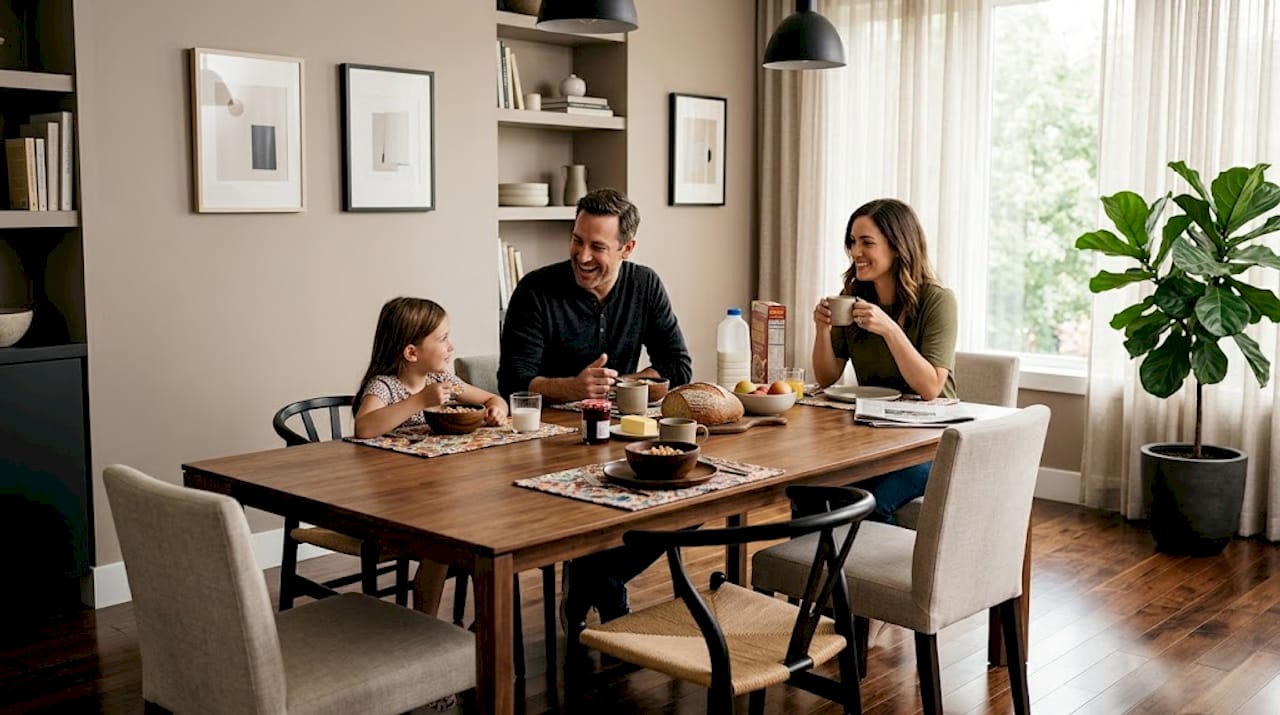
The key distinction this cycle makes is treating dark wood as an anchor, not a wall-to-wall solution. Here’s how the contrast plays out:
| Approach | Effect | Best used for |
|---|---|---|
| Pale wood everywhere | Light, open, minimal | Small spaces needing perceived volume |
| Dark wood everywhere | Heavy, closed, dated | Rarely recommended in 2026 |
| Dark wood as focal anchor | Rich, layered, warm | Most modern residential interiors |
| Mixed tones with contrast | Dynamic, personal, sophisticated | Open floor plans and statement rooms |
The most successful applications pair a walnut dining table or sideboard with creamy linen upholstery, soft plaster walls, and black metal accents. The contrast prevents any sense of visual heaviness while creating a richness that pale finishes simply cannot deliver. Using darker woods deliberately mixed with lighter textiles is the styling move that separates thoughtful interiors from trendy ones.
Pro Tip: If your current space has pale wood furniture you love, introduce walnut through a single piece like a side table or console. The contrast alone will update the entire room’s feeling without a full overhaul.
3. Artisanal details and visible craftsmanship are the new luxury
Here’s the trend that has the most staying power of everything happening in 2026 furniture design. Buyers increasingly prefer furniture that shows evidence of a human hand in its making. We’re not talking about rustic or rough-hewn pieces. We’re talking about subtle, skilled details that no machine produces uniformly.
What does artisanal character actually look like in furniture? A few concrete examples:
- Fluted drawer fronts where each groove is slightly imperfect in its depth
- Rattan panels hand-woven with visible variation in weave tension
- Carved wood panels where the grain is celebrated rather than concealed
- Surface treatments on stone or plaster that shift slightly in texture across the piece
“The luxury of the future is furniture that feels human. People are drawn to the evidence of time and skill, the slight variation that tells you a person made this, not a program.”
This mindset connects to something deeper. Clients increasingly desire furniture that earns character over time, where patina, wear, and aging become features rather than flaws. That’s the opposite of mass production’s promise of permanence without personality.
Pro Tip: Run your hand across a piece before buying. Look for subtle surface variation under light. If the finish looks identical at every angle, it was almost certainly machine-applied. True handcrafted furniture quality reveals itself in the details only touch can confirm.
4. Modular and adaptable furniture is graduating from novelty to necessity
Modular seating has existed for decades, but what’s different in 2026 is the sophistication of how it’s being designed and used. Puzzle-piece modular seating shown at Salone del Mobile 2026 featured faceted ottomans and wedge-like inserts that allow a single seating system to transform from an intimate loveseat-style arrangement to an expansive social configuration within minutes.
This modular furniture shift from static art to dynamic systems is driven by how people actually live now. Households host dinners one night and need a cleared floor plan the next. Open-plan apartments need furniture that multitasks without looking temporary.
When shopping for modular systems, consider these factors:
- Joining quality: Modules should lock or connect cleanly without gaps, wobble, or misaligned upholstery seams.
- Upholstery consistency: Fabric or leather should match precisely across modules so the assembled piece looks intentional.
- True reconfigurability: Some modular systems only look flexible on paper. Test the actual reconfiguration in person before committing.
- Scale range: A good system should work at two or three distinctly different sizes without feeling awkward at any of them.
Pro Tip: Ask the retailer or maker to show you the piece in at least two configurations before purchasing. A modular sofa that only really works in one arrangement is just a regular sofa with extra connectors.
5. Layered materials and mixed surfaces replace monotone interiors
The 2026 furniture styles worth watching all share one characteristic: no single material dominates. The approach is deliberate mixing. Stone tabletops on wood bases. Metal legs paired with upholstered shelving units. Rattan panels set within lacquered frames.
This layering approach serves both visual and tactile purposes. When you combine materials with different surface qualities, a room becomes physically interesting in a way that monochrome or single-material schemes never achieve. Your eye and your hand both find something to engage with.
For homeowners navigating this, a useful rule is to limit any single piece to three materials maximum. A dining table with a marble top, walnut base, and brass hardware hits three tactile registers without feeling chaotic. That restraint is what separates layered sophistication from visual clutter. You can explore how trending decor styles for 2026 are approaching this material layering across entire room compositions.
6. Furniture trends to leave behind in 2026
Not every trend ages gracefully. Certain furniture styles are losing designer and consumer support in 2026, and understanding why helps you avoid purchases you’ll regret in two years.
- Scallop details on cabinetry and upholstery. This motif peaked fast and spread too wide. It went from signature detail to mass-market cliché in under 18 months. Designers are moving on.
- Builder-grade furniture finishes. Flat, featureless painted MDF in stock white or gray reads as generic regardless of the price point. It signals no investment in materiality.
- Light blonde and whitewashed wood finishes. The pale wood era served a purpose, but its ubiquity has drained it of any design statement. Rooms built around blonde oak now feel unintentionally dated.
- Matching furniture sets. The idea that a sofa, loveseat, and armchair need to be from the same collection is gone. Mixing silhouettes, makers, and eras within a single room is how interiors develop genuine personality now.
- Overcrowded gallery walls above furniture. The impulse to cover every inch of wall space behind a sofa or bed has reached saturation. Restraint is the statement in 2026.
The underlying pattern across all of these is a rejection of the predictable and the generic. The 2026 furniture trend is fundamentally about authenticity and individuality, which means anything that reads as formulaic is going to feel wrong regardless of how recently it arrived. If refreshing an existing piece is more practical than replacing it, adding texture through throws, tactile cushions, or layered rugs can shift the perception of a dated piece considerably.
My honest take on what 2026 furniture trends really mean
I’ve watched enough trend cycles to know the difference between a genuine cultural shift and a styling moment. What’s happening in 2026 feels real to me, because it’s a direct reaction to something. The acceleration of AI, the sameness of algorithm-curated interiors, and the fatigue of chasing cool have pushed people toward something that simply feels human.
When I see designers at Salone championing visible tool marks and patina as luxury signals, I don’t read that as nostalgia. I read it as a correction. We over-indexed on perfection, flatness, and machine precision for years. The market is now recognizing that those qualities don’t feel like luxury. They feel like detachment.
What I find most interesting is how functional comfort is redefining what people call luxury. A deeply cushioned sofa with a curved back that actually supports how your spine sits is now more aspirational than a sculptural statement piece you can’t comfortably use for more than twenty minutes. That’s a meaningful shift in values, not just aesthetics.
My practical advice: don’t buy the trend. Buy the principle behind it. If a curved sectional fits your life, get one. If your real need is a handcrafted piece with character you’ll still love in fifteen years, prioritize the craft over the silhouette. The homeowners who’ll be happiest with their 2026 purchases are the ones building layered, personal interiors rather than photographing a trend moment.
— Donovan
How Furnituredesigngroup brings 2026 trends to life in your home
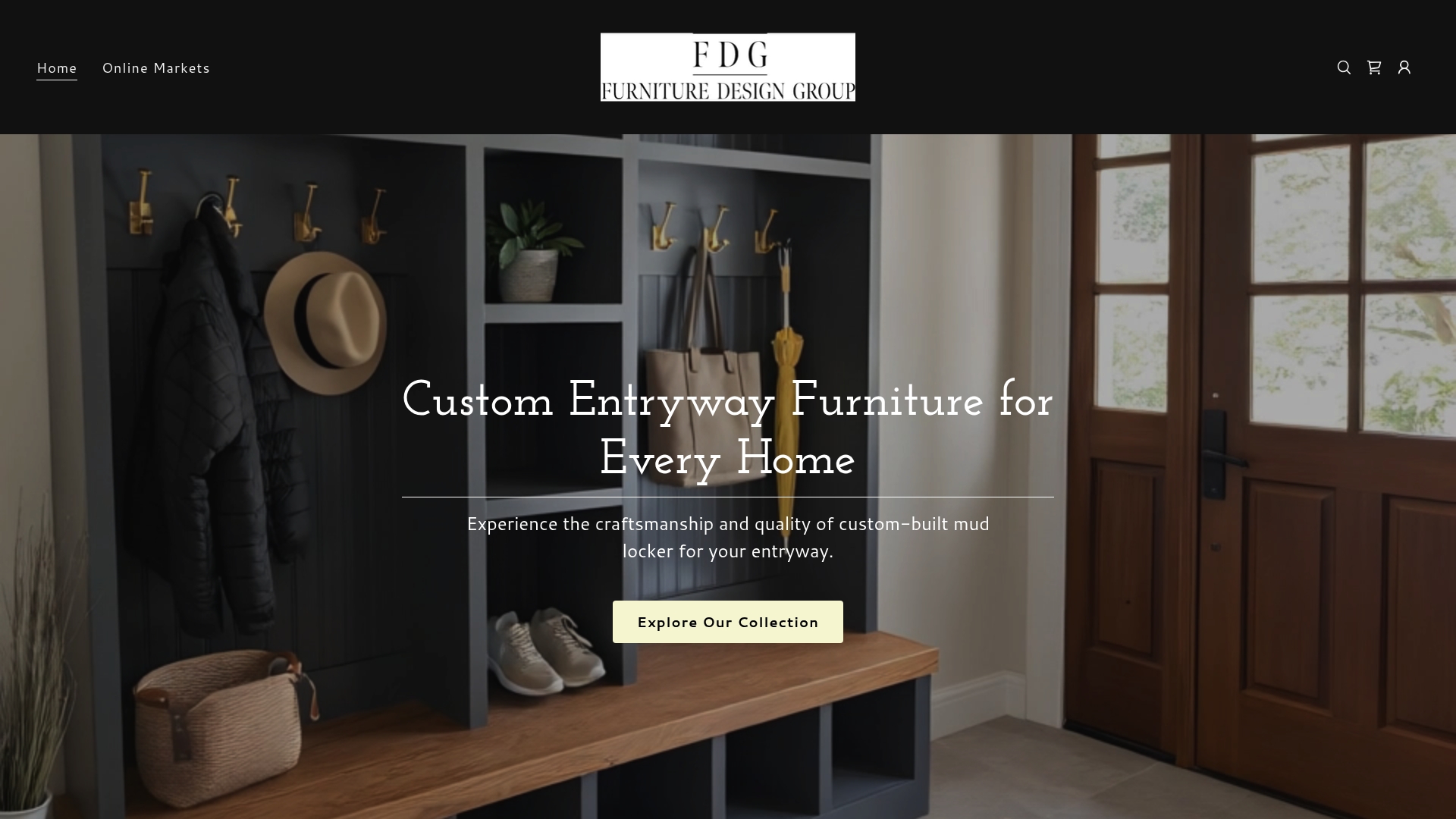
Everything defining the furniture design trends 2026 prioritizes, warmth, craft, and pieces that feel genuinely personal, is exactly what Furnituredesigngroup has been building for over 20 years. As a family-owned Maryland company, they specialize in custom-crafted furniture where artisanal details aren’t a selling point added after the fact. They’re built into every decision from wood selection to joinery.
If you’re drawn to the visible craftsmanship trend or want furniture that adapts to how you actually live, their gallery shows you what that looks like in practice. Browse the custom furniture gallery to see how bespoke entryway pieces, including their signature mud lockers, combine function with the kind of handmade character that 2026’s most enduring interiors are built around.
When you’re ready to move from browsing trends to creating something that lasts, their team will work with you directly. That’s how custom furniture masterpieces get made.
FAQ
What are the biggest furniture design trends for 2026?
The leading furniture design trends 2026 highlights include curved organic silhouettes, dark warm wood tones like walnut and caramel oak, visible artisanal craftsmanship, and adaptable modular seating systems. The overarching shift is from cold minimalism toward warmth, comfort, and authentic materials.
What furniture styles are going out of style in 2026?
Scallop details, builder-grade finishes, light blonde wood, and matching furniture sets are all losing favor in 2026. Designers point to overexposure and lack of customization as the primary reasons these styles feel dated now.
Is modular furniture worth buying in 2026?
Yes, modular furniture is a strong investment in 2026, provided the system genuinely reconfigures into multiple distinct layouts. Look for pieces with clean module connections and consistent upholstery across all sections, as shown at Salone del Mobile 2026.
How do I incorporate dark wood tones without making a room feel heavy?
Use dark wood as a single visual anchor, such as a dining table or sideboard, and balance it with creamy upholstery, lighter wall colors, and natural fiber textiles. Mixing tones and layering textures prevents the heaviness that comes from using dark wood across every surface.
What does artisanal furniture mean in 2026 interior design trends?
Artisanal furniture in 2026 refers to pieces with visible evidence of skilled handwork: subtle surface variation, fluted details, hand-woven elements, or carved panels where no two areas look mechanically identical. It’s the opposite of the uniform finish that mass production delivers.