
TL;DR:
- Handcrafted furniture from solid hardwoods lasts over 30 years, unlike short-lived mass-produced options.
- Skilled joinery and climate-adapted designs ensure durability, repairability, and aesthetic cohesion.
- Investing in custom, eco-friendly pieces provides long-term value, personalized fit, and environmental benefits.
Your entryway is the first thing guests see and the last thing you touch before leaving home. Yet most homeowners fill that space with flat-pack furniture that starts sagging within a few years. Handcrafted furniture from solid hardwoods can last 30 or more years, while mass-produced MDF pieces often fail within a decade. That gap is not just about looks. It is about materials, construction methods, long-term economics, and even your environmental footprint. If you are a Maryland homeowner thinking about upgrading your entryway, this article will walk you through everything you need to know to make a confident, lasting choice.
Table of Contents
- What makes handcrafted furniture different?
- The long-term value and economics of handcrafted furniture
- Tailored fit and elevated entryway aesthetics
- Sustainability and environmental impact
- Our take: The overlooked value of skilled craftsmanship for Maryland homes
- Transform your entryway with Maryland’s custom furniture specialists
- Frequently asked questions
Key Takeaways
| Point | Details |
|---|---|
| Durability outlasts mass-produced | Handcrafted furniture can last over 30 years, far beyond the short lifespan of mass-produced pieces. |
| Custom fit enhances entryways | Tailored entryway furniture maximizes storage, beauty, and functionality for Maryland homes. |
| True value in long-term savings | While costlier upfront, handcrafted pieces deliver superior value per year over decades of use. |
| Sustainability and less waste | Quality construction and eco-friendly materials dramatically reduce landfill impact. |
What makes handcrafted furniture different?
Most people assume furniture is furniture. You buy it, you assemble it, and it holds your stuff. But the way a piece is built determines how long it survives, how it handles your climate, and whether it can be repaired or must be replaced.
The biggest difference lies in joinery, which is the method used to connect wood pieces together. Mass-produced furniture typically uses staples, cam locks, and glue on particleboard or MDF (medium-density fiberboard, a wood byproduct pressed with resin). Handcrafted furniture uses time-tested techniques. Mortise-and-tenon and dovetail joints provide strength and longevity far beyond what staples or cam locks can offer. These joints interlock mechanically, meaning they hold even when the glue eventually ages.
Solid hardwoods like white oak, maple, and cherry behave very differently from MDF under stress and moisture. MDF swells when it absorbs humidity and crumbles under repeated impact. Solid wood flexes slightly and recovers. This matters a great deal in Maryland, where summers are humid and winters are dry. Handcrafted wood joinery accommodates Maryland’s humid climate, reducing warping and maintaining structural stability across seasons.
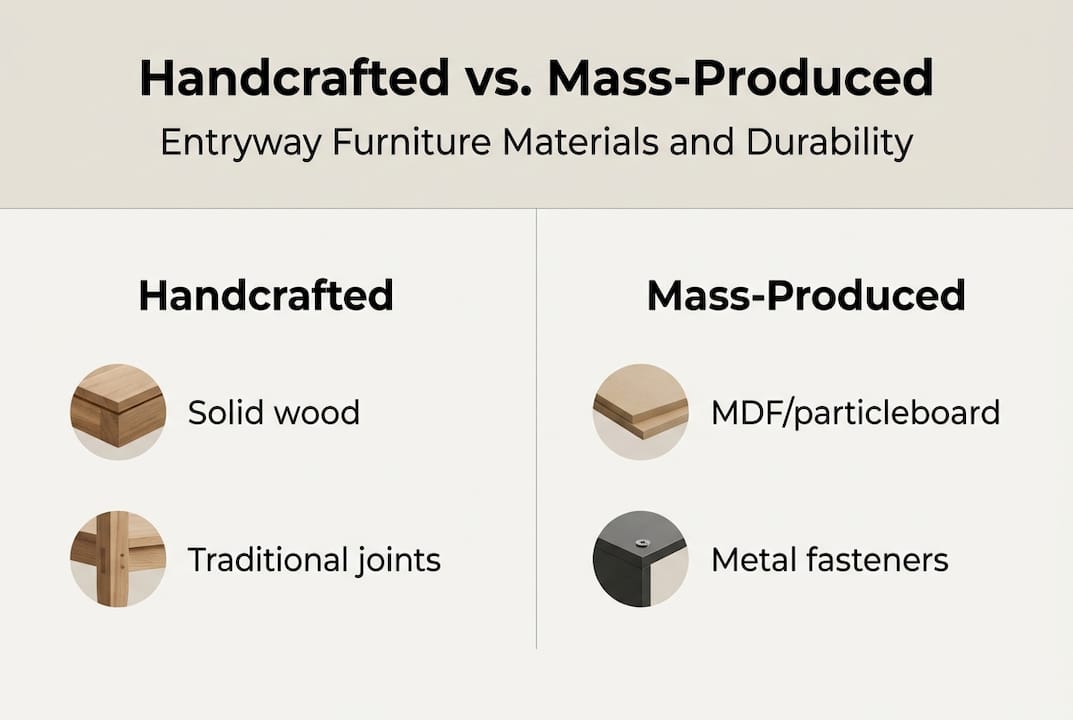
Here is a direct comparison of what you are actually getting:
| Feature | Handcrafted furniture | Mass-produced furniture |
|---|---|---|
| Primary material | Solid hardwood | MDF or particleboard |
| Joinery method | Mortise-and-tenon, dovetail | Staples, cam locks, glue |
| Lifespan | 30 or more years | 3 to 10 years |
| Climate adaptability | High | Low |
| Repairability | Yes, refinishable | Generally not repairable |
| Customization | Full | Limited to stock sizes |
Handcrafted pieces also offer something mass production cannot: the ability to repair and refinish. A scratched or dented solid wood surface can be sanded and refinished. A scratched MDF surface is essentially ruined.
Key advantages of handcrafted entryway furniture include:
- Structural integrity that holds up to daily heavy use
- Climate resistance suited to Maryland’s seasonal humidity swings
- Repairability that extends the life of the piece indefinitely
- Precise fit for your specific entryway dimensions
“The difference between a piece that lasts a decade and one that lasts a lifetime often comes down to a single joint. Dovetail and mortise-and-tenon connections distribute stress across the wood grain, not against it.”
Understanding custom furniture design at this level helps you ask the right questions before you buy.
The long-term value and economics of handcrafted furniture
Handcrafted furniture costs more upfront. There is no getting around that. But the real question is not what you pay today. It is what you pay over 20 years.
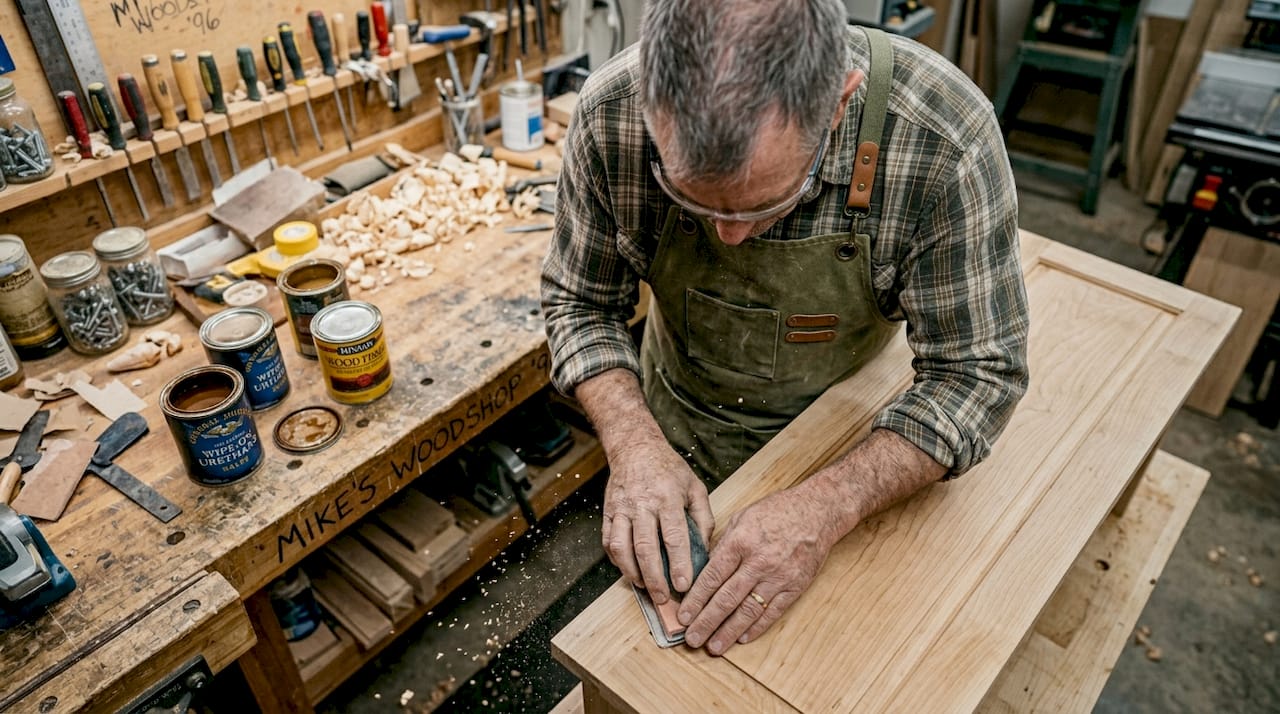
Handcrafted furniture lasts 30 or more years versus 3 to 10 years for mass-produced alternatives, which means the cost-per-year calculation often favors the handcrafted option significantly. Consider a simple example: a mass-produced entryway bench at $400 that lasts 5 years costs $80 per year. A handcrafted bench at $1,800 that lasts 30 years costs $60 per year. You actually spend less over time.
| Item | Upfront cost | Lifespan | Cost per year |
|---|---|---|---|
| Mass-produced bench | $400 | 5 years | $80/year |
| Handcrafted bench | $1,800 | 30 years | $60/year |
| Mass-produced (3 replacements) | $1,200 | 15 years | $80/year |
| Handcrafted (single purchase) | $1,800 | 30 years | $60/year |
The numbers shift even further when you factor in repair costs, disposal fees, and the time spent shopping for replacements. And the custom furniture market is growing at a 9.2% CAGR through 2032, which signals that more homeowners are recognizing this value equation.
Here is a practical framework for making a financially sound furniture decision:
- Calculate your timeline. If you plan to stay in your Maryland home for 10 or more years, handcrafted almost always wins on cost-per-year.
- Factor in resale value. Quality custom pieces can increase perceived home value and are often noted in real estate listings.
- Account for repair versus replace. Mass-produced furniture rarely survives a repair attempt. Solid wood can be refinished, reglued, or rebuilt.
- Consider the hidden costs. Disposal, delivery fees for replacements, and your own time all add up across multiple replacement cycles.
- Ask about warranties. Reputable handcrafted furniture makers stand behind their work in ways big-box stores cannot.
Pro Tip: When evaluating custom furniture investments, ask your maker whether the piece can be refinished or repaired in 15 years. A confident yes is a strong signal of genuine quality.
Tailored fit and elevated entryway aesthetics
Maryland homes come in all shapes and sizes, from historic Annapolis rowhouses to newer builds in the Baltimore suburbs. Standard furniture dimensions rarely account for the quirks of real entryways: the awkward corner, the low ceiling, the narrow hallway that still needs to hold backpacks, shoes, and dog leashes.
Custom handcrafted furniture offers a perfect fit for unique entryways, optimizing storage and enhancing home value in ways that off-the-shelf pieces simply cannot. A piece built to your exact measurements uses every inch of available space without looking forced or cluttered.
Beyond dimensions, entryway customization means you control the function. You can specify:
- Dedicated cubbies sized for your family’s bags and gear
- Built-in bench seating with hidden storage underneath
- Coat hooks positioned at the right height for adults and children
- Shoe drawers or open shelving based on your household’s habits
- Charging stations integrated discreetly into the design
The aesthetic benefits are just as significant. You choose the wood species, the finish tone, the hardware style, and the overall silhouette. That means your entryway furniture can echo the trim work, flooring, or cabinetry already in your home rather than fighting against it.
Pro Tip: When working with furniture specialists in Maryland, always mention your flooring material and trim color. Skilled craftspeople can match undertones precisely, creating a cohesive look that feels intentional rather than assembled.
Designing with Maryland’s climate in mind also matters at this stage. Solid wood expands in summer humidity and contracts in winter dryness. A good craftsperson accounts for this in how panels are fitted and how joints are cut, so your piece moves with the seasons rather than cracking under them.
Sustainability and environmental impact
Every furniture purchase is also an environmental decision, even if it does not feel that way at the checkout counter. The volume of discarded furniture in American landfills is staggering, and most of it is mass-produced.
Handcrafted furniture reduces environmental impact through a longer lifespan and the use of sustainable materials, resulting in significantly less landfill waste compared to mass-produced alternatives. A piece that lasts 30 years instead of 5 means six fewer manufacturing cycles, six fewer deliveries, and six fewer disposal events for that single furniture slot in your home.
For Maryland homeowners who care about their footprint, here are the most impactful material choices:
- FSC-certified hardwood (Forest Stewardship Council certified, meaning the wood was harvested responsibly)
- Reclaimed wood sourced from old barns, factories, or demolished structures
- Low-VOC finishes (volatile organic compounds, which off-gas harmful chemicals indoors)
- Water-based stains and sealers that are safer for your family and the environment
“The pre-production phase of furniture manufacturing carries the largest environmental footprint. Choosing one high-quality piece over multiple cheap replacements is one of the most effective ways to reduce your personal furniture-related emissions.”
Maryland has a strong tradition of responsible forestry, and many local craftspeople source wood from regional suppliers. That shortens the supply chain and reduces transportation emissions compared to imported flat-pack furniture shipped from overseas factories.
Sustainability and quality are not separate goals here. They reinforce each other. A piece built to last is, by definition, a piece built to reduce waste.
Our take: The overlooked value of skilled craftsmanship for Maryland homes
After more than 20 years building custom entryway furniture for Maryland homeowners, we have noticed a pattern. Most people come to us after a frustrating experience with mass-produced furniture, not before. They have already replaced a bench twice or watched a mud locker warp after one wet winter. By the time they call us, they are not asking about price. They are asking about permanence.
What gets overlooked in most furniture conversations is how much the local climate shapes the right construction choice. Maryland’s humidity is not just uncomfortable in August. It is a structural force that acts on every joint in your furniture year-round. Kiln-dried hardwood and precision joinery are not luxury features. They are functional requirements for this region.
We have also seen what happens when shortcuts are taken, even in custom work. Pieces built with green (undried) lumber or rushed glue-ups develop gaps and squeaks within a few seasons. True craftsmanship means measuring twice, drying the wood properly, and fitting joints before any finish is applied.
The real-life Maryland projects we are most proud of are the ones where homeowners tell us, years later, that the piece still looks exactly as it did on delivery day. That is the standard we hold ourselves to, and it is the standard you should expect from any craftsperson you hire.
Transform your entryway with Maryland’s custom furniture specialists
If this article has helped you see your entryway differently, the next step is easier than you might think. At Furniture Design Group, we have spent over two decades helping Maryland homeowners create entryways that are functional, beautiful, and built to last a lifetime.
We offer free consultations to walk through your space, understand your storage needs, and discuss material and design options that fit your home and your budget. Whether you are starting from scratch or replacing something that has finally worn out, explore local furniture artisans who know Maryland homes inside and out. Visit Maryland custom furniture to get in touch and see examples of our work. Your entryway deserves better than another flat-pack solution.
Frequently asked questions
How long does handcrafted entryway furniture last compared to mass-produced options?
Handcrafted furniture from solid hardwood can last 30 or more years, while mass-produced MDF or particleboard models generally last 3 to 10 years before sagging or delaminating.
Why is handcrafted furniture a better investment for Maryland homeowners?
Handcrafted custom furniture delivers better long-term value because wood joinery handles Maryland’s humidity more effectively, and solid wood pieces can be repaired and refinished over decades rather than replaced.
Is investing in handcrafted furniture environmentally friendly?
Yes. Quality pieces last longer and reduce landfill waste, and they can be made with FSC-certified or reclaimed wood, making them a more eco-conscious choice than mass-produced alternatives.
What’s the typical cost and wait time for custom entryway furniture?
Custom furniture typically costs 2 to 5 times more upfront and may require 8 to 16 weeks for completion, reflecting the skilled labor and quality materials involved.
Can I customize the materials and design details of my entryway furniture?
Absolutely. Custom carpentry allows full selection of wood species, finishes, hardware, and precise dimensions so your piece fits your space and your style perfectly.