
TL;DR:
- Craftsmanship involves skilled handwork and careful judgment, creating furniture that feels meaningful and durable.
- Choosing handcrafted entryway furniture enhances your home’s character, emotional connection, and long-term value.
Walk into any home, and the entryway tells you everything you need to know about the people who live there. Yet most homeowners settle for whatever flat-pack bench or generic coat rack fits the space, assuming all furniture serves the same purpose equally well. That assumption quietly robs your home of something real. Handcrafted entryway furniture doesn’t just look different from mass-produced alternatives; it functions differently, feels different to the touch, and carries a meaning that store-bought pieces simply cannot replicate. This guide breaks down what craftsmanship actually means, why it matters specifically for entryways, and how you can bring it into your own Maryland home with confidence.
Table of Contents
- Why craftsmanship matters in interior design
- Mass-produced vs. handcrafted: A side-by-side comparison
- How to spot quality craftsmanship in entryway furniture
- Personalizing your entryway: Applying craftsmanship principles
- Why true craftsmanship creates lasting value in your home
- Bring craftsmanship into your Maryland home
- Frequently asked questions
Key Takeaways
| Point | Details |
|---|---|
| Craftsmanship adds meaning | Handcrafted entryway furniture creates emotionally rich, unique spaces in your home. |
| Handcrafted outlasts mass-market | Custom pieces offer durability, personal touch, and long-term value compared to factory-made options. |
| Expert evaluation matters | Trained eyes can spot true craftsmanship, ensuring you get what you pay for in custom furniture. |
| Personalization elevates entryways | Applying craftsmanship lets you blend utility and style for a more functional, inviting space. |
Why craftsmanship matters in interior design
Craftsmanship, at its core, is the application of skilled hands and trained judgment to the making of an object. It stands in direct contrast to mass production, where speed and uniformity are the goals and individual decisions are largely removed from the process. In furniture making, craftsmanship means a person chose this particular piece of wood, cut this joint by hand, and finished this surface with care for how it would look and feel decades from now.
That distinction plays out in powerful ways when it comes to craftsmanship in home interiors. A handcrafted entryway bench, for example, doesn’t just hold your weight when you pull on your boots. It communicates a sense of intention and permanence. Guests notice it without knowing why. Your family interacts with it every single day, and over time, the quality of that daily interaction shapes how the whole home feels.
There’s also an emotional dimension worth taking seriously. A growing number of homeowners are pushing back against the sterile sameness of modern interiors. Craftsmanship demand reflects a broader consumer shift toward “meaningful” interiors and handcrafted pieces rather than purely minimal or mass-produced aesthetics. People want objects in their homes that carry a story, not just a SKU number.
Exploring custom furniture services is often the first step homeowners take when they realize that generic furniture isn’t measuring up to their vision for a space. The entryway, being the first and last room you pass through daily, deserves that elevated standard.
“The difference between a handcrafted piece and a mass-produced one isn’t just visual. It’s in how you feel when you use it every day.”
Signs of genuine craftsmanship to look for:
- Visible, intentional joinery (mortise and tenon, dovetail, or tongue and groove)
- Hand-applied finishes that show subtle texture and depth
- Solid wood rather than particleboard or MDF at structural points
- Hardware that operates smoothly and fits without wobble
- Proportions that feel considered, not just functional
Pro Tip: Run your fingers along the underside of any furniture piece you’re considering. Mass-produced items often have sharp, unfinished edges underneath. Handcrafted pieces are typically finished even where no one is looking, because the craftsperson takes pride in the whole object, not just the visible surfaces.
Mass-produced vs. handcrafted: A side-by-side comparison
Now that the value of craftsmanship is clear, it’s useful to see a direct comparison to the standard alternatives many homeowners encounter. Walking into a big-box furniture store, you’ll find entryway benches and hall trees priced attractively and available immediately. That convenience is real. But understanding exactly what you’re trading away helps make the decision much clearer.
The shift toward authenticity and “unadulterated craftsmanship” reflects a market that has grown skeptical of furniture designed to be replaced rather than kept. Many homeowners have lived through the frustration of a particleboard cabinet that swells and warps after a wet Maryland winter, or a bench that wobbles after two years of daily use.
| Feature | Mass-produced furniture | Handcrafted furniture |
|---|---|---|
| Materials | Engineered wood, veneers, plastics | Solid hardwood, quality metals, natural finishes |
| Durability | 5 to 10 years typical lifespan | Decades, often generational |
| Customization | Limited to available sizes and finishes | Fully tailored to your space and style |
| Uniqueness | Identical to thousands of others | One of a kind |
| Resale value | Depreciates quickly | Retains or increases in value |
| Emotional connection | Minimal | High, especially when locally made |
| Initial cost | Lower | Higher, reflecting skill and materials |
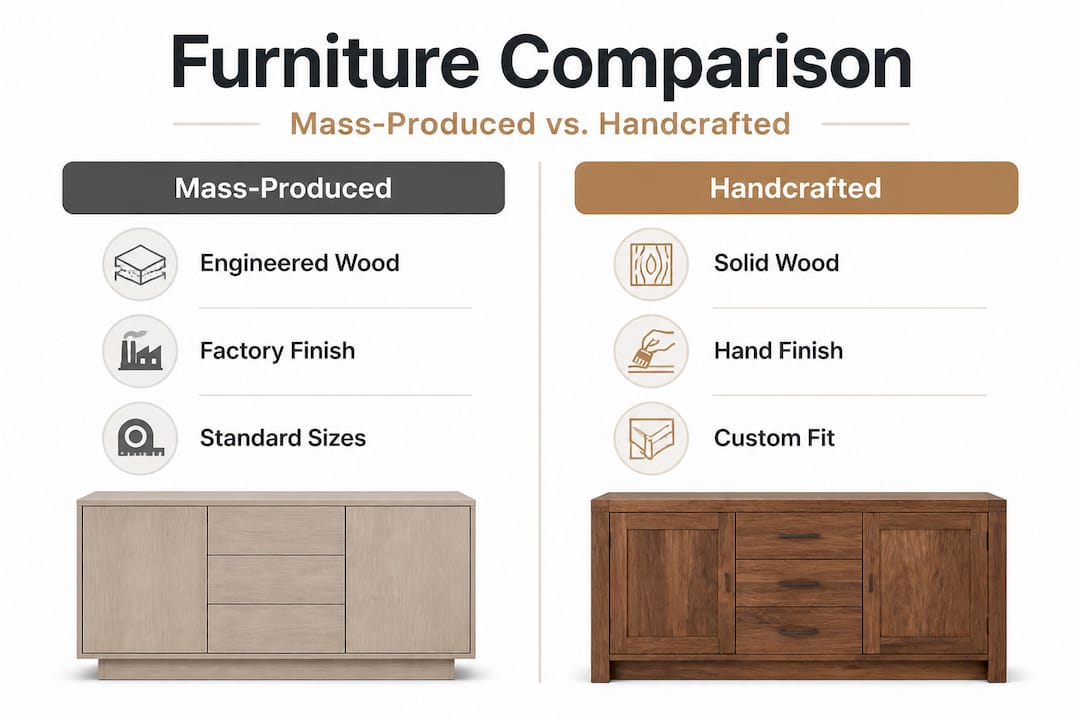
The cost comparison deserves honest attention. Handcrafted furniture does cost more upfront. But when you factor in replacement costs, the math often shifts. A mass-produced entryway cabinet bought for $300 and replaced every seven years costs more over two decades than a well-made custom piece that lasts indefinitely. Modern sustainable interiors increasingly recognize this lifecycle value as both an economic and environmental argument for quality.
Entryways specifically benefit from bespoke design in ways other rooms don’t. Every Maryland home has a slightly different layout, doorway width, and traffic pattern. A mudroom bench built to your exact wall dimensions, with hooks at the right height for your family’s use, and storage sized for your specific gear, functions at a level that off-the-shelf products simply cannot reach. Exploring the process of creating unique furniture starts with exactly that kind of intentional thinking about your specific needs.
What you gain with a handcrafted entryway piece:
- A piece built to the precise dimensions of your space
- Materials selected for your climate and use patterns
- Finishes that coordinate with your existing home design
- A direct relationship with the person who built it
- Confidence that it will still be functional and beautiful in 20 years
How to spot quality craftsmanship in entryway furniture
A fair question remains: how can you tell the difference? This section offers practical steps for anyone wanting to gauge true craftsmanship in person. Not every piece labeled “handcrafted” deserves the title, and knowing how to evaluate quality protects your investment.
Research on craftsmanship evaluation shows that quality assessments are unreliable without trained judgment, meaning that casual shoppers benefit greatly from learning specific, concrete criteria before visiting showrooms or reviewing portfolios.
Steps to evaluate craftsmanship in entryway furniture:
- Examine the joinery. Look at corners and joints. Dovetail and mortise-and-tenon connections are signs of skilled woodworking. Staples, nails, and visible glue blobs are red flags.
- Check the wood grain. Solid wood shows consistent grain patterns throughout a piece. Veneers look perfect and uniform because they’re a thin layer over cheaper substrate material.
- Test the weight. Lift a corner if you can. Quality solid wood furniture is noticeably heavier than pieces built from engineered materials.
- Open drawers and doors. They should glide smoothly without sticking, rattling, or misalignment. Poor tolerances are a sign of rushed production.
- Inspect the finish. A hand-applied finish has subtle depth and slight variation. Spray-on factory finishes look completely uniform and can feel almost plastic-like.
- Ask for a portfolio. Any skilled craftsperson should be willing and proud to show you previous work. Browse the custom furniture gallery to see examples of finished entryway pieces and understand what quality looks like in practice.
| Assessment point | What quality looks like | What to avoid |
|---|---|---|
| Joinery | Tight, interlocking, no gaps | Staples, visible nails, loose corners |
| Surface finish | Smooth with visible hand-applied depth | Plastic sheen, uniform perfection |
| Hardware | Solid metal, operates smoothly | Hollow feel, stiff or wobbly operation |
| Wood type | Solid hardwood throughout | Particleboard core with veneer |
| Back panels | Finished or solid wood | Thin cardboard-like material |
Pro Tip: Ask the craftsperson specifically which species of wood they’re using and why. A knowledgeable furniture maker will have clear reasons for their material choices, relating to grain, hardness, finish compatibility, and how the wood behaves in your specific climate. Vague answers about “quality wood” without specifics are worth treating with skepticism.
Personalizing your entryway: Applying craftsmanship principles
Once you know how to spot quality, the next step is bringing those principles into your own entryway design. This is where the real excitement begins, because a truly personalized entryway can change how your whole home feels every single day.
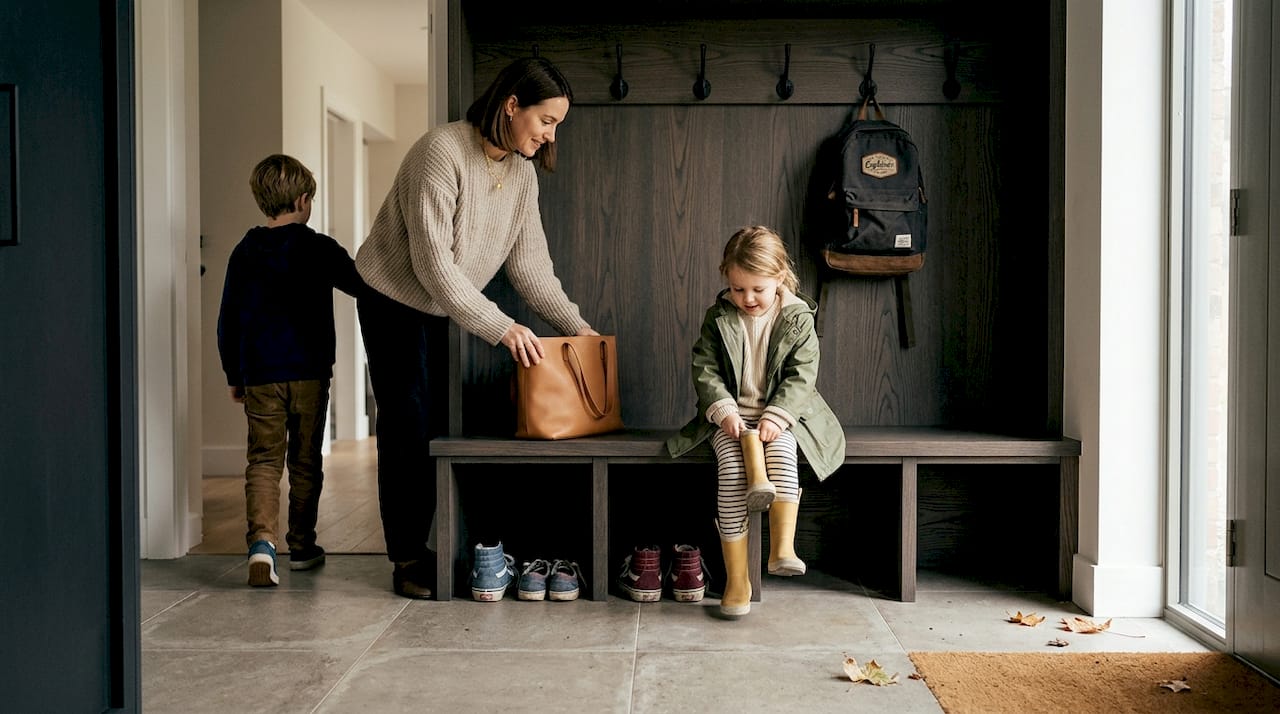
Start by assessing what your entryway actually needs to do. A family with young children needs very different features than a couple who works from home. Maryland homes near the Chesapeake deal with mud, wet gear, and humid summers. A mountain cabin near Deep Creek has different storage demands than a rowhouse in Annapolis. Your entryway furniture should be designed around your real life, not a catalog photo.
The growing preference for meaningful interiors is largely driven by homeowners who finally stopped tolerating furniture that almost fits and started investing in pieces built exactly for them. When you commission custom entryway furniture, you make decisions about dimensions, wood species, finish color, hardware style, and functional features like built-in charging stations, shoe drawers, or bench seat height.
Explore custom entryway solutions designed around real Maryland homes to understand how those decisions come together. The best outcomes happen when the homeowner and craftsperson talk through actual daily routines before a single measurement is taken. That conversation is itself part of the craftsmanship process.
There are also practical ways to optimize a small or awkward entryway using multi-functional design tips that skilled craftspeople apply naturally. A narrow entry hall, for example, can accommodate a custom built-in bench with flip-top storage, hooks mounted at three different heights for adults and children, and a floating shelf above. None of that is possible with standard store sizes.
Ideas for personalizing your entryway through craftsmanship:
- Built-in bench with storage: Maximizes a tight space while hiding shoes, bags, and seasonal gear
- Custom mud locker system: Individual compartments for each family member, fitted with hooks, shelves, and optional doors for a cleaner look
- Artisan coat rack: A single statement piece in a bold wood species that anchors the whole entryway design
- Custom shelving and console table: Ties together style and function for entries that double as display spaces
- Material matching: Matching the wood tone and finish to your stair railing or trim creates a sense of cohesion that no off-the-shelf piece can achieve
Balancing budget with quality is a real conversation worth having. Many craftspeople, ourselves included, will work with you to prioritize where the investment makes the most impact, whether that’s a standout mud locker system or a custom bench that anchors the space.
Why true craftsmanship creates lasting value in your home
Here’s the perspective most articles on furniture skip entirely: craftsmanship isn’t primarily about aesthetics. It’s about time.
We’ve worked with Maryland families for over 20 years, and the pattern is consistent. Homeowners who invest in genuinely handcrafted entryway furniture talk about those pieces differently than everything else in their home. They become reference points. “That bench was here when we brought the kids home from the hospital.” “My father-in-law built something just like this.” These aren’t just objects; they’re anchors to moments and people.
Mass-produced furniture can’t do that, not because it’s cheaper, but because it wasn’t made with attention. The shortcuts taken in factories eliminate the very thing that makes an object meaningful. When a skilled craftsperson cuts a dovetail joint, they’re making a decision that will still be holding your family’s weight in 40 years. That decision carries weight of its own kind.
There’s also an uncomfortable truth about the “custom” label in today’s market. Many companies call their work handcrafted while using CNC routers for every cut and unskilled labor for assembly. The result looks fine at first glance. It falls apart under real use. Learning to distinguish genuine craftsmanship from marketing language is not cynicism; it’s wisdom. We encourage every homeowner to visit our showroom, ask hard questions, and look at the custom masterpieces we’ve built before committing to anything. That kind of transparency is itself a mark of real craftsmanship.
Trends in interior design come and go faster than ever. The farmhouse aesthetic gave way to Scandinavian minimalism, which is now giving way to warm maximalism. Quality craftsmanship outlasts every one of those cycles. A beautifully made walnut bench with hand-rubbed oil finish looked right in 1990, looks right now, and will look right in 2040. That’s the investment case for craftsmanship that no trend report can make for you.
Bring craftsmanship into your Maryland home
If this article has shifted how you think about your entryway, you’re ready to take the next step. The difference between a mediocre entryway and a truly welcoming one often comes down to a single well-made piece built with real intention.
At Furniture Design Group, we’ve spent over two decades helping Maryland homeowners create entryways that work as hard as their families do and look beautiful doing it. Our custom furniture services start with a real conversation about your space, your routines, and your vision. From there, every decision, including material, dimension, finish, and hardware, is made with your home specifically in mind. Browse our custom furniture masterpieces to see the range of what’s possible, or view our gallery for finished project inspiration. We’d love to help you build something worth keeping.
Frequently asked questions
How can I tell if entryway furniture is truly handcrafted?
Look for visible joinery details like dovetails or mortise-and-tenon joints, solid wood construction, and hand-applied finishes, none of which appear in factory-made pieces.
Why is craftsmanship more expensive than store-bought furniture?
Handcrafted pieces require premium solid materials and skilled labor invested across many hours, producing a result that outlasts and outperforms standard store furniture by decades.
Are there eco-friendly benefits to choosing handcrafted entryway furniture?
Yes, because handcrafted furniture lasts far longer than mass-produced alternatives, you buy less often, generate less waste, and typically support craftspeople who source wood responsibly.
Can I customize handcrafted furniture for a small Maryland entryway?
Absolutely. Skilled craftspeople tailor every dimension, finish, and functional feature to your exact space, making custom pieces ideal for awkward layouts or tight entryway halls.