
TL;DR:
- Custom Maryland furniture is tailored to specific architectural styles, climate, and lifestyle needs.
- Local craftsmanship ensures durability through advanced joinery and climate-resistant materials.
- Working with local makers involves collaboration from design to installation, ensuring client satisfaction.
Walk into any big-box store and you’ll find entryway furniture that was designed for no one in particular. It doesn’t account for your ceiling height, your mudroom layout, the way Maryland summers push humidity into every corner of your home, or the fact that three kids and a dog are coming through your front door every afternoon. Generic furniture fails Maryland homeowners in ways that are easy to overlook until you’ve already lived with the frustration. This article breaks down exactly why local, custom furniture makers deliver a fundamentally different outcome and how you can make that work for your home.
Table of Contents
- The unique benefits of local furniture makers in Maryland
- Craftsmanship that stands apart: Materials and methods
- From concept to installation: The client journey with Maryland makers
- How to choose the right local furniture maker for your entryway project
- Why most homeowners undervalue the impact of local makers
- Bring your entryway vision to life with Maryland’s custom furniture leaders
- Frequently asked questions
Key Takeaways
| Point | Details |
|---|---|
| Personalized design advantage | Local furniture makers collaborate to craft entryway solutions unique to Maryland homeowners. |
| Superior craftsmanship | Techniques like dovetail joinery and premium materials ensure lasting durability and style. |
| Smooth client journey | Designing, building, and installing a custom piece typically spans 8 to 16 weeks with expert guidance. |
| Smart selection tips | A clear checklist and the right questions help you choose the best Maryland furniture maker. |
The unique benefits of local furniture makers in Maryland
There’s a reason homeowners who invest in custom locally made furniture rarely go back to off-the-shelf alternatives. The difference isn’t just aesthetic. It’s structural, functional, and deeply personal.
When you work with a local maker, you’re not filling out a form and waiting for a container shipment from overseas. You’re sitting across from a craftsperson who asks you what time of day your entryway gets the most traffic, whether you need pull-out drawers for soccer cleats or hooks at a child’s height, and what wood species would complement the trim work you already have. That kind of direct collaboration simply doesn’t exist when you order from a national retailer.
Maryland homes come with their own architectural personality. Whether you’re in a Federal-style row house in Baltimore, a Colonial in Annapolis, or a craftsman bungalow in Silver Spring, your entryway has specific proportions and character that deserve a furniture response. Local makers understand this because they live here too. They know the quirks of older Maryland construction, the ceiling heights that vary from decade to decade, and the spatial relationships that make an entryway feel generous or cramped.
Climate is another critical factor that most homeowners don’t think about until it’s too late. Maryland sits in a zone where humidity swings dramatically between summer and winter. Wood that isn’t selected and finished for this environment will expand, contract, warp, and eventually fail. Local craftspeople factor this into every decision they make about materials and joinery. As noted in expert construction guidance, using dovetail joinery and solid hardwoods for humidity resistance is standard practice among skilled local makers, while mass-produced pieces often skip these details entirely.
Beyond the product itself, working with a local maker supports the Maryland economy in a meaningful way. Every dollar spent with a local craftsperson circulates through local suppliers, local finishers, and local tradespeople. You’re also getting a level of ongoing accountability that a national brand simply can’t offer. If a drawer starts sticking two years down the road, you’re calling someone who knows your project by name, not waiting on hold with a customer service department.
Key advantages of choosing a local Maryland furniture maker:
- Designs tailored to your exact floor plan and architectural style
- Materials chosen specifically to handle Maryland’s humidity cycles
- Face-to-face collaboration at every design stage
- Post-installation service and accountability from someone local
- Contribution to the regional craft economy and sustainable sourcing
“The best custom furniture doesn’t just fill a space. It solves a problem, reflects a lifestyle, and grows more satisfying over time.”
Pro Tip: Before committing to any maker, visit their workshop or showroom in person. Seeing how they store their wood, organize their finishing area, and present completed work tells you more about their standards than any website can.
Craftsmanship that stands apart: Materials and methods
Now that you grasp the benefit of working with local makers, let’s see how their craftsmanship justifies the investment.
The gap between a custom-built entryway piece and a mass-market alternative isn’t just about price. It’s about the decisions made at every stage of construction, decisions that determine whether your furniture lasts five years or fifty.
Start with joinery. Dovetail joinery, the interlocking wedge-shaped cuts used at corners and drawer boxes, creates a mechanical bond that resists pulling apart under daily stress. Compare this to the pocket screws, staples, and dowels that most factory furniture relies on. Those methods are faster and cheaper, but they’re also significantly weaker. In an entryway where drawers are pulled open dozens of times a day, that difference adds up quickly. Local makers who craft custom masterpieces use dovetail joinery as a baseline, not an upgrade.
Material selection is equally important. Furniture-grade plywood, as opposed to the lower-grade sheets used in mass production, uses more plies with fewer voids, meaning it holds screws better, resists warping more effectively, and provides a smoother surface for finishing. Paired with solid hardwood components at the faces, edges, and structural joints, the result is a piece that behaves predictably across Maryland’s seasonal humidity shifts. Woods like white oak, hard maple, and cherry have been used in fine furniture for centuries precisely because they respond well to humidity changes without catastrophic cracking or splitting.
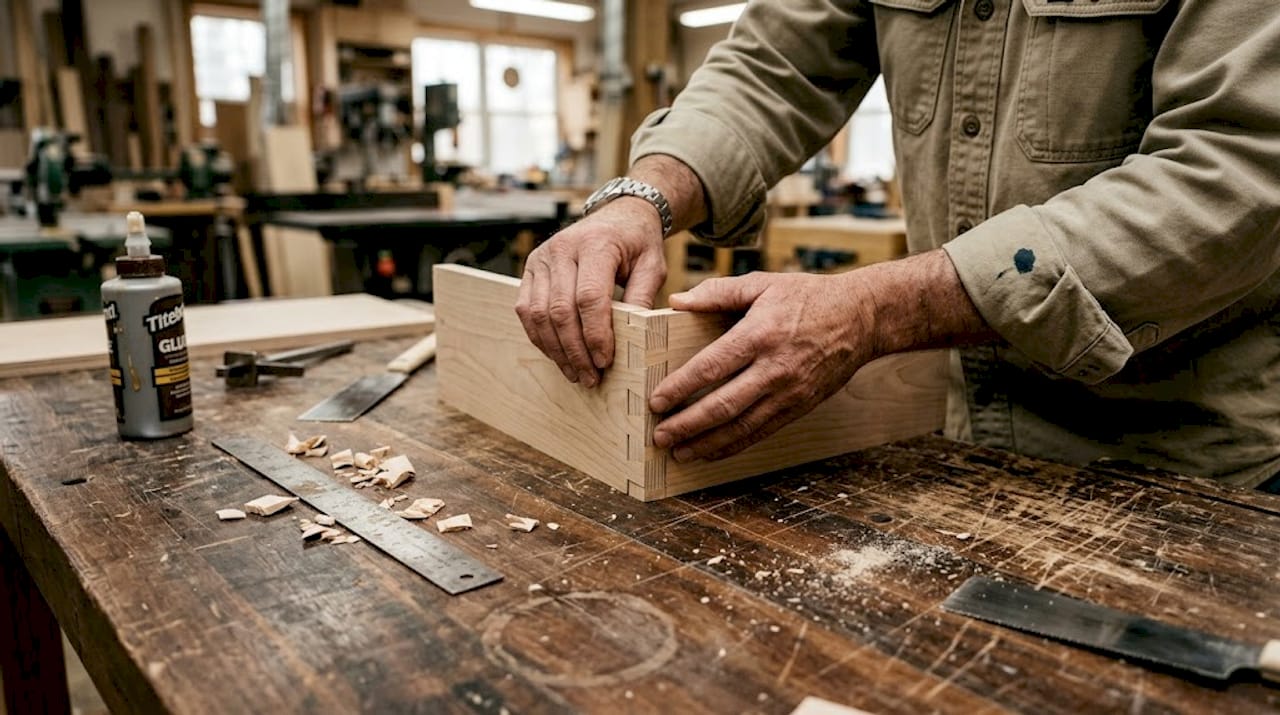
Precision matters in ways that are easy to underestimate. Local craftspeople working at the top of their trade regularly achieve tolerances within 1/16 of an inch, meaning joints close cleanly without filler, seams line up perfectly, and drawers slide with the quiet resistance that signals quality. That kind of precision isn’t vanity. It’s the reason a well-built piece feels solid rather than rattly, and why it continues to function properly years after installation.
Comparison: Local custom vs. mass-market furniture construction
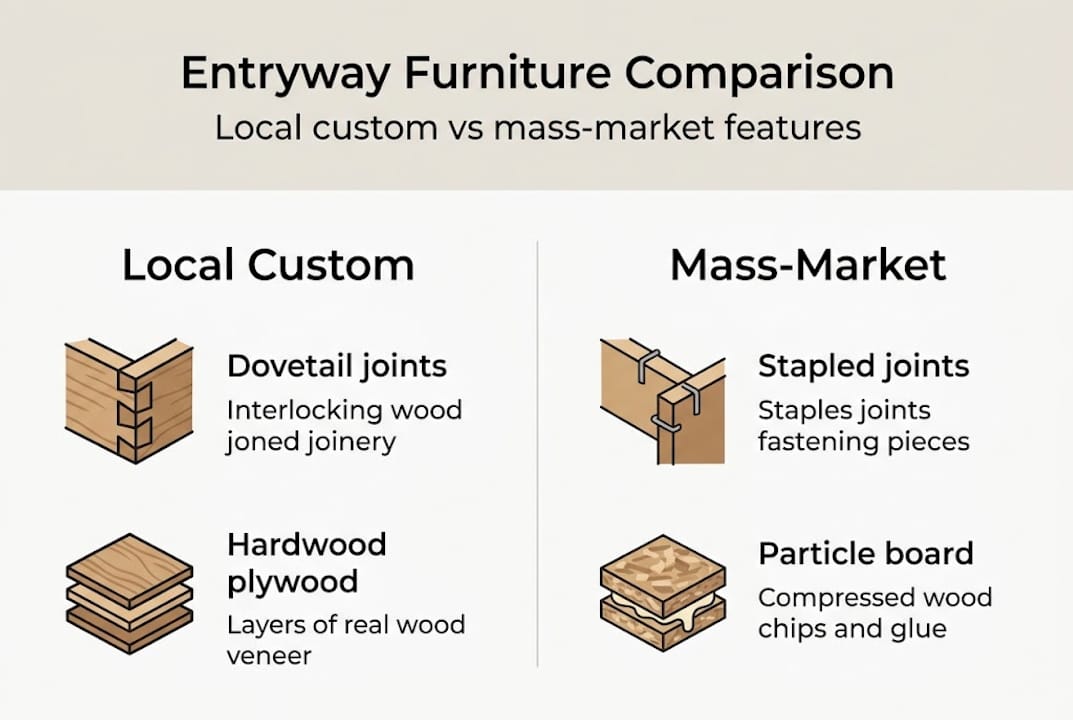
| Feature | Local custom furniture | Mass-market furniture |
|---|---|---|
| Joinery method | Dovetail, mortise and tenon | Pocket screws, staples, dowels |
| Wood materials | Solid hardwoods, furniture-grade plywood | Particleboard, MDF, low-grade plywood |
| Fit and precision | Within 1/16 inch, no filler needed | Factory tolerances, filler often applied |
| Humidity resistance | Engineered for Maryland climate | Generic production, no regional adaptation |
| Finish quality | Multiple coats, hand-sanded between layers | Spray-line application, minimal prep |
| Post-sale service | Direct contact with maker | National support line |
Studies in woodworking longevity consistently point to joinery and material quality as the two most important variables in furniture lifespan. The use of solid hardwoods paired with precision joinery isn’t just tradition. It’s the most reliable method for producing furniture that survives real-world use.
From concept to installation: The client journey with Maryland makers
Appreciating fine craftsmanship is one thing. Participating in the creation process is another.
If you’ve never worked with a custom furniture maker before, the process might feel unfamiliar. The good news is that experienced Maryland makers guide you through it clearly, and the collaboration itself is often one of the most satisfying parts of the project. Here’s what the journey typically looks like from start to finish.
-
Initial consultation. Your maker visits your entryway or you meet at their showroom with photos and measurements. This conversation goes deeper than dimensions. You talk about how the space is used, what frustrates you about your current setup, how much storage you actually need, and what style feels right for your home. Good makers ask questions you haven’t thought to ask yourself.
-
Design development. Based on the consultation, your maker produces drawings or digital renderings showing how the piece will look in your space. This stage often involves two or three rounds of revisions. You might want the hooks moved lower, the bench deeper, or the finish shifted from matte to satin. All of that gets worked through before a single board is cut.
-
Material selection. You’ll review actual wood samples and finish options, not just pictures. Seeing how white oak looks under your entryway lighting versus how cherry reads in the same space makes a real difference. This step ensures the finished piece integrates naturally with your existing home.
-
Production. This is where the craftsperson goes to work. As the custom furniture process confirms, production typically runs 8 to 16 weeks depending on complexity and scheduling. Some makers provide progress photos or welcome check-in visits to the workshop, which gives you confidence and keeps the project feeling real.
-
Installation. Your maker handles installation directly, ensuring everything fits as designed. Any on-site adjustments are made by the people who built the piece, not a subcontracted installer who has never seen the project before.
-
Post-install follow-up. Reputable local makers check in after a few weeks to confirm everything is working as expected and to address any settling or adjustment needs.
The entire timeline, as expert industry data confirms, runs 8 to 16 weeks with active client collaboration throughout. That time investment pays off in a result that feels genuinely made for you.
Pro Tip: Bring inspiration photos to your first consultation, but also bring photos of what you don’t like. Knowing what to avoid is just as useful to a designer as knowing what to pursue.
How to choose the right local furniture maker for your entryway project
As you approach a project, choosing the right partner is just as important as the design itself.
Not every maker who calls themselves a custom furniture specialist has the skills or practices to justify that label. Before you commit to a relationship, do your homework. Here’s what to look for and what to watch out for.
What to look for in a quality Maryland furniture maker:
- A portfolio that shows completed entryway projects, not just raw woodwork
- Willingness to let you visit their workshop or showroom in person
- Clear, specific answers about the materials they use and why
- A written proposal that includes timeline, materials, and milestones
- References from past clients who had similar projects completed
- Evidence of humidity-resistant practices and local climate awareness
Red flags to avoid:
- Vague answers when you ask about wood species or joinery methods
- No written contract or timeline provided upfront
- Pressure to decide quickly without seeing portfolio examples
- Inability to explain why they charge what they charge
- No post-installation service or follow-up offered
Questions to ask and what strong answers look like:
| Question | What a strong answer sounds like |
|---|---|
| What joinery methods do you use? | “We use dovetail joinery on all drawer boxes and mortise-and-tenon for structural frames.” |
| How do you handle Maryland humidity? | “We select wood species and finishes specifically rated for humid climates and allow proper acclimation time.” |
| What’s the production timeline? | “Typically 8 to 16 weeks from approved design to installation, depending on complexity.” |
| Can I visit your workshop? | “Absolutely. We encourage it and we’ll show you materials in progress.” |
| What happens if something needs adjustment after install? | “We follow up within 30 days and handle any needed adjustments at no charge.” |
Strong Maryland furniture specialists will answer all of these questions without hesitation because they genuinely know their process and stand behind it. It’s worth noting that makers who use dovetail joinery, furniture-grade plywood, and solid hardwoods should be able to explain exactly why these choices matter and how they apply to your specific project.
A written contract protects both parties and signals that a maker operates professionally. It should include the agreed design, materials list, payment schedule, production timeline, and post-installation terms. Any maker unwilling to put these things in writing is a maker worth walking away from.
Why most homeowners undervalue the impact of local makers
With actionable selection tips in mind, it’s worth reconsidering the real value behind local craftsmanship.
Here’s the uncomfortable truth: most homeowners think of custom furniture as a luxury rather than a solution. That framing costs them. When your entryway doesn’t work, it doesn’t just look bad. It adds friction to every morning and every evening. You’re fighting with a bench that’s the wrong height, hooks that are in the wrong place, and storage that doesn’t actually fit your family’s gear. Those small daily frustrations compound over years.
The benefits of custom design go beyond aesthetics. A well-designed entryway piece solves real architectural challenges, like the odd alcove that no standard piece fits, or the load-bearing wall that prevents you from adding a closet. Custom work doesn’t fight your home’s structure. It works with it.
Entryways are also the first and last space you experience every day. Their functional and emotional impact on your home life is disproportionately large for their square footage. A beautifully crafted, perfectly fitted piece changes how you feel when you leave the house and when you return. That’s not a luxury. That’s a smart, long-term investment in daily quality of life. Custom pieces also hold their form and finish far longer than mass-market alternatives, which means they add genuine resale value rather than being replaced every five to seven years.
Bring your entryway vision to life with Maryland’s custom furniture leaders
Once you recognize the true value of local expertise, taking the next step is easy.
At Furniture Design Group, we’ve spent over 20 years helping Maryland homeowners transform entryways from afterthoughts into the most functional, welcoming spaces in their homes. We’re a family-owned team that takes every project personally, from the first consultation to the final installation.
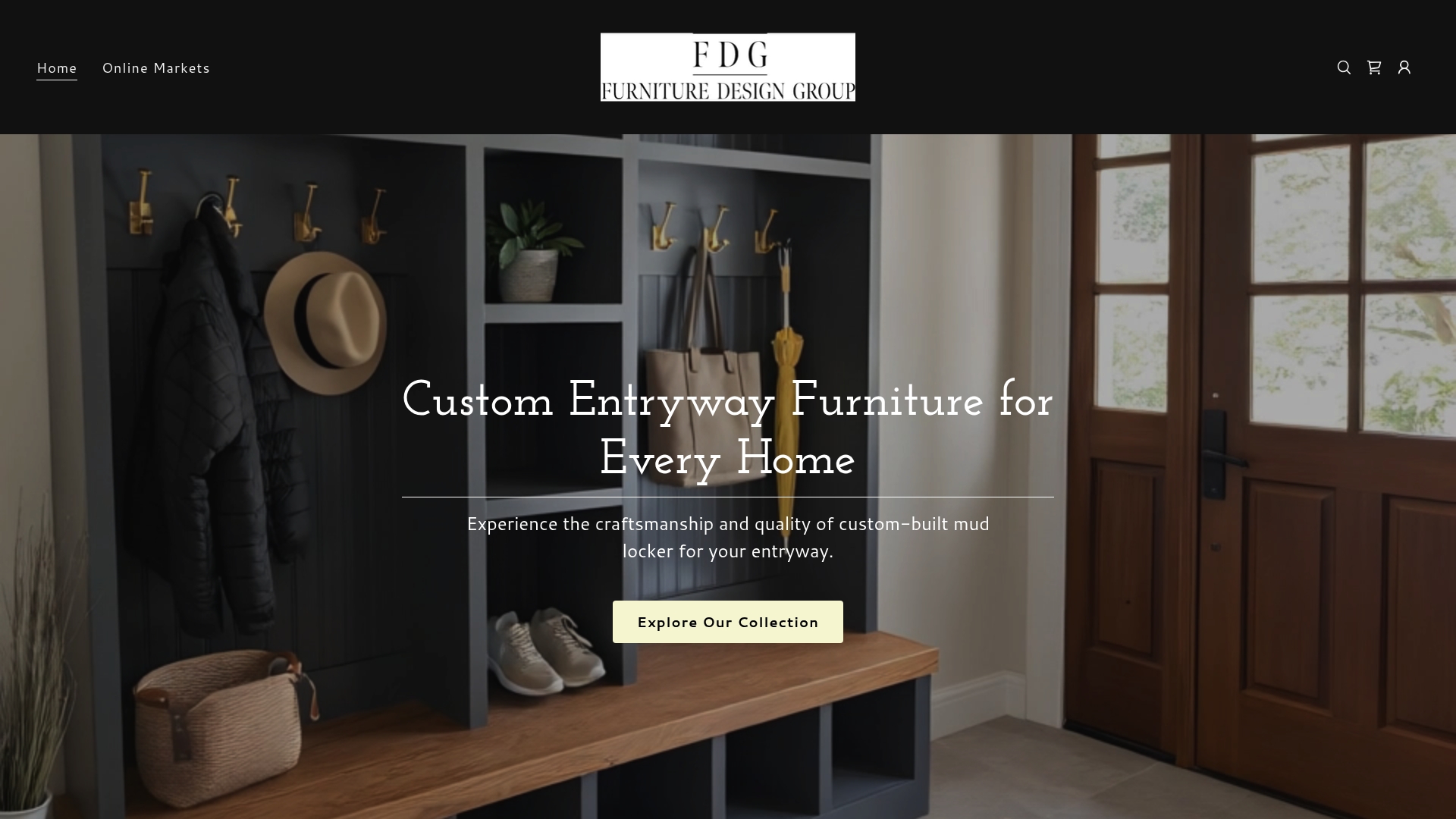
If you’re ready to see what’s possible, we invite you to browse our portfolio of creating custom entryway furniture and visit our showroom to experience the quality firsthand. Whether you need a mud locker for a busy family or an elegant storage bench for a formal foyer, we’d love to hear about your project. Reach out by phone, email, or through our website to start the conversation today.
Frequently asked questions
How long does it take to create custom entryway furniture with a local Maryland maker?
It usually takes 8 to 16 weeks from initial consult to installation, depending on client collaboration and design complexity. More involved designs with multiple finishes or integrated storage systems typically fall toward the longer end of that range.
What makes local furniture more durable for Maryland homes?
Local makers use techniques like dovetail joinery and solid hardwoods for humidity resistance, which result in greater longevity and fewer repairs. These material and method choices are specifically adapted to Maryland’s seasonal climate swings.
Can local makers customize furniture to fit unique Maryland entryways?
Yes, local experts collaborate directly with clients to tailor designs to the unique dimensions, needs, and aesthetics of Maryland entryways. As expert guidance confirms, precision tolerances of 1/16 of an inch mean every piece fits cleanly without filler or compromise.