
TL;DR:
- Material quality and proper joinery are essential for durable custom entryway furniture in Maryland’s climate.
- Using kiln-dried hardwoods like white oak or maple ensures resistance to humidity-related warping and cracking.
- Verifying certifications, craftsmanship, and specifying materials upfront prevent costly failures over time.
The word “custom” carries a lot of weight. Homeowners and interior designers in Maryland often assume that a custom-built entryway piece automatically means superior quality. But here’s the uncomfortable reality: a beautifully designed mud locker or entryway bench can warp, crack, or fall apart within a few years if the wrong materials were used. Maryland’s climate, with its humid summers and cold, dry winters, is particularly unforgiving. The materials your builder chooses, and how they’re treated and joined, will determine whether your investment lasts a decade or a lifetime. This guide breaks down exactly what to look for, ask for, and specify.
Table of Contents
- Why material selection is crucial for custom furniture durability
- Best wood species, metals, and composites for Maryland entryways
- Joinery, veneers, and construction: Craftsmanship makes materials work
- How to evaluate and specify materials for your custom furniture project
- The overlooked truths about custom furniture materials
- Bring your vision to life with Maryland’s custom furniture experts
- Frequently asked questions
Key Takeaways
| Point | Details |
|---|---|
| Material quality is essential | High-quality, properly dried materials are the foundation of durable custom entryway furniture. |
| Craftsmanship must match materials | Even premium materials fail if assembled with poor joinery or shortcuts. |
| Climate drives material choice | Maryland’s humidity and temperature swings require moisture-resistant and strong materials paired with quality finishes. |
| Ask for documentation | Request kiln-drying and durability test certificates for peace of mind when ordering custom pieces. |
Why material selection is crucial for custom furniture durability
Most furniture failures are not design failures. They’re material failures. A stunning piece with the wrong wood species, improperly dried lumber, or cheap adhesives will begin to show problems within a few seasons. Warping, splitting, drawer misalignment, and joint separation are all classic signs of poor material choices, not poor design.
The single most important technical factor is moisture content. Wood is a living material, even after it’s been milled. It expands and contracts based on the humidity around it. If lumber isn’t properly kiln-dried before it’s used, it will continue to release moisture after the piece is built, causing movement that no joinery can fully contain. Kiln-dried to 6-8% moisture content per ASTM D4442 is the standard that prevents warping in finished furniture.
Beyond moisture, durability testing matters. The ISO 7170 standard puts furniture through 20,000 or more simulated use cycles to assess structural performance. Pieces that meet this benchmark are engineered to handle real-world use, not just look good in a showroom.
Here’s a quick comparison of common wood types used in entryway furniture:
| Wood type | Hardness | Moisture resistance | Best for |
|---|---|---|---|
| White oak | High | Excellent | Full entryway units, mud lockers |
| Maple | High | Good | Drawer boxes, shelving |
| Pine | Low | Poor | Decorative accents only |
| MDF | N/A | Poor | Not recommended for entryways |
| Poplar | Medium | Fair | Interior framing, painted pieces |
“The difference between furniture that lasts 5 years and furniture that lasts 50 often comes down to whether the builder followed material standards or cut corners on drying and grading.”
For furniture durability essentials, the foundation is always material integrity, not surface appearance.
Pro Tip: When speaking with your builder, ask specifically whether they use mortise-and-tenon or dovetail joinery versus adhesives alone. Adhesives fail over time, especially in humid environments. Mechanical joinery holds.
- Warping is almost always caused by improperly dried lumber
- Splitting typically signals low-grade or incorrectly oriented wood grain
- Joint separation points to over-reliance on glue without mechanical reinforcement
- Surface finish failures often trace back to poor substrate preparation
Best wood species, metals, and composites for Maryland entryways
Maryland sits in a climate zone that sees genuine seasonal extremes. Summers bring high humidity that swells wood fibers. Winters bring dry indoor heat that contracts them. This cycle, repeated year after year, is what separates materials that perform from those that don’t.
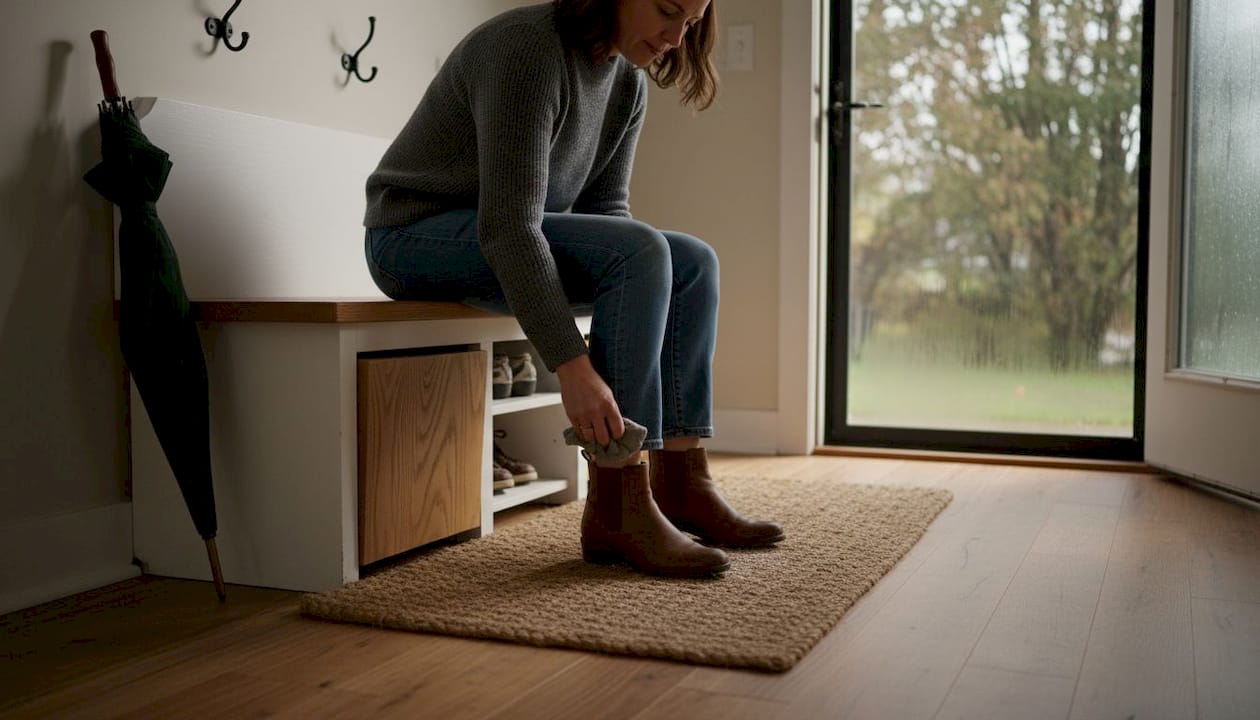
For solid wood, hardwoods with a Janka rating above 950 lbf are the starting point. High-humidity entryways require hardwoods above this threshold paired with protective finishes to resist moisture-driven movement. White oak is the top performer for Maryland conditions. It’s dense, naturally resistant to moisture, and takes stain and finish exceptionally well. Hard maple is a close second, particularly for drawer boxes and interior components.
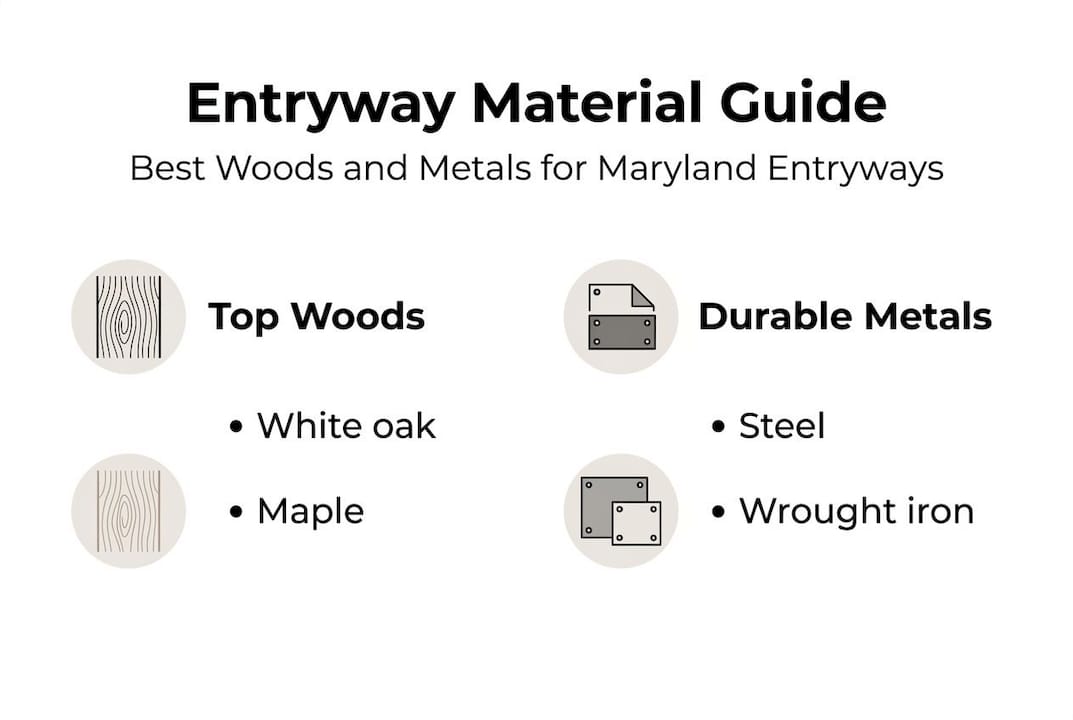
Here’s how the top contenders compare:
| Material | Janka rating | Humidity performance | Recommended use |
|---|---|---|---|
| White oak | 1,360 lbf | Excellent | Full units, doors, frames |
| Hard maple | 1,450 lbf | Good | Drawers, shelving |
| Walnut | 1,010 lbf | Good | Accent panels, tops |
| Steel/iron | N/A | Excellent (coated) | Load-bearing frames, hooks |
| Baltic birch plywood | N/A | Good | Carcass construction |
Metal framing and hardware deserve more attention than they typically get. Steel or wrought iron components add structural strength to high-traffic areas like coat hook rails and bench frames. Powder-coated finishes protect against moisture and scratching. When selecting robust materials, pairing hardwood with metal accents creates both visual interest and structural reliability.
Engineered woods, specifically Baltic birch plywood with a multi-ply core, are a legitimate choice for carcass construction. They offer dimensional stability that solid wood can’t always match in large panel applications. Avoid standard particleboard entirely in entryway applications. It absorbs moisture rapidly and loses structural integrity fast.
As for stone and marble, they can work beautifully as bench tops or accent surfaces. However, using marble for luxury entryway pieces requires proper sealing and a structurally sound base, since marble is heavy and unforgiving of any frame flex.
Pro Tip: A quality surface finish, whether oil, lacquer, or conversion varnish, is not cosmetic. It’s a moisture barrier. On wood components, it significantly extends the life of the material by slowing the absorption and release of humidity.
Joinery, veneers, and construction: Craftsmanship makes materials work
You can source the finest white oak in Maryland and still end up with a failing piece if the construction is poor. Materials and craftsmanship are inseparable. One without the other is a gamble.
Joinery is where craftsmanship becomes measurable. Mortise-and-tenon and dovetail joints enhance structural integrity far beyond what staples or glue alone can achieve. These techniques create mechanical locks between wood components that resist racking, pulling, and twisting forces. In a busy entryway where doors slam, bags get dropped, and children hang off coat hooks, that mechanical strength is not optional.
Here are the joinery methods worth knowing:
- Mortise-and-tenon: The gold standard for frame construction. One piece slots into a cavity in the other, creating a joint that handles both compression and tension.
- Dovetail: Ideal for drawer boxes. The interlocking shape resists pulling forces, which is exactly what drawers experience daily.
- Dowels: A reliable middle-ground option when properly sized and glued, though less robust than the above two.
- Pocket screws or staples: Acceptable for interior, non-structural components only. A red flag if used at primary joints.
Veneering is another area where quality varies wildly. Veneer over high-grade plywood with multi-ply cores offers genuine stability for large panels, reducing the wood movement that solid wood experiences. The key word is substrate. If the core is particleboard rather than quality plywood, the veneer will eventually bubble, peel, or crack as the substrate fails.
“The substrate beneath a veneer tells you more about a piece’s future than the face wood itself. Always ask what’s underneath.”
For exceptional furniture craftsmanship, the details inside the piece matter as much as the surface you see.
Pro Tip: Pull open a drawer and look at the corners. Dovetail joints are visible and distinctive. If corners are held together with staples or simple butt joints, that’s a sign of production-grade construction, not bespoke quality.
How to evaluate and specify materials for your custom furniture project
Knowing the right materials is only useful if you can translate that knowledge into your actual project. Here’s a practical framework for working with your furniture maker.
- Request a material specification sheet. Before any work begins, ask your builder to document every material they plan to use: wood species, grade, plywood type, hardware brand, and finish product. This should be part of your written agreement.
- Ask for kiln-drying certification. Kiln-dried certification per ASTM D4442 or ISO 7170 test results are legitimate proof of material integrity. A quality builder will have these available or be able to obtain them.
- Have the joinery conversation early. Ask specifically which joinery method will be used for primary structural connections, drawer boxes, and panel attachments. Get the answer in writing.
- Visit the workshop if possible. Seeing how a builder works tells you more than any brochure. Look at the lumber they stock, the equipment they use, and how they store materials.
- Don’t let price override longevity. The most common trap is choosing a builder based on a lower quote without understanding what corners were cut. A piece that fails in three years costs more than a well-built piece that lasts thirty.
- Document every decision. Every material choice, finish selection, and joinery specification should appear in your custom furniture project planning contract. Verbal agreements disappear.
Pro Tip: Add a clause to your contract specifying that substitutions to agreed materials require written approval. This protects you if supply chain issues arise mid-project and a builder is tempted to swap a specified hardwood for a cheaper alternative.
For custom furniture project planning, the contract is your protection and your blueprint.
The overlooked truths about custom furniture materials
After more than 20 years of building bespoke entryway furniture for Maryland homes, we’ve seen a pattern that frustrates us. Homeowners spend months choosing the right design, the right style, the right color. Then they hand the project to a builder without asking a single question about materials or joinery.
The word “custom” has become a marketing term, not a quality guarantee. Most custom furniture fails because buyers trust the label instead of specifying what goes into the piece. A builder can call something custom and still use kiln-dried pine, particleboard cores, and pocket-screw joinery. Technically custom. Practically, a disappointment.
Maryland’s climate is particularly unforgiving of these shortcuts. The humidity swings between seasons expose every weakness in a material or joint within just a few years. What looks perfect in June can show gaps and warping by February.
What seasoned designers and homeowners wish they’d known sooner is simple: the conversation about materials needs to happen before the design conversation. Nail down the wood species, the moisture content standards, the joinery methods, and the finish system first. Then design around those confirmed choices. The real-world durability lessons we’ve learned point to one truth: a beautiful piece built on the right foundation will still look beautiful in 25 years.
Bring your vision to life with Maryland’s custom furniture experts
Now that you understand what separates lasting entryway furniture from furniture that disappoints, the next step is working with a team that takes material quality as seriously as you do.
At Furniture Design Group, we’ve spent over 20 years crafting bespoke entryway pieces for Maryland homes, with every decision grounded in material integrity and artisanal construction. We specify kiln-dried hardwoods, use mechanical joinery on every structural connection, and document every material choice before a single board is cut. If you’re ready to start a project or simply want to explore what’s possible, visit our guide to Creating Custom Furniture Masterpieces or reach out directly to discuss your entryway vision with our team.
Frequently asked questions
What is the best wood for custom entryway furniture in Maryland?
Kiln-dried hardwoods like white oak or maple, with a Janka rating above 950 lbf, offer the best resistance to Maryland’s humidity and foot traffic.
How can I tell if a piece is made with quality joinery?
Look for visible mortise-and-tenon or dovetail joints at corners and drawer boxes, and avoid pieces where corners are simply stapled or nailed together.
Is veneer ever better than solid wood for large furniture panels?
Yes, veneer over multi-ply plywood can outperform solid wood on large panels by reducing seasonal movement, as long as the core is quality plywood rather than particleboard.
What documentation should I request to confirm material quality?
Ask your builder for kiln-drying certificates per ASTM D4442 and ISO 7170 durability test results to confirm materials meet recognized performance standards.