
TL;DR:
- Choosing durable, moisture-resistant materials like porcelain tile and white oak for floors and furniture bases ensures Maryland entryways withstand daily moisture, grit, and temperature fluctuations. Using a layered system of mats, seals, and custom cabinetry designed for humidity helps prevent damage and prolongs system integrity. Proper material selection and system-wide planning are essential to creating an entryway that remains functional and attractive for years.
The wrong entryway materials can turn Maryland’s rainy springs and snowy winters into a nightmare of warped floors, swollen cabinet bases, and stained wood that never looks clean. Making smart material choices from the start means fewer repairs, easier cleanup, and an entryway that actually holds up to the daily grind of boots, backpacks, and wet umbrellas. Whether you’re starting from scratch or planning a full entryway refresh, this guide walks you through the best flooring, furniture, and finish options that match Maryland’s specific climate realities.
Table of Contents
- Understand your entryway’s challenges
- Essential materials for entryway flooring
- Furniture material decisions: structure, base, and finish
- Materials for challenging Maryland climates
- Final checks: maintenance strategies for lasting entryways
- The crucial detail most homeowners overlook
- Ready to transform your entryway? Custom solutions for every Maryland home
- Frequently asked questions
Key Takeaways
| Point | Details |
|---|---|
| Assess moisture exposure | Always consider how much water, grit, and humidity your entryway faces before selecting materials. |
| Prioritize resilient flooring | Porcelain tile and luxury vinyl offer long-term durability and are easy to maintain in Maryland homes. |
| Choose the right core | Use waterproof materials like white oak and avoid particle board for bases that touch the floor. |
| Zone your materials | Match each surface—base, body, doors—to the moisture it will encounter for best results. |
| Don’t forget upkeep | Use mats, boot trays, and quick cleanups to extend the life of your entryway system. |
Understand your entryway’s challenges
With the importance of entryway material choice clear, let’s pinpoint what your specific entryway will demand.
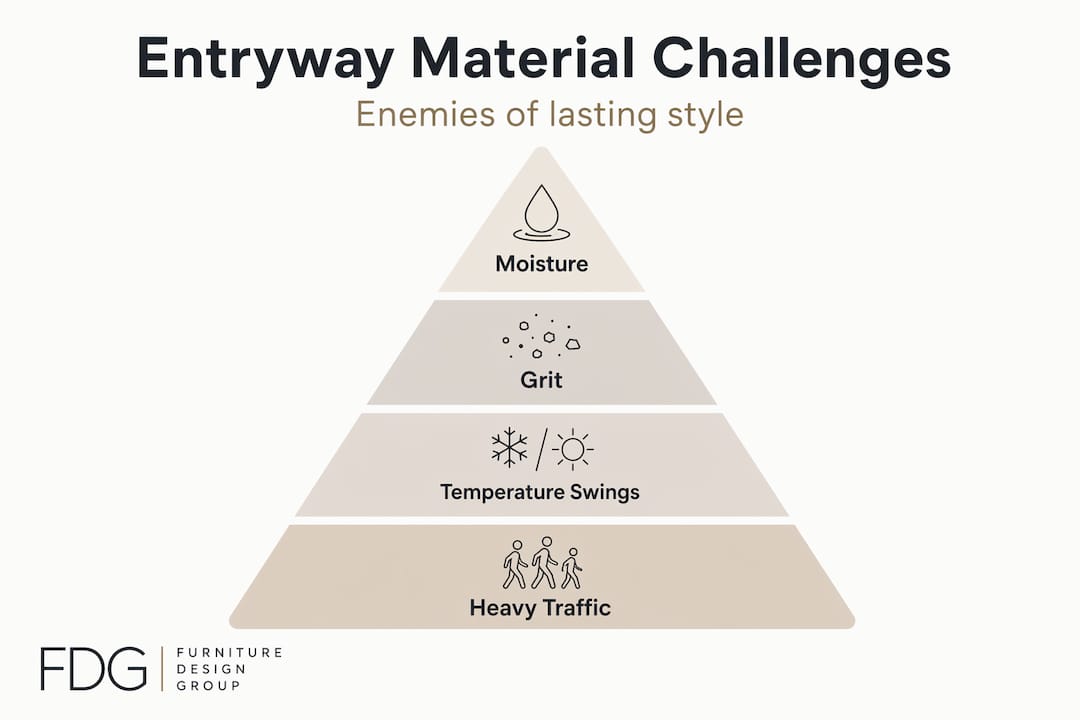
Every Maryland entryway faces a predictable set of enemies: moisture, temperature swings, tracked-in grit, and constant daily foot traffic. Understanding these forces in detail helps you make material choices that don’t just look good on day one but hold up for years.
Maryland’s climate creates a uniquely punishing environment for entryways. Rainy springs bring constant wet foot traffic. Snowy winters mean melting ice, salt residue, and boot mud all hitting your floors and furniture base at once. Summer brings high humidity, especially in Southern Maryland’s coastal areas where salt air accelerates corrosion and moisture damage in materials that might otherwise perform fine inland. Temperature swings between seasons cause materials to expand and contract repeatedly, which stresses joints, finishes, and any material that isn’t dimensionally stable.
Here’s what your entryway is working against every single day:
- Moisture from rain, snow melt, and seasonal humidity
- Grit and debris including sand, salt, dirt, and gravel tracked in on shoe soles
- Temperature fluctuation causing repeated expansion and contraction in materials
- UV exposure near glass-panel doors, fading finishes and degrading some materials
- Heavy impact from bags, sports equipment, and shoe removal
“Entryway flooring must balance durability and moisture resistance because this area receives grit and moisture tracked indoors.” Resilient flooring options like porcelain tile and luxury vinyl are specifically recommended because they meet both demands without constant upkeep.
Staying on top of handling humidity in the home is part of the broader system that protects your entryway materials long term. And for custom furniture recommendations that are built for Maryland’s conditions, working with someone who understands the local climate makes a significant difference.
Pro Tip: Never rely solely on your base material to handle moisture. Use a layered system: a quality outdoor mat outside the door, an absorbent indoor mat just inside, and a boot tray for wet footwear. This combination reduces the moisture load your floor and furniture base have to handle by a substantial amount.
Essential materials for entryway flooring
After scoping the main entryway hazards, let’s dive into the best flooring choices to stand up to Maryland’s daily realities.
Flooring is the first line of defense in any entryway. Choosing the right surface means thinking about more than color and texture. You need to weigh moisture resistance, scratch and grit tolerance, ease of cleaning, and how well the material holds up to seasonal stress. Here’s a direct comparison of the most practical options for Maryland homeowners:
| Material | Moisture resistance | Grit/scratch resistance | Maintenance | Style options |
|---|---|---|---|---|
| Porcelain tile | Excellent | Excellent | Low | Very wide range |
| Ceramic tile | Very good | Good | Low | Wide range |
| Luxury vinyl plank | Very good | Very good | Very low | Wide range |
| Natural stone | Good (sealed) | Very good | Moderate | Limited, premium |
| Hardwood | Poor (unsealed) | Fair | High | Wide range |
| Laminate | Poor | Fair | Moderate | Wide range |
Porcelain tile is widely regarded as the top performer for high-traffic wet zones. It’s dense, non-porous, and virtually immune to the kind of moisture damage that ruins wood or laminate over time. Luxury vinyl plank (LVP) has become a close second because modern LVP handles moisture very well, has a softer feel underfoot, and installs quickly over existing subfloors. Entryway flooring inspiration from custom furniture specialists often integrates flooring choices with the cabinetry and bench materials to create a cohesive, durable system.
If you’re drawn to the warmth of wood or the character of laminate, the risks are real and worth knowing:
- Unsealed hardwood swells, warps, and stains when wet repeatedly
- Laminate’s core material absorbs water at seams and edges, causing bubbling and delamination
- Both require significantly more maintenance and re-finishing over time
- Salt residue from winter boots is particularly damaging to wood finishes
For humidity-resistant materials throughout the home, the same logic applies: select materials engineered to resist what Maryland’s weather delivers.
Practical methods like mats, boot trays, and prompt spill management are part of choosing the right overall material system, not just an afterthought. The best floor material in the world still fails faster without basic protective habits in place.
Pro Tip: For quick daily cleanup, choose a grout color that’s two to three shades darker than your tile. Light grout shows every bit of tracked-in dirt and requires far more scrubbing to keep looking presentable. A mid-tone or charcoal grout dramatically reduces visible grime between cleanings.
Furniture material decisions: structure, base, and finish
With durable and resilient floors supporting your entryway, the next priority is furniture materials that stand up to daily use.
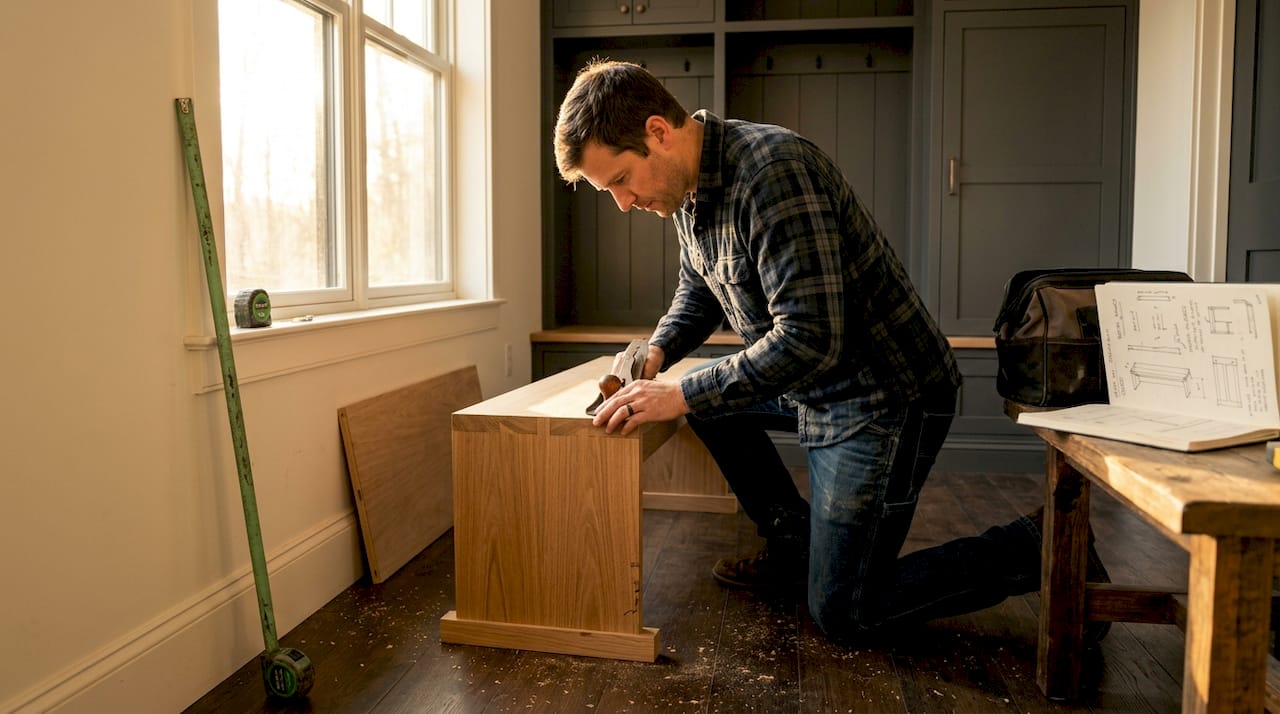
Entryway furniture, whether a mud locker, built-in bench, or storage cabinet, lives in one of the most demanding zones in your home. The materials you choose for the base, carcass (the box structure), and doors need to match the specific exposure each component faces. Not all parts of a piece of furniture face the same risks, and smart builders treat each zone differently.
Here’s the hierarchy that works best for Maryland entryways:
-
Base and toe-kick: This is the zone closest to the floor, where water pools, boot drip lands, and mop heads make contact. Use white oak or plywood here. White oak is particularly suited to moisture exposure because tyloses (tiny structures in the wood cells) naturally seal the pores, giving white oak significant water and rot resistance compared to most other hardwoods.
-
Carcass/body: Plywood is the right call for the main box structure. It holds screws well, doesn’t swell uniformly when exposed to minor humidity fluctuations, and stays structurally sound over time. A common methodology for painted or humidity-sensitive entryway furniture uses MDF for upper components and doors that don’t contact standing moisture, while reserving plywood or solid wood for the base and toe-kick.
-
Doors and upper panels: MDF (medium-density fiberboard) is excellent for painted surfaces because it machines cleanly, holds paint without grain telegraphing through, and doesn’t expand and contract the way solid wood does. It works well in upper positions that stay dry.
-
Avoid entirely for floor-level bases: Particle board and melamine should never be used for bases or boxes that sit at floor level. When any standing water reaches these materials, swelling starts almost immediately and can compromise structural integrity quickly.
| Component | Best material | Why it works | Avoid |
|---|---|---|---|
| Base/toe-kick | White oak, plywood | Moisture resistant, stable | Particle board, melamine |
| Carcass body | Plywood | Strong, screw-holding | Particle board |
| Doors/upper panels | MDF, solid wood | Smooth for paint, stable | Unfinished softwood |
| Bench seat | White oak, hard maple | Impact resistant, durable | MDF, particle board |
For inspiration on what’s possible with quality built-in entryway furniture, seeing finished projects helps homeowners understand how these material decisions come together visually and functionally.
Choosing moisture resistance in materials is a decision that pays off over a decade, not just the first season. Budget-friendly shortcuts in material selection almost always show up as expensive repairs within three to five years.
Pro Tip: If you want a fully painted entryway piece, use MDF for all upper elements and visible flat panels, but specify solid white oak or birch plywood for the base and any component within 12 inches of the floor. This keeps paint crisp and surfaces smooth where it’s most visible, while protecting against moisture damage where it’s most likely to occur.
Materials for challenging Maryland climates
Finally, if your Maryland home is near the coast or faces especially high humidity, some additional strategies ensure peak durability.
Homes in Southern Maryland, particularly those near the Chesapeake Bay or the Patuxent River corridor, face an added layer of challenge. Salt-laden air accelerates corrosion, humidity stays elevated for longer stretches, and even “indoor” materials near entry doors get more moisture exposure than comparable homes further inland.
For these situations, standard residential materials aren’t always enough. Consider these options:
- Fiber cement: Commonly used for exterior trim and siding, fiber cement resists moisture, salt air, and insects. For entryway wainscoting or base trim near the door, it outperforms wood in coastal conditions by a significant margin.
- Cellular PVC trim: This material doesn’t absorb moisture at all, doesn’t rot, and holds paint indefinitely without peeling. It’s ideal for base moldings, door casings, and any trim at floor level in a high-humidity entryway.
- Marine-grade plywood: Unlike standard construction plywood, marine-grade uses waterproof adhesive throughout and has fewer internal voids. For furniture bases in particularly wet entryways, it adds a meaningful layer of protection against delamination.
“If you want materials that can withstand Southern Maryland’s high humidity and salt exposure, choose moisture-resistant exterior and interior-adjacent materials rather than untreated wood or porous options.” This advice from coastal Maryland renovation professionals reflects what experienced builders have seen fail time and again in this region.
If your entryway faces these additional climate pressures, exploring custom options for tough climates with a builder who understands Maryland conditions is the most reliable path to a durable result. Applying moisture-proof finishes to every exposed surface adds another layer of protection that generic off-the-shelf furniture simply doesn’t offer.
Final checks: maintenance strategies for lasting entryways
With advanced materials in place, just a few habits will keep your entry looking and working like new year-round.
Even the best materials fail faster without consistent care. The good news is that proper maintenance for a well-designed entryway is simple and quick, as long as it happens regularly.
- Clean mats weekly. Shake or vacuum entry mats at least once a week. Dirty mats stop absorbing moisture and start transferring grit onto your floor surface.
- Empty and rinse boot trays. During wet seasons, boot trays fill with dirty water quickly. Empty and rinse them every two to three days to prevent overflow onto your floor or furniture base.
- Wipe up spills and puddles immediately. Even moisture-resistant materials benefit from fast cleanup. Standing water, especially salt-laden water from winter boots, accelerates finish degradation on any material.
- Inspect for swelling or finish damage. Every season, run your hand along the base of your furniture and check floor grout lines for cracks. Catching early signs of swelling or moisture intrusion means a simple fix rather than a major repair.
- Re-seal grout and wood surfaces. Porcelain tile grout and white oak surfaces benefit from a fresh sealant application every two to three years, depending on traffic volume.
These practical methods for daily cleanup and moisture control are what separate an entryway that looks great for ten years from one that starts looking tired after two or three.
For ongoing ideas and seasonal updates, entryway design inspiration is a good resource to revisit as your household’s needs evolve.
Pro Tip: Schedule two dedicated entryway inspections per year: one in early spring after the ice and salt season, and one in late fall before winter begins. Address any finish wear, swelling, or mat condition before the next season hits. Ten minutes of proactive attention prevents hours of repair work later.
The crucial detail most homeowners overlook
Here’s something we’ve noticed after more than 20 years building custom entryways for Maryland homeowners: most people who end up with a failing entryway didn’t make a bad individual material choice. They made a systems failure. They chose a good floor but ignored the furniture base. Or they installed beautiful white oak benches but skipped proper finishing on the toe-kick. Or they bought durable flooring and then placed a cheap, non-draining boot tray directly on the floor that collected standing water for weeks at a time.
An entryway is a system, and every component has to support the others. The floor, the furniture materials, the trim, the mats, and your household habits all need to work together. We’ve seen particle board bases turn to pulp inside beautifully finished painted cabinets because the builder used the wrong material for the base zone. We’ve seen gorgeous stone floors develop deep staining because the homeowner never re-sealed the grout after the first year.
What separates lasting entryways from disappointing ones isn’t usually the price point. It’s whether the builder and the homeowner both understood the full environment and made every decision with that environment in mind.
Our strong advice: prioritize proven water and grit strategies over aesthetics when the two conflict. You can always add character through hardware, paint color, or custom millwork details. But you cannot easily undo a swollen base or a floor that’s been salt-damaged for three seasons. Visit our lessons from custom entryways to see how this systems thinking plays out in real Maryland homes.
Don’t wait for the first signs of swelling or staining to act. Build the system right from the start.
Ready to transform your entryway? Custom solutions for every Maryland home
With this knowledge, you’re ready to combine smart material choices with custom design for an entryway that truly fits your life.
At Furniture Design Group, we build every piece with Maryland’s climate at the center of the decision. That means white oak bases, plywood carcasses, properly finished MDF where it performs best, and hardware that won’t corrode in humid conditions. Every custom piece we create is designed to function as a system, not just look good in a catalog photo.

Browse our past entryway projects to see how material choices translate into real results inside Maryland homes. When you’re ready to discuss your specific space, our team offers design consultations where we walk through your entryway’s exact exposure zones, your household’s daily routines, and the material recommendations that make the most sense for your situation. Reach out through our custom furniture services page to start the conversation and get a tailored recommendation built around your home.
Frequently asked questions
What material is best for entryway benches in a wet climate?
White oak is the top choice because tyloses seal its pores, making it highly resistant to water and rot compared to most other hardwoods.
Should MDF or plywood be used for entryway built-ins?
Use plywood or solid wood for bases and toe-kicks, and reserve MDF for upper sections that stay dry and don’t contact standing moisture.
What are the best entryway floor materials for Maryland homes?
Porcelain tile and luxury vinyl are the strongest options because they handle moisture and grit without requiring constant maintenance or re-finishing.
What should be avoided on entry furniture bases in wet climates?
Never use particle board or melamine for bases, as swelling can quickly compromise the structural integrity of the entire piece when water makes contact.