
TL;DR:
- Maryland furniture craft emphasizes solid hardwoods and full customization over mass-produced options.
- Custom entryway pieces from Maryland artisans last decades, repairable and built for your specific space.
- Working with local craftsmen ensures personalized design, sustainable practices, and a piece that truly fits your home.
Maryland Furniture Craft: Custom Design for Homeowners
Most Maryland homeowners spend weeks searching online retailers for entryway furniture, never realizing that world-class craftsmanship is available right in their own backyard. With 197 furniture makers in Maryland as of 2026, including 80 concentrated in Baltimore alone, the state has a thriving community of skilled artisans who build custom pieces from solid wood, no veneers, no shortcuts. Whether you need a mud locker, a storage bench, or a statement console, understanding Maryland furniture craft is the first step toward getting something truly made for your home.
Table of Contents
- Understanding Maryland furniture craft
- Custom entryway furniture: Options and opportunities
- The craftsmanship process: From idea to installation
- Finding and choosing your Maryland furniture maker
- A craftsman’s touch: Why local matters more than ever
- Bring Maryland craftsmanship into your home
- Frequently asked questions
Key Takeaways
| Point | Details |
|---|---|
| Local craft expertise | Maryland hosts nearly 200 skilled furniture makers offering custom pieces and superior materials. |
| Entryway creativity | Custom Maryland furniture simplifies even challenging entryways with tailored solutions. |
| Personalized process | Homeowners benefit from direct collaboration and durable, solid wood craftsmanship. |
| Value of going local | Choosing Maryland craftspeople ensures quality, sustainability, and support for the local economy. |
Understanding Maryland furniture craft
Maryland furniture craft refers to the tradition of skilled, local artisans building furniture by hand using solid wood and time-tested joinery techniques. This is not mass production. It is not flat-pack assembly. It is the practice of shaping real materials into functional, lasting pieces that are designed specifically for the person who commissioned them.
Maryland has a long history of woodworking that traces back to colonial settlements along the Chesapeake Bay. Early craftsmen in Annapolis and Baltimore built furniture for wealthy merchants and plantation households, establishing a regional style that blended English and American influences. That tradition never fully disappeared. Today, it lives in the workshops of family-owned studios and independent makers throughout the state.
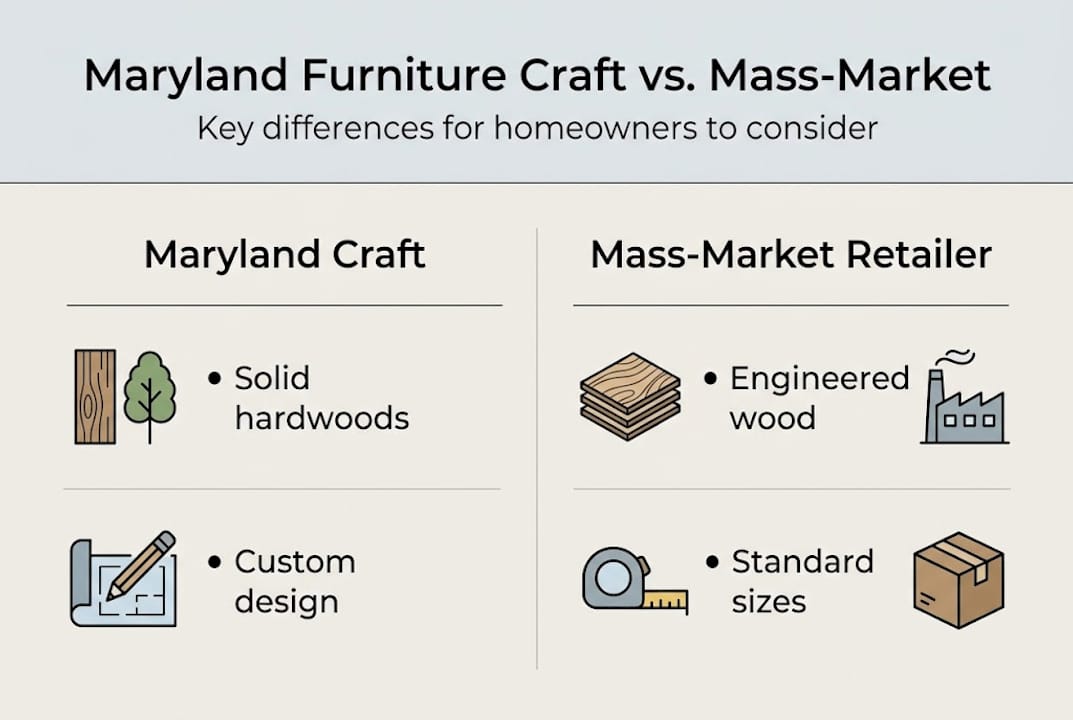
What makes modern Maryland furniture craft distinctive is its emphasis on personalization and material integrity. Local makers typically use solid hardwoods such as white oak, cherry, maple, and walnut. These species are often sourced from regional suppliers or reclaimed from Maryland land. Compare that to the particleboard cores and paper-thin veneers that dominate big-box furniture stores, and the difference becomes obvious the moment you run your hand across the surface.
“Maryland’s furniture makers bring something that a factory line simply cannot replicate: the knowledge that every joint, every finish, and every proportion was chosen with your specific space in mind.”
According to a market report, Maryland has 197 makers, with Baltimore serving as the densest hub. This concentration matters because it creates healthy competition that drives quality up and gives homeowners real choices.
Here is a quick snapshot of what the Maryland furniture craft landscape looks like:
| Feature | Maryland craft makers | Mass-market retailers |
|---|---|---|
| Material | Solid hardwood | Particleboard or MDF |
| Customization | Full design input | Limited options |
| Longevity | Decades with care | 5 to 10 years average |
| Origin | Local workshop | Overseas factory |
| Repairability | Fully repairable | Often not repairable |
Working with Maryland furniture experts means you are investing in a piece that will likely outlast several rounds of mass-market furniture. That is not a minor detail. Over a 20-year period, a single well-made custom piece often costs less than replacing budget furniture two or three times.
Custom entryway furniture: Options and opportunities
With a clear understanding of Maryland’s craft tradition, let’s explore the practical choices available for your own home’s entryway. The entryway is the first room your guests see and the last one you pass through each morning. It deserves more than a coat hook from a hardware store.
Maryland furniture makers offer a wide range of entryway pieces, each designed to solve a specific problem while adding visual character to your home:
- Mud lockers: Tall, compartmentalized storage units perfect for families with kids. They can include cubbies, hooks, shoe drawers, and benches all in one structure.
- Entry benches: Freestanding seating with or without storage underneath, ideal for putting on shoes or setting down bags.
- Console tables: Slim, elegant surfaces for keys, mail, and decorative items. They work especially well in narrow entryways.
- Coat racks and wall units: Wall-mounted systems that combine hooks, shelves, and mirrors into a cohesive design.
- Storage credenzas: Wider units with doors and drawers that handle serious organization needs in larger foyers.
Here is how custom and mass-market entryway furniture actually compare:
| Factor | Custom Maryland-made | Big brand mass-market |
|---|---|---|
| Price range | $800 to $3,500+ | $150 to $900 |
| Materials | Solid wood, no veneers | MDF, veneer, particleboard |
| Design fit | Built to your exact space | Standard sizes only |
| Lead time | 4 to 12 weeks | Ships in days |
| Lifespan | 30 to 50+ years | 5 to 10 years |
| Repair options | Fully refinishable | Often disposable |
Style is another place where custom work shines. Maryland makers are experienced across traditional, transitional, and modern farmhouse aesthetics. If your home has colonial trim details, a craftsman can mirror those proportions in the piece itself. If you prefer a clean Shaker look, they can deliver that too. Many offer solid wood cabinetry techniques that create furniture-grade finishes indistinguishable from built-ins.
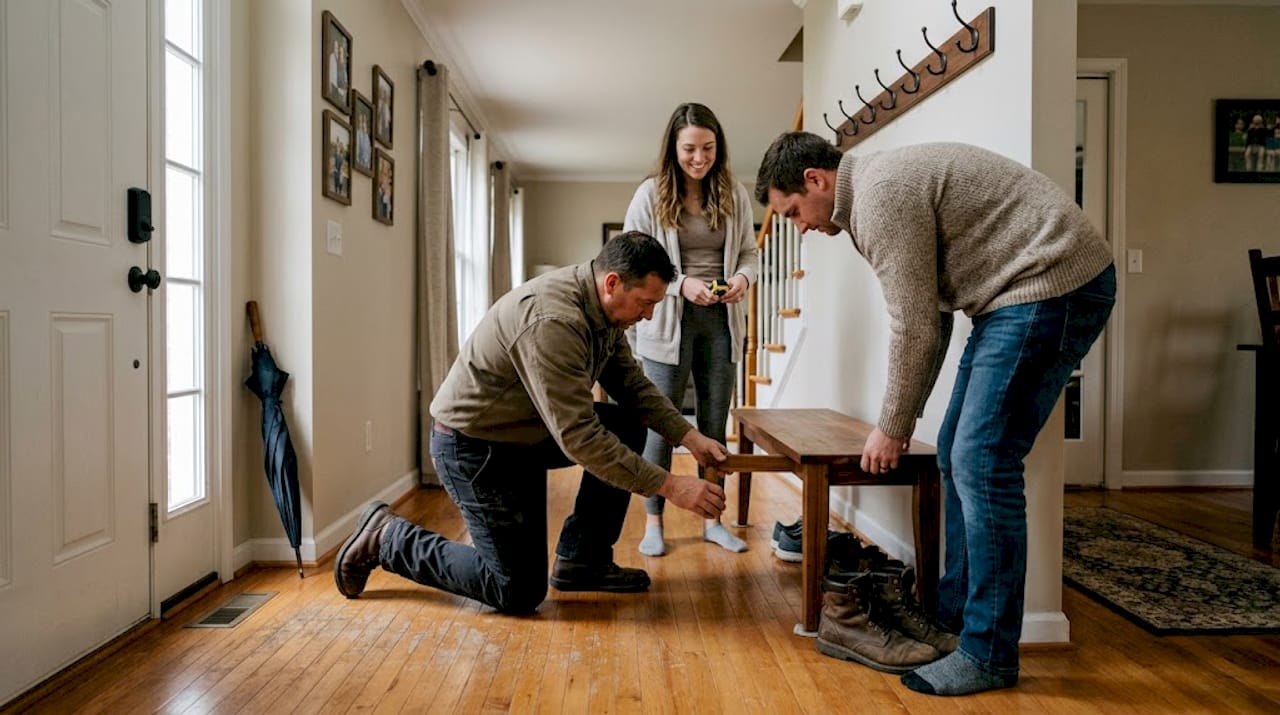
Custom craftsmanship also solves layout problems that standard furniture simply cannot address. Got an entryway that is 54 inches wide with an awkward door swing? A skilled maker builds exactly to that footprint. Need hooks at a lower height for young children and a higher shelf for adults? That gets built in from the start.
Pro Tip: Schedule your design consultation before you pick a finish or style. Walk your craftsman through the space, share photos of your home’s existing woodwork, and talk about how your family actually uses the entryway. The earlier these conversations happen, the more precisely the final piece will reflect your real needs rather than a generic template. Good custom furniture design starts with listening.
The craftsmanship process: From idea to installation
If you’re thinking about a custom piece for your entryway, here’s how the process usually unfolds with a Maryland craftsman. It is more straightforward than most homeowners expect, and understanding each phase helps you stay engaged and get the best outcome.
-
Initial consultation: You meet with the maker, either at your home or their showroom. You discuss dimensions, style preferences, wood species, hardware, and how the piece will be used daily. Good makers ask a lot of questions here because the answers shape everything that follows.
-
Design and drawing: The craftsman produces sketches or digital drawings for your review. This is your chance to refine proportions, adjust storage configurations, and confirm the overall look. Do not skip the feedback stage. A revision here takes minutes. A revision after the wood is cut takes days.
-
Material selection: You choose your wood species and finish. Makers who follow Maryland furniture craft principles use solid hardwoods, no veneers, so the grain and color you see in a sample board is what you get throughout the entire piece.
-
Construction: This is where the shop time happens. Joinery is cut, panels are glued and clamped, and surfaces are shaped by hand and machine. Traditional joinery methods like mortise and tenon or dovetail joints are common. These methods do not rely on staples or glue alone, which is why they last so much longer.
-
Finishing: The piece is sanded progressively through fine grits, then finished with oil, wax, lacquer, or paint depending on your preference and the wood species. Multiple coats are applied and sanded between each for a smooth, durable result.
-
Delivery and installation: The maker delivers the piece and, if it is a wall-mounted or built-in style unit, installs it securely. This step matters. A custom piece installed correctly looks intentional. A piece dropped off and left leaning against a wall never quite lands right.
Pro Tip: Choose solid wood over engineered alternatives whenever your budget allows. Solid wood can be sanded, refinished, and repaired indefinitely. A scratch on a veneer surface often cannot be fixed without replacing a panel. That repairability is a key reason solid wood holds its value over decades. The custom furniture process at quality Maryland shops reflects this commitment at every stage.
Timelines vary, but most custom entryway pieces take four to twelve weeks from deposit to delivery. Complexity, wood species availability, and the shop’s current workload all affect the timeline. A simpler bench in a readily available wood like maple might be ready in four weeks. A large mud locker with custom hardware and paint finish might take ten to twelve weeks. Budget accordingly and plan ahead, especially if you want the piece ready before a move or renovation is complete.
Finding and choosing your Maryland furniture maker
After learning about the process, it’s important to pick a maker who fits your vision and values. Not every shop is the same, and a mismatch between your expectations and a maker’s specialty can lead to frustration on both sides.
Here is where to start your search:
- Online craft directories: Sites that list local artisans by specialty and region often include portfolio photos and customer reviews. Search specifically for entryway furniture or custom storage.
- Local referrals: Ask neighbors, interior designers, or friends who have recently renovated. Word-of-mouth recommendations carry real weight in a craft industry where reputation is everything.
- Showroom visits: Baltimore’s concentration of 197 furniture makers means you can visit multiple showrooms in a single day. Seeing and touching the work in person tells you more than any photo can.
- Social media and websites: Many Maryland makers showcase their recent work on Instagram or their business sites. Look for consistent quality, variety of styles, and transparency about materials and process.
Once you have a shortlist, evaluate each maker using these criteria:
- Portfolio depth: Have they built pieces similar to what you need? A maker who specializes in dining tables may not be the right choice for a complex entryway storage system.
- Material transparency: Do they clearly state the wood species and joinery methods they use? Makers who work with solid hardwoods are usually proud to say so.
- Customer testimonials: Look for reviews that mention the full experience, not just the finished product. Communication, timeline accuracy, and installation quality all matter.
- Questions they ask you: A good craftsman will want to understand your space, your family’s habits, and your long-term goals for the piece. Beware of anyone who jumps straight to pricing without learning about your needs.
Also consider geographic proximity. Working with a maker who is local to your part of Maryland simplifies site visits, delivery logistics, and any follow-up service. Baltimore’s dense community of Maryland furniture craftspeople makes it easier to visit, compare, and build a real relationship with the person who will be building something permanent for your home.
Ask these questions before you sign anything: What wood do you use and where does it come from? Can I see examples of similar entryway pieces you have built? What is included in your warranty or follow-up service? How do you handle design changes after the deposit is paid? The answers will reveal a lot about the maker’s professionalism and values.
A craftsman’s touch: Why local matters more than ever
Here is something we believe strongly after more than 20 years building custom entryway furniture for Maryland homeowners: the internet has made it easy to buy furniture from anywhere, but it has made it harder to get furniture that actually fits your life.
A national chain does not know that your entryway gets six inches of direct afternoon sunlight that will bleach out certain finishes. They do not know that your kids leave muddy cleats at the door every Saturday. They cannot account for the fact that your ceiling trim sits three inches lower on the left side than the right. A local Maryland craftsman can learn all of this in a single 30-minute consultation and build accordingly.
There is also a sustainability argument that rarely gets made clearly enough. Local makers source regionally, run smaller operations, and build pieces meant to last generations rather than a few years. That is genuinely better for the environment than buying three rounds of flat-pack furniture over a decade. Learning from artisan creation stories shows how much intention goes into each build, and that intention matters.
Finally, there is the pride of ownership. A piece that was designed for your home, built by someone in your state, and installed by the person who made it carries a different kind of weight. It is not just furniture. It is a decision you will never regret.
Bring Maryland craftsmanship into your home
Custom entryway furniture built by a skilled Maryland craftsman is closer to your front door than you might think. At Furniture Design Group, we have spent over 20 years creating bespoke entryway solutions for homeowners across Maryland, from compact mudroom benches to full mud locker systems built around your family’s specific needs.
We build every piece using solid hardwoods, traditional joinery, and finishes selected to match your home’s existing character. If you are ready to replace a cluttered, mismatched entryway with something built to last, we would love to hear from you. Explore our work and see what goes into our custom furniture masterpieces, or visit our showroom to start a conversation. Your ideal Maryland furniture solution is one inquiry away.
Frequently asked questions
What makes Maryland furniture craft unique compared to other regions?
Maryland furniture craft stands out for its emphasis on solid hardwoods, full customization, and a high concentration of skilled makers, with 197 makers statewide and 80 in Baltimore alone, ensuring competitive quality and variety.
How long does it typically take to get a custom entryway piece made?
Most custom entryway pieces from a Maryland craftsman take between four and twelve weeks, depending on the complexity of the design, the wood species chosen, and the shop’s current workload.
Are Maryland furniture makers more expensive than buying from big brands?
Custom Maryland-made furniture typically costs more upfront, but the superior quality, durability, and repairability mean it often costs less over a decade compared to replacing mass-market pieces multiple times.
Can Maryland craftsmen build storage solutions or built-ins for small entryways?
Absolutely. Most Maryland makers specialize in space-saving, custom wood solutions designed around your exact entryway dimensions, making them ideal for tight or irregular spaces.