
When you imagine your dream entryway or custom mudroom, you picture the finished piece perfectly integrated into your home. What you might not anticipate is how a single misunderstood term can derail that vision entirely. The difference between “veneer” and “solid wood” isn’t just semantics, it’s the gap between a $2,000 piece and a $5,000 investment. For Maryland homeowners and interior designers, fluency in custom furniture terminology transforms consultations from confusing exchanges into productive collaborations. This guide equips you with the essential vocabulary to communicate confidently with artisans, avoid costly misunderstandings, and ensure your custom furniture project delivers exactly what you envision.
Table of Contents
- Why custom furniture terminology matters
- Core custom furniture terms defined
- Common terminology mix-ups: A comparison
- Applying your new terminology: Maryland-specific scenarios
- Take your custom furniture projects further with expert support
- Frequently asked questions
Key Takeaways
| Point | Details |
|---|---|
| Terminology prevents errors | Knowing custom furniture terms helps avoid costly miscommunications and design mistakes. |
| Empowers smart choices | Clear vocabulary allows you to make confident selections and negotiate precisely with artisans. |
| Local styles matter | Understanding both universal and Maryland-specific terms ensures your projects fit local tastes perfectly. |
| Written clarity is key | Confirm all terms in writing to ensure your custom furniture project matches expectations. |
Why custom furniture terminology matters
The language of custom furniture isn’t just industry jargon, it’s the foundation of successful projects. When you tell an artisan you want a “distressed finish” but they interpret it as “antiqued,” you’ll receive a piece that looks nothing like what you imagined. These miscommunications cost Maryland homeowners an average of 15-20% in project revisions and delays.
Understanding terminology reduces errors and helps clarify expectations in custom orders. For homeowners, this knowledge prevents expensive mistakes like ordering the wrong wood species or misunderstanding construction methods. You’ll avoid situations where you thought you were getting dovetail joinery but received simpler butt joints instead. For interior designers, precise terminology streamlines the entire workflow, from initial client consultations to final artisan instructions.
Clear terminology also transforms the bidding process. When you can articulate exactly what you need using industry-standard terms, artisans provide more accurate quotes. You’ll receive realistic timelines because there’s no ambiguity about project scope. The quality of work improves dramatically when everyone speaks the same language from day one.
Pro Tip: Create a shared custom furniture glossary document during your first consultation. Have your artisan define any unfamiliar terms in writing, then reference this document throughout the project to maintain alignment.
“The single biggest communication problem is the illusion that it has taken place. In custom furniture, assuming you and your artisan share the same definitions leads to disappointment every time.”
Now that you understand why language is a critical tool, let’s demystify the most essential terms you need to know.
Core custom furniture terms defined
Mastering fundamental terminology empowers you to participate actively in design decisions rather than passively accepting recommendations. Familiarity with standard terminology allows for more precise requests and better outcomes. Here are the core terms that form the foundation of custom furniture conversations:
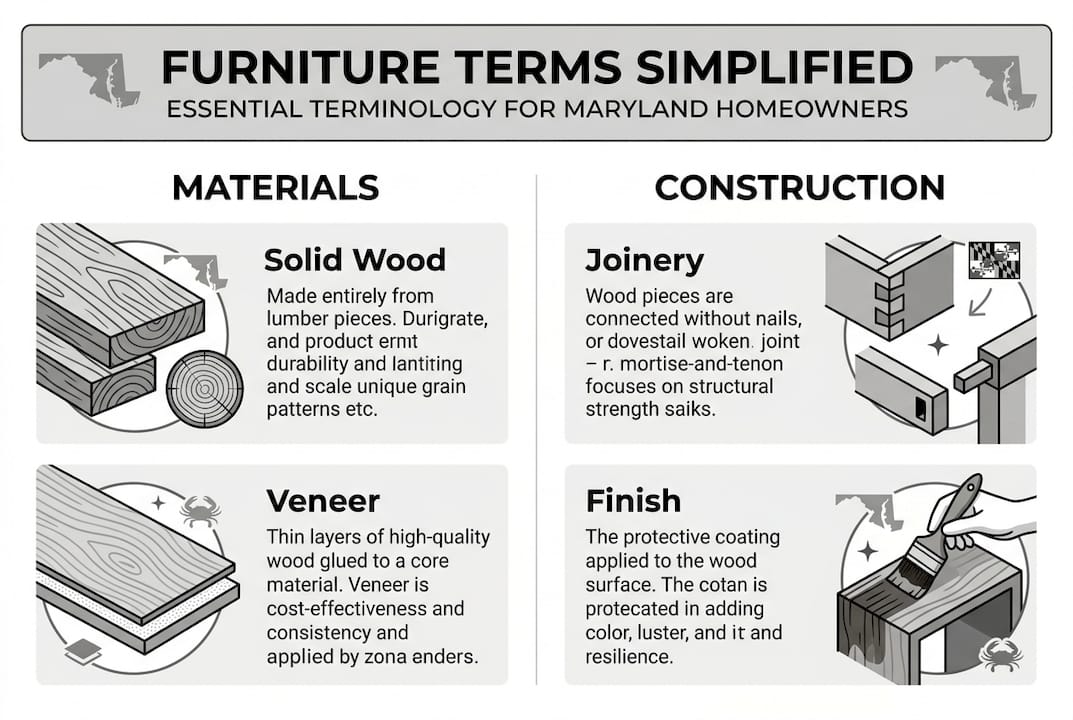
| Term | Definition | Why It Matters |
|---|---|---|
| Joinery | Methods of connecting wood pieces (dovetail, mortise and tenon, dowel) | Determines furniture strength and longevity |
| Veneer | Thin layer of quality wood applied over substrate | Affects appearance, cost, and durability |
| Bespoke | Furniture designed and built uniquely for one client | Indicates true customization vs. modified standard pieces |
| CAD | Computer-Aided Design drawings showing precise dimensions | Provides visual confirmation before construction begins |
| Finish | Protective and decorative coating (oil, lacquer, polyurethane, wax) | Impacts maintenance requirements and aesthetic |
| Hardware | Functional and decorative metal components (hinges, pulls, handles) | Influences both usability and style |
| Substrate | Base material beneath veneer or finish | Affects structural integrity and price point |
| Grain | Natural pattern in wood created by growth rings | Determines visual character and matching challenges |
The five most commonly misunderstood terms create the majority of project complications:
- “Custom” vs. “Bespoke”: Custom often means modifications to existing designs, while bespoke indicates entirely original creations from scratch
- “Stain” vs. “Paint”: Stain penetrates wood to enhance natural grain, paint covers it completely with opaque color
- “Solid wood” vs. “Wood furniture”: Solid wood means the entire piece uses real wood, while wood furniture might include veneers or composite materials
- “Hand-rubbed” vs. “Hand-applied”: Hand-rubbed involves multiple applications with sanding between coats, hand-applied simply means not sprayed
- “Distressed” vs. “Rustic”: Distressed involves intentional aging techniques, rustic refers to natural, unrefined aesthetic
When you encounter unfamiliar terms during consultations, asking for clarification demonstrates engagement rather than ignorance. Request examples, photos, or samples to ensure you’re visualizing the same outcome as your artisan. This proactive approach to furniture design vocabulary prevents misunderstandings before they become expensive problems.
With the basics set, let’s compare some terms that sound similar but can lead to very different results if misused.
Common terminology mix-ups: A comparison
Certain term pairs cause confusion so frequently that they deserve special attention. Understanding these distinctions protects your investment and ensures satisfaction with the final product.

| Term A | Term B | Key Difference | Impact on Your Project |
|---|---|---|---|
| Veneer | Solid Wood | Veneer is thin wood layer over substrate; solid wood is wood throughout | Veneer costs 30-50% less but requires gentler care |
| Stain | Paint | Stain shows wood grain; paint conceals it | Stain highlights natural beauty, paint offers unlimited color options |
| CAD Drawing | Sketch | CAD provides precise measurements; sketch shows general concept | CAD enables accurate material estimates and construction |
| Bespoke | Custom | Bespoke is designed from zero; custom modifies existing designs | Bespoke takes longer and costs more but fits your space perfectly |
| Oil Finish | Polyurethane | Oil penetrates wood; polyurethane creates surface layer | Oil requires regular maintenance, polyurethane offers superior protection |
| Dovetail | Butt Joint | Dovetail interlocks pieces; butt joint simply connects ends | Dovetail provides heirloom quality, butt joints are functional but basic |
Distinguishing terms like veneer vs. solid wood is crucial for informed custom orders. When you encounter ambiguous or unfamiliar terminology, follow these steps to gain clarity:
- Ask for visual examples: Request photos of previous projects using the specific technique or material being discussed
- Request written definitions: Have your artisan document terms in your contract or proposal to create a permanent reference
- Compare alternatives: Ask how choosing one option over another affects timeline, cost, and maintenance requirements
- Verify understanding: Repeat back what you heard in your own words and confirm your interpretation matches theirs
- Research independently: Look up terms on reputable understanding custom furniture materials resources to build your knowledge base
Pro Tip: Before signing any contract, create a terminology checklist. Go through your proposal line by line and mark any term you’re not 100% confident about. Schedule a follow-up call specifically to review these items. This 30-minute investment prevents months of frustration.
Maryland’s design aesthetic often blends coastal influences with urban sophistication and historic charm. Terms like “weathered finish” might mean driftwood gray in Annapolis but barn-wood brown in Frederick. Regional context matters when discussing style preferences, so provide visual references alongside terminology to ensure alignment.
Equipped with clarity on what’s what, let’s see how you can use this knowledge effectively in your next custom furniture project.
Applying your new terminology: Maryland-specific scenarios
Theory becomes valuable only when applied to real situations. Here’s how to leverage your terminology knowledge throughout your Maryland custom furniture journey:
- Initial consultation: Open with “I’ve researched custom furniture terminology and want to make sure we’re aligned on key terms.” This signals you’re an informed client who values precision
- Prioritizing features: Use specific terms when ranking importance: “Dovetail joinery is non-negotiable, but I’m flexible on hardware finish”
- Material selection: Ask “Is this solid walnut or walnut veneer over plywood substrate?” rather than just “Is this real wood?”
- Finish discussions: Specify “I want a hand-rubbed oil finish that develops patina, not polyurethane that maintains consistent appearance”
- Timeline negotiations: Reference terminology when discussing phases: “How long between CAD approval and joinery completion?”
- Budget conversations: Frame questions precisely: “What’s the cost difference between bespoke design and customizing your existing mudroom locker design?”
Effective communication consistently leads to higher custom furniture customer satisfaction in Maryland. Projects where clients and artisans establish shared terminology from the start experience 40% fewer revision requests and complete an average of three weeks faster than projects with communication gaps.
Maryland’s diverse architectural landscape means terminology application varies by region and style. In Baltimore’s historic rowhouses, terms like “space-efficient joinery” and “vertical storage solutions” dominate entryway furniture discussions. Coastal properties in Ocean City prioritize “marine-grade finishes” and “moisture-resistant substrates.” Suburban homes in Montgomery County often focus on “transitional hardware” and “neutral stain palettes” that complement various design styles.
Consider a recent Bethesda project where clear terminology made the difference. The homeowner requested a “farmhouse-style mudroom locker with distressed finish.” By clarifying that “distressed” meant intentional dings and worn edges (not just aged appearance) and “farmhouse” indicated visible hardware and chunky proportions (not delicate details), the artisan delivered exactly what the client envisioned. The project required zero revisions because terminology established precise expectations from day one.
Another Annapolis designer working on a waterfront property used specific finish terminology to achieve the perfect coastal aesthetic. By requesting “cerused oak with matte polyurethane topcoat” instead of vaguely asking for “beachy wood,” she received mudroom lockers that perfectly balanced durability with the desired weathered appearance. The cerusing technique (filling grain with white paste) created the sun-bleached look while polyurethane protected against humidity.
When you visit local custom furniture projects showrooms or consultations, bring a list of terminology questions specific to your project. Ask about regional wood availability (Maryland black walnut vs. imported varieties), local finish preferences based on climate considerations, and hardware styles that complement your home’s architectural period. This preparation demonstrates respect for the artisan’s expertise while ensuring your vision translates accurately into reality.
With this foundation, you’ll find collaboration vastly smoother and outcomes more satisfying.
Take your custom furniture projects further with expert support
You now possess the terminology foundation to communicate effectively about custom furniture projects. But knowledge becomes truly powerful when paired with experienced guidance. That’s where partnering with seasoned artisans transforms good projects into exceptional ones.
Furniture Design Group brings over 20 years of custom furniture expertise to Maryland homeowners and interior designers. We don’t just build beautiful pieces, we guide you through every terminology decision to ensure your vision becomes reality. From initial consultations where we establish shared vocabulary to final installation where every detail matches your expectations, our family-owned company prioritizes clear communication alongside quality craftsmanship.
Our showroom in Maryland features completed projects that demonstrate how precise terminology translates into stunning results. You’ll see the difference between various joinery techniques, compare finish options side by side, and understand why specific hardware choices complement different design styles. Schedule a consultation to discuss your project using the terminology you’ve learned, and experience how effective communication accelerates the design process while eliminating costly misunderstandings.
Frequently asked questions
What are the most important custom furniture terms to know?
Key terms include joinery, veneer, bespoke, CAD, finish, and hardware, each defining materials, processes, or types of customization. These six terms appear in virtually every custom furniture conversation and form the foundation for more detailed discussions about your specific project needs.
How does terminology impact custom furniture pricing?
Accurate terminology affects project bidding and final pricing by ensuring you’re quoted for exactly what you want, avoiding surprises related to materials or finishes. When you specify “solid cherry with hand-rubbed oil finish” instead of just “nice wood,” artisans provide precise quotes rather than estimates with wide ranges.
Is Maryland custom furniture terminology different from other regions?
While most terms are universal, regional differences can influence choice of styles and materials, with Maryland emphasizing coastal finishes, historic reproduction hardware, and locally sourced hardwoods. Understanding these regional preferences helps you communicate more effectively with local artisans.
How can I confirm my artisan and I are using terms the same way?
Confirming terms in writing prevents miscommunication by creating a permanent reference document. Always request definitions in your contract or proposal, and review these carefully before approving any project phase to ensure continued alignment throughout the build process.