
TL;DR:
- A well-designed mudroom adds value, order, and convenience for Maryland families.
- Permits are required for structural, electrical, or plumbing modifications, varying by county.
- Investing in quality materials and craftsmanship ensures durability and long-term satisfaction.
Every Maryland morning tells the same story: muddy boots by the door, backpacks dropped on the floor, coats piled on a single hook that gave up months ago. It’s chaotic, and it costs you time every single day. A well-planned mudroom renovation fixes that permanently. Beyond the daily convenience, a functional entryway adds measurable value to your home and gives your family a genuine sense of order. This guide walks you through every stage of a Maryland mudroom renovation, from the first measurement to the final coat of paint, with local requirements and practical decisions covered at every step.
Table of Contents
- Assessing your needs and space
- Permits, preparation, and local Maryland requirements
- Demo and build: Steps to transforming your space
- Finishing touches: Paint, hardware, and accessories
- Mudroom renovation cost, ROI, and common mistakes
- Our perspective: The mudroom mistake most Maryland homeowners make
- Ready to design your custom Maryland mudroom?
- Frequently asked questions
Key Takeaways
| Point | Details |
|---|---|
| Plan for function | Assess your family’s real needs and Maryland-specific conditions before you remodel. |
| Follow local codes | Permits and professional plans help you avoid delays and legal hassles in Maryland. |
| Invest in quality | Choose durable materials and professional workmanship to maximize your mudroom’s value and ROI. |
| Don’t skip the details | Smart finishes and accessories boost utility, longevity, and day-to-day happiness. |
Assessing your needs and space
Now that you’re motivated to tackle the clutter, let’s start by clarifying what you need in your new mudroom. Before you buy a single board or pull a single nail, assessing needs and sketching the layout is the essential first step. Skip this and you’ll build storage that doesn’t fit your life.
Start with simple questions. Who uses this space every day? A family with three kids, a dog, and a weekly soccer schedule needs something completely different from a couple who works from home. What are you actually storing? Make a real list before you assume.
Common storage needs for Maryland families:
- Shoes and boots (including wet, muddy ones after rainy Maryland winters)
- Coats, jackets, and rain gear
- Backpacks and sports bags
- Pet leashes, food containers, and towels
- Keys, mail, and small personal items
- Umbrellas and seasonal gear
Next, measure everything. Width, depth, and ceiling height all matter. A mudroom that feels spacious on paper can feel like a closet once cabinets go in. Sketch a basic layout on graph paper or use a free app. Maryland’s climate adds a specific wrinkle: you’re dealing with humid summers, muddy springs, and wet, salty winters. Your design has to account for wet floors, damp outerwear, and the kind of traffic that comes with all four seasons.
Pro Tip: Always allocate at least 36 inches of clear walkway through the mudroom. Anything narrower creates a daily bottleneck during busy mornings.
Take before photos now. You’ll refer back to them constantly during the build, and you’ll want them for permit documentation later.
Permits, preparation, and local Maryland requirements
With your needs and layout in hand, you’ll want to ensure your project is up to code. The difference between a cosmetic update and a structural renovation determines whether you need a permit at all. Painting walls or swapping out hooks? No permit required. Moving a wall, adding electrical outlets, or installing drainage? That’s a different story.
Structural, plumbing, and electrical changes in a mudroom renovation require a permit in Maryland. County requirements vary, so check with your local office before starting.
| Maryland county | Permit required for | Estimated approval time |
|---|---|---|
| Montgomery County | Structural, electrical, plumbing | 3–5 weeks |
| Prince George’s County | Structural, electrical, plumbing | 2–4 weeks |
| Howard County | Structural, additions, electrical | 2–3 weeks |
| Anne Arundel County | Structural, plumbing, electrical | 3–4 weeks |
“Permit approval in Maryland can add 2–4 weeks to your timeline. Build that window into your project schedule from day one.”
When you submit your plans, include a site plan, existing floor plan, and any proposed changes to drainage, ventilation, or electrical systems. Energy efficiency notes may also be required depending on the scope of work.
Essential documentation checklist:
- Site plan showing property boundaries
- Before photos of the existing space
- Proposed floor plan and elevation drawings
- Electrical or plumbing diagrams if applicable
- Local permit office contact information
Once permits are approved, prepare your workspace. Clear everything out of the area, cover adjacent floors with drop cloths, and gather your demo tools. A clean start prevents damage to surrounding areas and makes every step after faster.
Demo and build: Steps to transforming your space
Once your permits and prep work are in place, the real transformation begins. Demolition sounds dramatic, but done carefully, it’s methodical. Removing old trim, closets, and surfaces correctly sets you up for a clean, professional installation.
Demolition steps:
- Remove all trim and baseboards carefully (they may be reusable)
- Take out any existing shelving, hooks, or storage units
- Strip old flooring if it’s being replaced
- Patch and sand walls; address any moisture damage before building over it
- Mark stud locations clearly on the wall before installing anything
Once demo is done, you’re building. Here’s where the DIY vs. professional question matters most.
| Factor | DIY install | Professional install |
|---|---|---|
| Upfront cost | Lower | Higher |
| Skill required | Moderate to high | Handled for you |
| Maryland code compliance | Your responsibility | Included |
| Time | Longer | Faster |
| Custom fit and finish | Variable | Consistent |
For custom entryway furniture that truly fits your space and lasts decades, professional fabrication and installation removes the guesswork entirely.
When building or installing cabinetry, always secure units to wall studs, not just drywall. Maryland’s humidity makes material choice critical. Plywood and maple hold up far better than particleboard in damp entry conditions. MDF works well for painted surfaces but should have a sealed edge wherever moisture exposure is possible. If you’re interested in creating custom cabinetry that handles Maryland’s climate, the material selection stage is where that investment pays off for years.
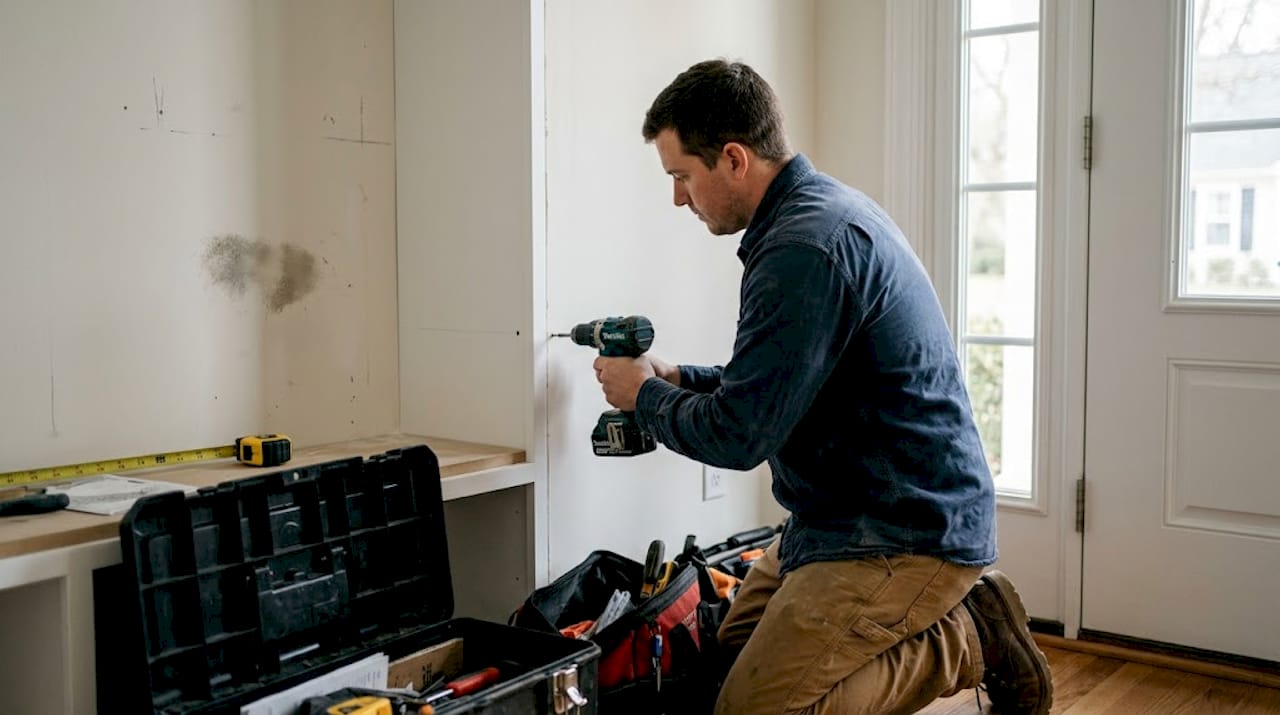
For painted finishes on existing cabinetry, cabinet refinishing tips can help you get a durable result without replacing everything.
Pro Tip: Go vertical. Tall cabinets or floor-to-ceiling shelves give you dramatically more storage without using additional square footage. In a small mudroom, this can double your usable space.
Finishing touches: Paint, hardware, and accessories
With structures in place, it’s time for the details that make your mudroom stand out. This stage is where a functional space becomes one you actually enjoy walking through every day.
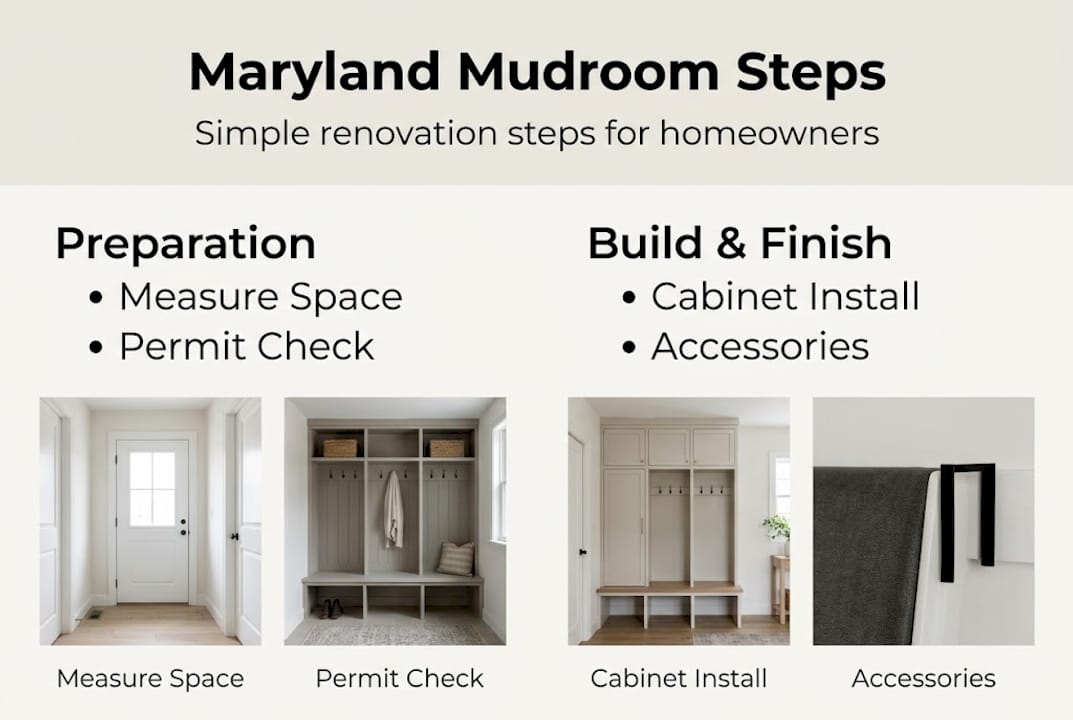
Paint choice matters more in a mudroom than almost anywhere else in your home. Maryland entryways face humidity, temperature swings, and constant contact. Choose a semi-gloss or satin finish in a moisture-resistant, scrubbable formula. Flat paint will absorb every muddy fingerprint and show wear within months.
Soft-close hardware, sturdy hooks, and precise joinery are what separate a custom-quality mudroom from a basic DIY project. Hardware isn’t just functional. It defines the look.
Recommended hardware for Maryland mudrooms:
- Soft-close cabinet hinges (prevents slamming during busy mornings)
- Heavy-duty coat hooks rated for thick winter jackets
- Bin pulls in a finish that resists fingerprints
- Magnetic closures for lightweight cabinet doors
- Stainless or coated hardware to resist humidity-driven corrosion
For flooring, prioritize waterproof materials. Porcelain tile and luxury vinyl plank (LVP) both handle wet boots and mopped floors without warping or staining. Tile is extremely durable but cold underfoot in winter. LVP is warmer and softer, installs faster, and has improved dramatically in water resistance over the past few years.
Accessories pull the space together. A shallow tray near the door catches keys and loose items. Woven baskets corral shoes without looking messy. A small chalkboard or whiteboard on the wall handles family messages without cluttering countertops.
Pro Tip: Choose a bench cushion in an outdoor-rated fabric. These resist moisture, clean up easily, and hold their color even in high-traffic areas where a standard fabric cushion would wear out in a single season.
Mudroom renovation cost, ROI, and common mistakes
Completing your mudroom means understanding what you’ve put in and what you’ll get back. Maryland labor costs and material prices push renovation budgets higher than national averages, so planning accurately matters.
| Item | Estimated cost range |
|---|---|
| Custom cabinetry and built-ins | $8,000–$15,000 |
| Professional installation | $3,000–$7,000 |
| Flooring (tile or LVP) | $1,500–$4,000 |
| Paint and hardware | $500–$1,500 |
| Permits and inspections | $200–$800 |
| Total range | $10,000–$30,000 |
Custom mudroom cabinetry in Maryland often runs $15,000–22,000 for the full installation, with a total remodel landing between $10,000 and $30,000 depending on scope and finishes.
“Functional spaces can recoup 70%+ of their investment at resale, especially in competitive Maryland markets where buyers prioritize storage and organization.”
Return on investment is real. Buyers in Maryland’s competitive suburban markets notice organized, finished entryways. A well-built mudroom signals that the rest of the home has been cared for the same way.
For larger projects, professional furniture assembly reduces installation errors and protects your investment in quality materials.
Common mistakes and how to avoid them:
- Skipping permits: Unpermitted work can block a home sale or require costly removal
- Underestimating the budget: Always add a 15–20% contingency for surprises
- Ignoring moisture control: Sealed floors and moisture-resistant finishes are non-negotiable in Maryland
- Buying cheap hardware: It fails fast under daily use and costs more to replace
- Poor lighting: A dark mudroom defeats the purpose of an organized space
Where DIY can save money:
- Painting walls and trim after cabinets are installed
- Installing hooks and accessories
- Laying LVP flooring in simple layouts
- Basic demo work if no permits are affected
Our perspective: The mudroom mistake most Maryland homeowners make
After more than 20 years of building custom entryway furniture for Maryland families, we’ve watched the same mistake repeat itself. Homeowners spend weeks researching tile patterns and paint colors, then order the cheapest cabinetry they can find online. The cabinets arrive flat-packed, built from particleboard, and within two years they’re swollen at the base, doors won’t close, and the whole project needs to be redone.
The conventional wisdom is that a mudroom is a utility space, so it doesn’t need to be beautiful or built to last. We’d argue the exact opposite. Your mudroom is the first thing every family member touches when they come home and the last thing they interact with before leaving. It sets the tone for your entire house.
The families who invest in quality materials and proper craftsmanship the first time tell us the same thing: they wish they’d done it sooner. They stop thinking about the mudroom entirely because it just works, every single day, in every Maryland season. That’s the real return on a custom build. Not just the resale value, but the daily ease of a space that was made for exactly how your family lives.
Choose your finishes carefully. Choose your materials for Maryland’s climate specifically. And if you’re going to spend $15,000 or more on this renovation, make sure what you’re buying will still look and function well in 2036.
Ready to design your custom Maryland mudroom?
If this guide has you thinking seriously about a renovation, the next step is seeing what’s possible for your specific home and family.

At Furniture Design Group, we’ve been building custom entryway furniture for Maryland homeowners for over 20 years. Every piece we build is designed around your space, your storage needs, and your climate. No flat-pack shortcuts. No generic layouts. We work with you from the first sketch to the final installation, so what you get is exactly what your home needs. Visit our Maryland showroom or reach out to start a conversation about your project.
Frequently asked questions
Do I need a permit for a mudroom renovation in Maryland?
You need a permit for any structural, electrical, or plumbing changes; check with your county office for specifics on your project scope.
How much does a custom mudroom cost in Maryland?
Expect to invest $10,000–30,000, with custom cabinetry and installation typically costing $15,000–22,000 for a full build.
What materials are best for mudroom cabinetry?
Plywood, maple, or MDF with moisture-resistant finishes offer the durability and stability that Maryland’s climate demands.
Can I do a mudroom renovation myself or should I hire a pro?
DIY works well for basic tasks like painting and accessory installation, but professionals ensure quality and code compliance for custom builds or any structural work.