
TL;DR:
- Proper furniture planning begins with accurate room measurements and understanding fixed elements to create a functional layout.
- Starting with the largest piece, establishing clearances, and testing the arrangement with tape or digital tools ensures the space works for everyday living.
- Avoid common mistakes like purchasing accent pieces or rugs prematurely and focus on a system-based approach that prioritizes function over style.
Most homeowners have done it: bought a gorgeous sectional, dragged it home, and realized it swallows the entire living room. Step by step furniture planning exists precisely to stop that from happening. When you follow a structured process before spending a dollar, you avoid the layout regrets that cost people not just money but months of living in a space that never quite feels right. This guide walks you through every stage of the process, from measuring your room to locking in a final layout you can actually live with.
Table of Contents
- Key takeaways
- Step by step furniture planning starts with knowing your space
- How to create a furniture layout that actually works
- Common mistakes that derail furniture planning
- Verifying and finalizing your furniture plan
- My honest take on furniture planning after years of watching people get it wrong
- Get custom furniture that fits your plan perfectly
- FAQ
Key takeaways
| Point | Details |
|---|---|
| Measure before anything else | Accurate room dimensions and fixed element locations are the non-negotiable foundation of any good layout. |
| Anchor with the largest piece | Place your biggest furniture item first and build the rest of the room around it. |
| Respect clearance standards | Maintain at least 36 inches for walkways and 14 to 18 inches between your sofa and coffee table. |
| Never buy accent pieces early | Premature purchasing of rugs and accessories locks you into a layout before you know it works. |
| Plan for the room’s job | Define what the room needs to do before choosing any furniture, not after. |
Step by step furniture planning starts with knowing your space
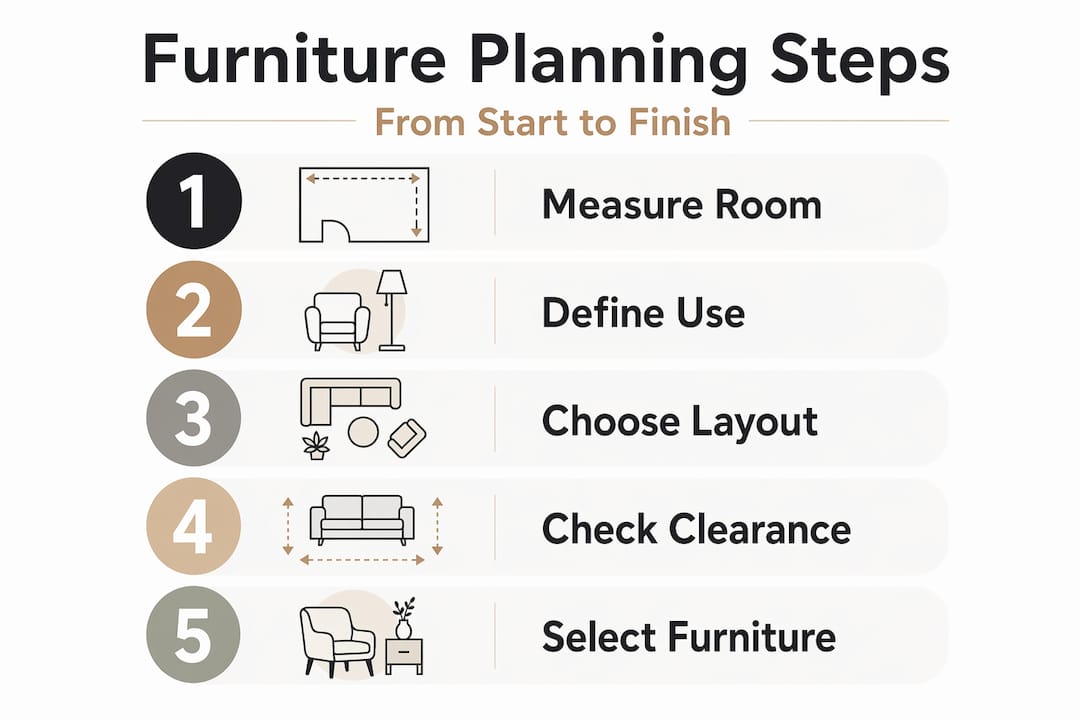
Before you move a single chair or open a single tab on a furniture website, you need to understand the room you are working with. This sounds obvious, but most planning failures start here. People eyeball dimensions, guess at clearances, and then wonder why nothing fits the way they imagined.
How to measure correctly
Grab a tape measure and record the full length and width of the room. Then note the location of every door, window, electrical outlet, and vent. These are fixed elements. You cannot move them, so your layout has to work around them. Sketch a rough floor plan on paper, or use a free digital tool like RoomSketcher or Planner 5D to map it out to scale.
A typical sofa runs about 7 feet wide, which sounds manageable until you account for the clearance needed in front of it, the walkway behind it, and the side tables flanking it. Mapping this on paper before you buy saves enormous headaches.
- Record ceiling height, especially if you are considering tall shelving or cabinets
- Note which direction doors swing, since a door swinging inward can kill an entire furniture arrangement
- Mark natural light sources, because seating placement relative to windows affects both comfort and glare
- Identify the room’s focal point, whether that is a fireplace, a TV wall, or a large window
Define the room’s primary job
Defining the room’s function before selecting furniture is what separates layouts that work from layouts that just look nice in photos. A living room that doubles as a home office needs completely different furniture choices than one used purely for movie nights.

Ask yourself: who uses this room, how often, and for what? A family with young kids needs wide traffic paths and durable upholstery. A couple who entertains frequently needs flexible seating that can expand conversation zones. The room’s job shapes every decision that follows.
Pro Tip: Write down three words that describe how you want the room to feel. Then check every furniture decision against those words before committing.
Room shape matters too. Rectangular rooms often benefit from placing the sofa perpendicular to the longest wall, which naturally creates zones without cramping the space. Square rooms give you more flexibility but require careful anchoring so the layout doesn’t feel directionless.
How to create a furniture layout that actually works
With your measurements in hand and your room’s function defined, you are ready to arrange furniture. The sequence matters as much as the choices themselves.
Follow this order for every room
- Place the largest piece first. In a living room, that is usually the sofa. In a bedroom, it is the bed. This anchor piece determines where everything else goes.
- Establish your focal point relationship. Orient the primary seating toward the room’s focal point, whether that is a TV, fireplace, or architectural feature.
- Create conversation zones. Seating no more than 8 feet apart keeps conversation natural and comfortable. Beyond that distance, people start raising their voices, and the room feels disconnected.
- Lay out traffic paths. Walk from every door to every other door and mark those natural routes. Furniture cannot block them.
- Add secondary pieces. Side tables, accent chairs, and ottomans fill in around the anchor pieces, not the other way around.
- Test with painter’s tape. Before moving anything heavy, tape out the footprint of large pieces on the floor. Live with it for a day and see if the paths feel right.
Pro Tip: Use a free online floor plan tool to drag and drop furniture to scale before touching anything in your actual room. It takes 20 minutes and can save you hours of physical labor.
Clearance numbers you need to know
Clearance is where most amateur layouts fall apart. People think about the furniture, not the space around it. The room-design-step-by-step standard clearances are not suggestions. They are based on how human bodies actually move through spaces.
| Zone | Recommended Clearance |
|---|---|
| Main traffic walkway | At least 36 inches |
| Sofa to coffee table | 14 to 18 inches |
| Bedside to bed | 24 to 30 inches |
| Dining chair to wall | 36 to 48 inches when chair is pulled out |
These standard clearances are worth printing out and keeping next to your floor plan sketch. When you are deciding between a 90-inch sofa and a 96-inch one, those 6 inches could be the difference between a room that flows and one that feels like an obstacle course.
One counterintuitive furniture arrangement tip: pulling sofas 4 to 6 inches away from walls actually makes rooms feel larger, not smaller. The gap creates visual depth and opens up natural pathways that don’t feel forced. For anyone planning furniture for small spaces, this single move changes the feel of a room dramatically.
Common mistakes that derail furniture planning
Even with good intentions, certain patterns trip up homeowners repeatedly. Recognizing them before they happen is the difference between a satisfying layout and a costly redo.
- Buying accent pieces too early. 70% of redesign regrets come from purchasing accent pieces before the core layout is locked in. Throw pillows, lamps, and side tables should come last, not first.
- Purchasing a rug prematurely. Buying a rug before sofa placement is finalized is the most expensive decorating error most homeowners make. Once you fall in love with a rug, you start building the entire room around it, which is the wrong direction.
- Pushing everything against the walls. This is the most common layout instinct and one of the least effective. Furniture pulled toward the room’s center creates intimacy and visual balance.
- Ignoring visual weight. A room full of bulky, low-to-the-ground furniture feels heavy and closed in. Mix in taller, lighter pieces to give the eye somewhere to travel.
- Skipping the awkward corner problem. Odd room shapes need specific solutions. An L-shaped room, for instance, works well with sectional seating that mirrors the room’s own geometry.
“The biggest planning error isn’t picking the wrong furniture. It’s picking furniture before you’ve finished planning the room.”
Adjusting layouts for awkward shapes takes patience, but the fix is usually simpler than people expect. If you have a long, narrow room, resist the urge to line furniture along both long walls. Instead, create two distinct zones across the width of the room and connect them with a clear central path. For anyone interested in decorating living room walls as part of their overall plan, the same principle applies: decide on your core layout before you start thinking about art placement.
Verifying and finalizing your furniture plan
A layout looks great on paper. Living in it tells you the real story. Before you call the plan done, put it through a few practical tests.
- Walk every path. Move through the room as you normally would, from the entry to the seating area, from the sofa to the TV, from the dining table to the kitchen. Every route should feel natural and unobstructed.
- Test the room at different times of day. Natural light shifts. A seating arrangement that feels open in the morning might feel cramped and shadowy in the evening. Spend a full day in the layout before committing.
- Check functional aging. Furniture as a system means thinking past appearance. Will the upholstery hold up to how this room is actually used? Is the coffee table height practical for the way your household sits?
- Plan for flexibility. Life changes. Kids grow up, work-from-home needs shift, and rooms take on new purposes. Leave enough open floor space to adapt the layout without a full overhaul.
- Run a room-specific checklist. For a bedroom, confirm bed accessibility from both sides, storage reach, and door clearance. For a living room, confirm conversation distances, TV sightlines, and traffic flow from every entry point.
The goal is a layout that doesn’t just look finished but actually works for how you live. Custom furniture solutions can also make a real difference at this stage, particularly in rooms where standard sizes consistently fall short.
My honest take on furniture planning after years of watching people get it wrong
I’ve watched homeowners go through this process dozens of times, and the pattern is almost always the same. They start with a piece they love, a sofa, a statement chair, or an heirloom table, and try to build the room backward from it. Then they’re surprised when nothing else fits right.
What I’ve learned is that the single most powerful shift a homeowner can make is treating furniture as a system rather than a collection of individual pieces. The sofa doesn’t exist on its own. It exists in relationship to the coffee table, the walking path behind it, the rug beneath it, and the light source beside it. When you see those connections before you buy, the decisions get much easier.
I’ve also seen people obsess over style when function should come first. A room can be beautiful and still feel wrong to live in. The arrangement tips that stick, the ones readers actually use and thank me for later, are always the ones rooted in how a body moves through a space, not how a room photographs.
My advice: measure more than you think you need to, test more than feels necessary, and buy your accent pieces absolutely last. The rooms that end up genuinely working are planned, not styled.
— Donovan
Get custom furniture that fits your plan perfectly
Once your layout is mapped and your dimensions are exact, the last thing you want is to compromise because standard furniture sizes don’t fit your space. That’s where Furnituredesigngroup makes a real difference.

With over 20 years of crafting bespoke furniture for Maryland homeowners, Furnituredesigngroup builds pieces sized to your exact floor plan, not a showroom’s average. Whether you need a custom entryway mud locker that fits a narrow hallway or a storage piece sized to a specific wall, their team works from your actual measurements. Explore their custom furniture services to see how made-to-order furniture can complete a plan you’ve worked hard to get right.
FAQ
What is the first step in furniture planning?
The first step is measuring your room accurately and mapping all fixed elements like doors, windows, and outlets. Without precise dimensions, every furniture decision that follows is a guess.
How far should a sofa be from a coffee table?
The recommended distance between a sofa and a coffee table is 14 to 18 inches, which keeps the table within comfortable reach without blocking legroom or traffic flow.
Should furniture touch the walls?
No. Pulling furniture 4 to 6 inches away from walls creates visual depth and natural pathways, which makes rooms feel larger rather than smaller.
When should you buy a rug in the planning process?
Buy your rug after your core furniture placement is finalized. Purchasing a rug too early is consistently cited as one of the most costly errors in room planning, because it forces you to build around the rug instead of the layout.
How do you plan furniture for small spaces?
Start with the largest piece, verify all clearances using the 36-inch walkway standard, and resist pushing furniture against walls. Using a digital floor plan tool before moving anything physical saves time and prevents damage in tight spaces.