
TL;DR:
- Proper entryway organization prevents daily clutter and improves household flow.
- Custom built-ins offer durable, tailored solutions suited for Maryland’s seasonal and space challenges.
- Regular maintenance and adaptive systems keep entryways functional and clutter-free over time.
Every Maryland homeowner knows the feeling: you walk through the front door and immediately trip over a pile of shoes, a stack of mail, and three coats that missed the hook. Your entryway sets the tone for your entire home, yet it’s often the most neglected space. A structured drop zone prevents that daily chaos from spreading into the rest of your house. This guide walks you through a practical, repeatable workflow to transform your entryway from a cluttered bottleneck into an organized, welcoming space using smart storage choices and custom furniture solutions built for Maryland homes.
Table of Contents
- Assess your entryway needs and challenges
- Gather your tools and select smart storage solutions
- Implement the entryway organization workflow step by step
- Maintain, troubleshoot, and adapt your entryway system
- Our expert take: Why custom entryway design outperforms DIY fixes
- Ready to create your perfect entryway?
- Frequently asked questions
Key Takeaways
| Point | Details |
|---|---|
| Assess your needs | Start by observing your home’s daily entry habits and clutter points to guide your setup. |
| Choose smart storage | Invest in custom furniture and tools tailored to handle Maryland’s weather and family routines. |
| Follow a stepwise workflow | A structured multi-zone approach with designated drop zones establishes lasting order. |
| Maintain regularly | A weekly routine keeps your entryway tidy and adaptable for changing needs. |
Assess your entryway needs and challenges
Before you buy a single hook or bin, spend a few days simply watching how your entryway gets used. Notice when clutter peaks. Is it right after school pickup? After a rainy commute? When guests arrive? Observing your actual traffic patterns reveals the real problem, not just the symptom.
Most entryway clutter falls into a handful of predictable categories:
- Footwear: Shoes and boots pile up because there’s no clear place to put them
- Outerwear: Coats, hats, and scarves land on the floor when hooks are full or missing
- Bags and backpacks: School bags, gym bags, and purses need a dedicated landing spot
- Mail and keys: Small items get lost in the shuffle without a designated surface
- Wet and muddy gear: Maryland winters and rainy springs mean wet boots and umbrellas need a contained zone
Maryland homes face specific challenges that generic organization advice ignores. Seasonal swings from humid summers to icy winters mean your entryway has to handle everything from flip flops to heavy snow boots within the same year. Family size matters too. A household with three kids and two working adults needs a fundamentally different system than a retired couple.
Pro Tip: Take photos of your entryway at its messiest. That image becomes your baseline and your motivation. Pin it somewhere visible while you plan your workflow.
Setting practical goals is the next step. Ask yourself: What does a successful entryway look like for your household? For most families, the answer involves a clear drop zone for daily essentials, dedicated spots for every family member, and a system that resets itself with minimal effort. Once you have that picture in mind, you’re ready to start making design decisions. Exploring custom entryway designs early in this process helps you understand what’s possible for your specific floor plan and family size.
Gather your tools and select smart storage solutions
With a clear picture of your challenges, it’s time to assemble the right tools and choose storage that actually fits your life. Start with the basics before committing to larger investments.
Here’s what most well-organized entryways rely on:
- Sturdy hooks: At two heights, one for adults and one for kids
- Shoe storage: A bench with cubbies underneath or a slim shoe rack
- Bins and baskets: For grouping items by person or category
- A key and mail station: A small shelf or wall-mounted organizer near the door
- Labels: Simple, clear labels help every family member know where things belong
- A tray or mat: For wet boots and umbrellas to contain moisture
Once the basics are covered, the bigger decision is whether to go with modular, off-the-shelf pieces or invest in custom built-ins. Here’s a quick comparison:
| Feature | Modular solutions | Custom built-ins |
|---|---|---|
| Cost upfront | Lower | Higher |
| Fit to your space | Approximate | Exact |
| Durability | Varies | High |
| Style cohesion | Limited | Seamless |
| Long-term value | Moderate | Strong |
Custom built-ins in Maryland homes offer durability against weather and high traffic that flat-pack furniture simply can’t match. When a muddy boot tray is integrated into a solid wood locker unit, it stays put. When a coat hook is anchored into a custom panel, it holds up for years.
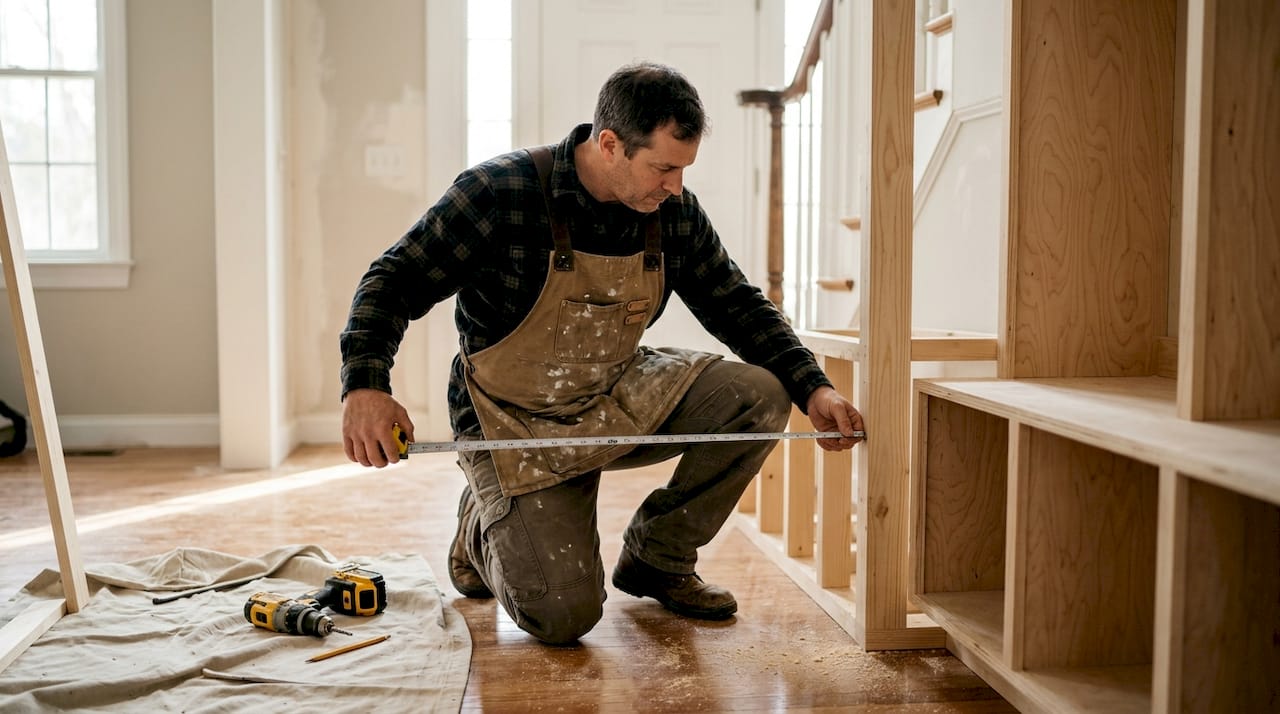
Pro Tip: In Maryland, choose materials rated for moisture resistance. Solid wood with a quality finish or MDF with a sealed coat handles humidity changes far better than particleboard, which warps and swells over time.
For tricky spaces, like a narrow row house entry or an awkward L-shaped foyer, custom storage options are often the only way to use every inch effectively. A custom mud locker built to your ceiling height, for example, gives you storage that a standard unit from a big-box store can never provide.
Implement the entryway organization workflow step by step
With your tools and custom solutions at the ready, you can now transform your entryway with these proven workflow steps.
- Clear everything out. Remove every item from your entryway. Start with a blank slate so you can see the actual space.
- Deep clean the area. Sweep, mop, and wipe down walls. A clean surface makes the next steps easier and more motivating.
- Create your drop zone. Designate a specific spot near the door for the items used every single day: keys, bags, and outerwear. This is the heart of your workflow.
- Install your storage. Mount hooks, place shoe storage, and position any furniture. If you’re working with custom pieces, this is when they go in.
- Label every zone. Use clear, simple labels so every household member knows exactly where things belong.
- Do a test run. Live with the system for one week before making adjustments. Real use reveals gaps that planning doesn’t.
- Schedule a weekly reset. Pick one day to return everything to its place and clear any overflow.
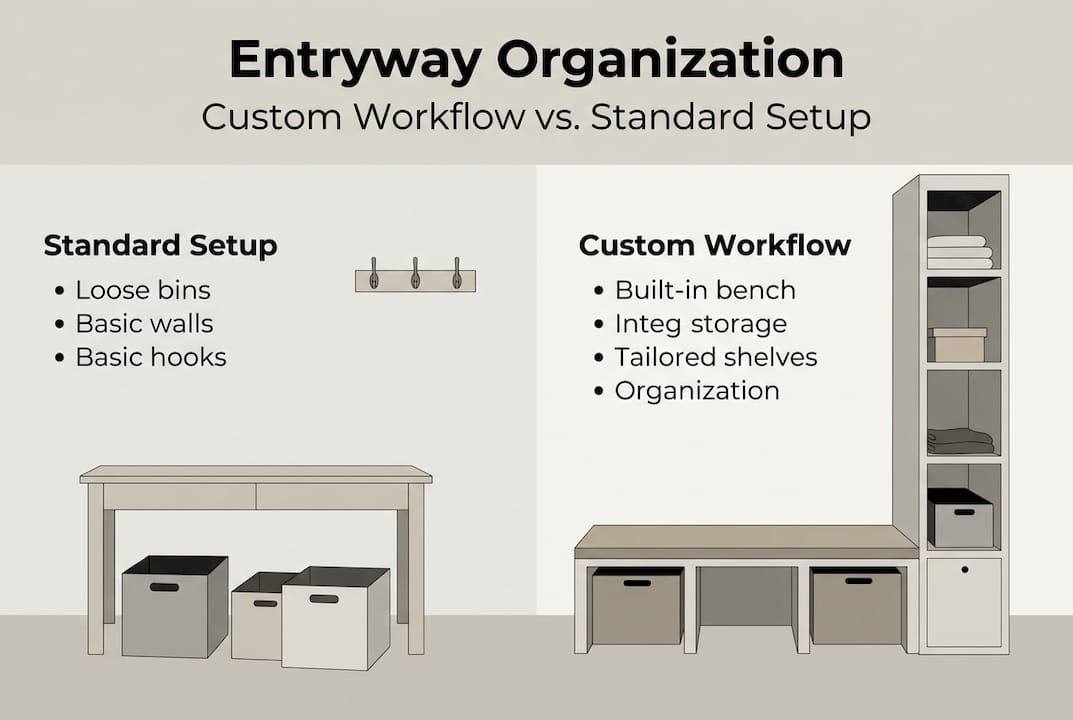
Here’s how the workflow compares with and without custom solutions:
| Step | Without custom solutions | With custom solutions |
|---|---|---|
| Drop zone | Improvised shelf or table | Built-in bench with dedicated cubbies |
| Coat storage | Freestanding rack, tips over | Wall-mounted locker, anchored and stable |
| Shoe storage | Pile by the door | Pull-out drawers or cubbies per person |
| Weekly reset time | 15 to 20 minutes | 5 to 10 minutes |
The biggest insight from working with Maryland families over two decades is this: habit-supporting design beats willpower every time. When your entryway physically guides people to put things in the right place, the system works without reminders or rules. Explore custom furniture installation tips to understand how professional installation reinforces those habits from day one.
Maintain, troubleshoot, and adapt your entryway system
After implementing your workflow, ongoing attention ensures it stays effective and adapts to your household’s changing needs.
A weekly reset routine is the single most effective maintenance habit for busy homes. It doesn’t need to be complicated. Set aside 10 minutes on Sunday evening or Monday morning to return stray items to their zones, clear the mail station, and wipe down the shoe tray. That’s it.
Here are the most common troubleshooting scenarios and how to handle them:
- Overflow on hooks: Add a secondary hook rail at a lower height, or assign a specific hook to each family member
- Lost keys: Install a dedicated key hook right at eye level next to the door. If it’s not the first thing you see, it won’t get used
- Wet gear piling up: Add a boot tray with a lip and a small umbrella stand. Contain the moisture before it spreads
- Kids ignoring the system: Lower the hooks and label cubbies with photos, not just words, for younger children
- Seasonal overflow: Rotate items. Store off-season gear in a closet and only keep current-season essentials in the entryway
Maryland’s four distinct seasons create a real challenge for entryway systems. In January, you need space for heavy coats, snow boots, and scarves. By July, the same zone needs to handle sandals, sunscreen, and beach bags. Building flexibility into your system from the start, through adjustable shelves or modular cubbies, saves you from a full reorganization every few months.
Safety reminder: Clutter in entryways is a leading cause of household tripping hazards. Keep pathways clear at all times, especially near the door threshold. If items are regularly left on the floor, that’s a sign your storage system needs adjustment, not a sign that your family needs more reminders.
When your needs shift significantly, whether a new baby, a teenager moving out, or a dog joining the household, don’t force the old system to stretch. Consider custom furniture adjustments that reconfigure your existing setup. For larger cleanouts during transitions, professional junk removal tips can help you handle the excess quickly and responsibly.
Our expert take: Why custom entryway design outperforms DIY fixes
After more than 20 years building entryway furniture for Maryland families, we’ve seen the same pattern repeat itself. A homeowner buys a $150 coat rack from a big-box store, fills it up in two weeks, and is back to square one by month three. Generic solutions fail in high-traffic, weather-exposed entryways because they’re built for average conditions, not your specific home.
Custom design changes the equation entirely. When storage is built to your ceiling height, your door swing, and your family’s actual habits, it stops feeling like furniture and starts feeling like part of the house. That’s not a luxury. That’s function.
We’ve also learned that the most organized households aren’t the ones with the strictest rules. They’re the ones where the design does the work. A locker with a labeled cubby for each child doesn’t need a reminder note on the door. The local success stories we’re most proud of are the ones where a family tells us they stopped arguing about the entryway entirely. That’s what good design delivers.
Ready to create your perfect entryway?
If this workflow has shown you what’s possible, the next step is making it real in your home. A custom entryway system designed specifically for your Maryland home solves both the workflow and the aesthetic in one move.
At Furniture Design Group, we’ve spent over 20 years crafting bespoke mud lockers and entryway furniture for Maryland homeowners who want lasting organization and genuine style. We’d love to help you design a space that works as hard as your family does. Explore custom entryway furniture to see what’s possible, or contact Furniture Design Group to schedule a free consultation with our team. Your entryway transformation starts with one conversation.
Frequently asked questions
What is the best way to start organizing my entryway?
Begin by clearing out all clutter, then establish a dedicated drop zone for daily essentials like keys and bags. Starting with a blank slate helps you see the space clearly before adding any storage.
How often should I reset or tidy my entryway system?
A weekly reset routine is enough to prevent clutter from building up in most households. Pick a consistent day and keep it to 10 minutes or less.
Are custom entryway built-ins worth the investment?
For Maryland homes, custom built-ins offer durability, a precise fit, and seamless style that off-the-shelf options can’t replicate over time. They also reduce the time you spend reorganizing because the design supports your habits from day one.
What if my entryway is too small for bulky furniture?
Custom solutions are designed to work within your actual dimensions, including slim vertical units that maximize wall space without crowding a narrow entry. A professional can often find storage opportunities in small entryways that standard furniture completely misses.