
Choosing mudroom furniture for your Maryland home involves more than picking attractive pieces. You need solutions that withstand the state’s humid climate while organizing your family’s daily chaos of coats, shoes, and bags. The right custom mudroom furniture transforms a cluttered entryway into a functional, welcoming space that serves your household for years. This guide delivers expert-backed criteria to help you evaluate materials, storage configurations, and construction quality so you can make confident decisions that enhance both organization and durability in your home’s busiest transition zone.
Table of Contents
- Key takeaways
- 1. Evaluate functionality: zoning and storage type
- 2. Choose durable, moisture-resistant materials
- 3. Balance open vs. closed storage with integrated seating
- 4. Select quality hardware and construction for durability
- 5. Compare furniture options for Maryland mudroom needs
- 6. Make the best choice: expert situational recommendations
- Discover custom mudroom furniture for Maryland homes
- FAQ
Key Takeaways
| Point | Details |
|---|---|
| Zones for coats shoes bags | Plan dedicated zones for coats, shoes, and bags to improve organization and daily flow. |
| Moisture resistant materials | Use moisture resistant materials such as hardwood plywood to maintain dimensional stability in Maryland humidity. |
| Bench seating with under storage | Incorporate built in benches with under storage to maximize vertical space and keep floors clear. |
| Adjustable shelving and hooks | Plan for growth with adjustable shelving and removable hooks to adapt as needs change. |
| Edge banding protects exposed edges | Edge banding on exposed plywood edges protects against moisture and extends life. |
1. Evaluate functionality: zoning and storage type
Your mudroom works best when it mirrors how your family actually lives. Start by observing daily patterns: who enters first, what items pile up, and which accessories need immediate access versus seasonal storage. Zoning reduces cross-contamination of dirt and improves long-term organization by assigning specific areas for coats, shoes, bags, and accessories.
Create physical boundaries using vertical dividers or color-coded sections. Position hooks at 40 to 44 inches for children and 60 to 66 inches for adults to encourage independence. Design cubbies 12 to 14 inches wide per family member, allowing enough room for bulky winter gear without crowding. Open storage like hooks and cubbies provides speed for daily items, while closed cabinets hide seasonal equipment and maintain visual calm.
Labeling zones proves especially valuable for households with kids. Simple tags or color systems help children return items to correct spots, reducing the mental load on parents. Consider integrating bench seating with under-storage to maximize vertical space while keeping floor areas clear. Regular seasonal rotation prevents overcrowding as weather changes and family needs shift.
Pro Tip: Measure your family’s tallest winter coat and widest shoes before finalizing cubby dimensions. Add two inches to each measurement for comfortable fit and air circulation, preventing moisture buildup that leads to odors.
- Assess traffic flow to position frequently used items nearest the door
- Designate a landing zone for keys, mail, and daily essentials
- Plan for growth by including adjustable shelving and removable hooks
- Review mudroom organization strategies for additional layout inspiration
2. Choose durable, moisture-resistant materials
Maryland’s climate challenges mudroom furniture with humidity levels that warp inferior materials and shorten furniture lifespan. Prioritize moisture-resistant materials like hardwood plywood for cabinet construction, as it offers dimensional stability superior to solid wood in fluctuating conditions. Plywood’s cross-grain construction resists expansion and contraction that causes doors to stick and joints to separate.
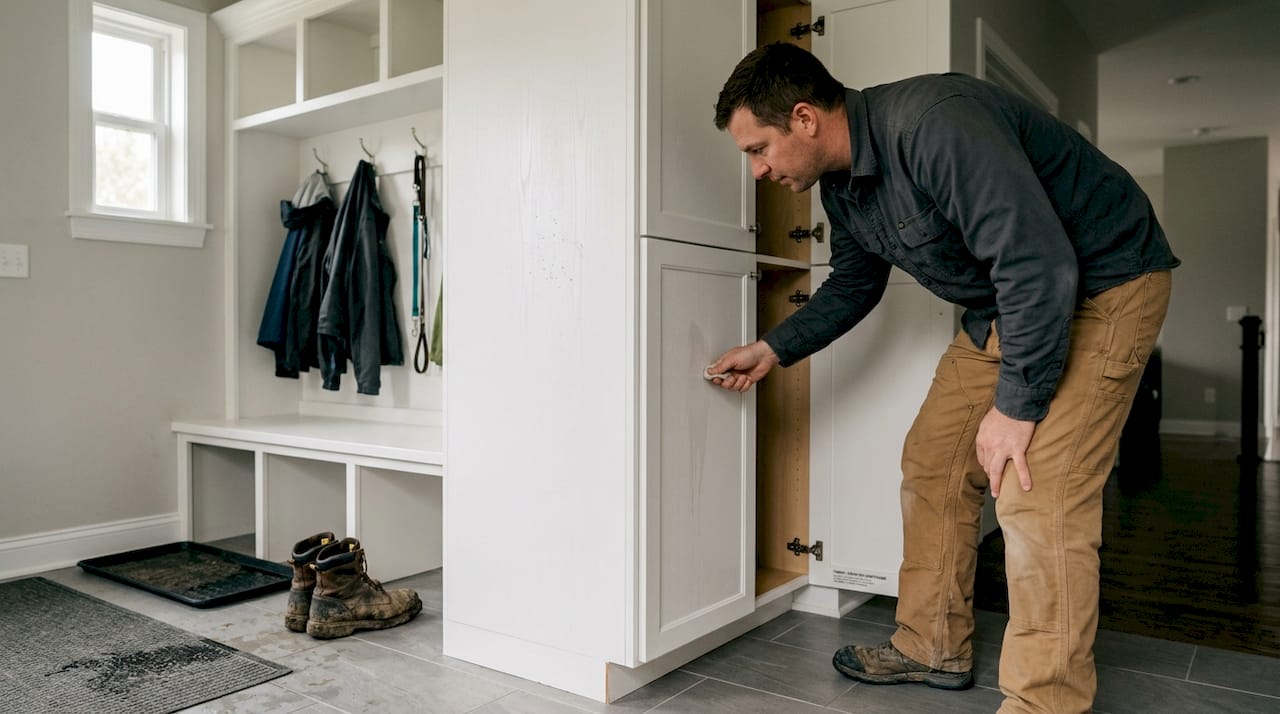
For flooring, porcelain tile with R10 to R11 slip resistance provides safety and durability against wet shoes and tracked-in snow. Unlike vinyl or laminate, porcelain withstands heavy foot traffic without showing wear patterns or requiring frequent replacement. The grout lines also create natural traction that reduces slip hazards during wet Maryland winters.
Water-resistant finishes protect wood surfaces from moisture damage and simplify cleaning. Look for polyurethane or conversion varnish rather than basic paint, as these create impermeable barriers against spills and humidity. Apply finish to all six sides of wood components, including hidden areas, to prevent moisture absorption through unprotected surfaces.
| Material | Humidity resistance | Durability rating | Maintenance level | Cost range |
|---|---|---|---|---|
| Hardwood plywood | Excellent | High | Low | $$-$$$ |
| Solid wood | Moderate | High | Medium | $$$-$$$$ |
| MDF | Poor | Medium | High | $ |
| Porcelain tile | Excellent | Very high | Low | $$-$$$ |
| Vinyl plank | Good | Medium | Low | $-$$ |
Pro Tip: Request edge banding on all exposed plywood edges during custom fabrication. This thin veneer strip seals vulnerable edges where moisture typically penetrates, extending furniture life by years while creating a finished appearance.
- Verify cabinet interiors receive the same finish quality as exterior surfaces
- Explore durable cabinet construction methods for additional material insights
- Test finish samples in humid conditions before committing to full installation
- Schedule annual inspections to catch and repair finish damage early
3. Balance open vs. closed storage with integrated seating
The most functional mudrooms strategically combine storage types to serve different needs throughout your day. Balance open storage for daily access with closed cabinets for clutter control and seasonal items. Open hooks positioned at ergonomic heights allow family members to hang coats in seconds, eliminating the excuse of inaccessible storage that leads to piles on floors.
Closed cabinets earn their space by concealing visual clutter and protecting infrequently used items from dust. Store beach gear, holiday decorations, and guest supplies behind doors, keeping daily-use zones clear and organized. The 80/20 rule applies here: make 80 percent of daily items openly accessible and reserve 20 percent of space for closed storage of occasional-use equipment.
Built-in bench seating at 17 to 19 inches high and 15 to 18 inches deep transforms your mudroom into a functional dressing area. Under-bench storage expands capacity without consuming additional floor space, crucial in compact Maryland homes. Maintain at least 36 inches of walkway clearance between furniture pieces to ensure comfortable movement when multiple family members use the space simultaneously.
| Storage type | Accessibility | Visual impact | Best for | Limitations |
|---|---|---|---|---|
| Open hooks | Immediate | High visibility | Daily coats, bags | Creates visual clutter |
| Open cubbies | Quick | Moderate visibility | Shoes, small items | Requires regular tidying |
| Closed cabinets | Requires opening | Clean appearance | Seasonal gear, supplies | Slower access |
| Bench storage | Lift-up access | Hidden | Bulky items, extras | Limited height |
Consider bench seating with under-storage that incorporates hydraulic lifts for easy access to hidden compartments. This feature proves especially valuable for storing items like sports equipment or cleaning supplies that you need regularly but prefer to keep out of sight.
Pro Tip: Install a mix of single and double hooks at each position. Double hooks accommodate layering lightweight items like scarves over heavier coats, effectively doubling your hanging capacity without adding hardware.
- Compare open vs closed storage pros and cons for your specific household size
- Position closed storage at eye level for adults, open storage lower for children
- Include at least one closed cabinet with adjustable shelves for flexibility
4. Select quality hardware and construction for durability
Hardware quality separates furniture that lasts decades from pieces requiring replacement within years. Soft-close hinges and dovetail joints enhance longevity and usability by reducing wear from repeated use. Soft-close mechanisms prevent door slamming that loosens screws and cracks cabinet frames, while providing a premium feel that elevates daily interactions with your mudroom.
Dovetail joints create mechanical locks between wood pieces that support significantly higher loads than stapled or doweled connections. This construction method proves critical for mudroom furniture bearing the weight of heavy winter coats, wet boots, and packed backpacks. Quality joinery maintains structural integrity even as wood expands and contracts with seasonal humidity changes.
Proper ventilation inside cabinets prevents the moisture buildup that leads to mold growth and musty odors. Specify louvered doors or ventilation strips in cabinet backs to promote air circulation. This feature becomes essential in Maryland’s humid summers when wet umbrellas and damp shoes need to dry without creating breeding grounds for mildew.
Plywood shelving supporting 100 to 300 pounds per linear foot provides stable storage for heavy items without sagging. Verify shelf thickness matches intended loads: three-quarter inch plywood for standard storage, one inch for heavy equipment. Reinforce longer spans with center supports to maintain level surfaces over years of use.
Pro Tip: Test cabinet hinges during showroom visits by opening and closing doors 10 times rapidly. Quality soft-close mechanisms maintain consistent speed and silence across repetitions, while inferior hardware shows variation or produces clicking sounds.
- Request quality cabinet joinery and hardware specifications in writing before purchase
- Choose full-extension drawer slides rated for 100-pound loads minimum
- Verify all hardware carries manufacturer warranties of at least five years
- Install bumpers on cabinet doors to protect walls from handle impact
5. Compare furniture options for Maryland mudroom needs
Understanding how different materials and configurations perform in Maryland’s climate helps you prioritize features that matter most. Plywood proves more stable in humidity than solid wood, making it the practical choice for cabinet construction despite solid wood’s aesthetic appeal. The dimensional stability of plywood prevents the seasonal door adjustments and drawer sticking that plague solid wood furniture in fluctuating humidity.
Storage configuration choices impact both daily convenience and long-term satisfaction. Open systems excel at encouraging family participation in organization, as the low barrier to use means items actually get put away. Closed storage maintains pristine appearances but requires more discipline to prevent cabinets from becoming catch-all spaces that defeat organizational goals.
Bench depth determines how comfortably adults can sit while putting on shoes. Standard 18-inch depths accommodate most users, while compact 15-inch options suit small spaces without sacrificing too much comfort. Deeper benches feel luxurious but consume precious floor space that might better serve storage or traffic flow in tight entryways.
| Feature | Option A | Option B | Cost difference | Best for |
|---|---|---|---|---|
| Material | Hardwood plywood | Solid wood | Plywood saves 20-30% | Plywood: humid climates |
| Storage | Open hooks/cubbies | Closed cabinets | Similar cost | Open: daily use |
| Bench depth | 15 inches | 18 inches | Minimal | 15in: small spaces |
| Finish | Water-resistant poly | Standard paint | Poly adds 15% | Poly: moisture areas |
| Hardware | Soft-close | Standard | Adds $30-50/door | Soft-close: longevity |
Small Maryland homes benefit most from vertical storage solutions that maximize wall height rather than consuming floor area. Slim benches under 15 inches deep paired with tall cabinets reaching ceiling height provide ample storage while maintaining open sightlines that make compact spaces feel larger.
- Review storage and material comparisons for detailed performance data
- Calculate cost per year of use rather than upfront price when comparing options
- Prioritize features your family will interact with daily over aesthetic upgrades
- Request material samples to evaluate in your actual mudroom lighting conditions
6. Make the best choice: expert situational recommendations
Your ideal mudroom furniture configuration depends on specific household factors that generic advice overlooks. Vertical storage and slim benches under 15 inches depth maximize space in small Maryland homes without blocking natural light from adjacent rooms. This approach proves especially valuable in rowhomes and townhouses where entryways measure just 4 to 6 feet wide.
Busy families with multiple children need personalized zones with clear labels to maintain order during hectic morning and evening routines. Assign each family member a dedicated section with their name or photo, creating accountability that reduces arguments over misplaced items. Color-coding by person adds visual clarity that even young children can follow independently.
Seasonal rotation systems prevent mudrooms from overflowing as weather changes. Store summer gear in labeled bins during winter months, swapping contents when temperatures shift. This practice maintains functional space for current-season items while protecting off-season equipment from damage. Schedule rotation during spring and fall cleaning to establish a reliable rhythm.
Budget-conscious homeowners should prioritize moisture-resistant plywood construction over decorative elements. You can always add aesthetic upgrades later, but replacing warped or damaged furniture proves far more expensive than investing in quality materials initially. Focus spending on structural components and hardware that impact daily function and longevity.
“The best mudroom furniture balances your family’s specific habits with materials that withstand your local climate. Generic solutions rarely deliver the durability and organization Maryland homeowners need for long-term satisfaction.”
Pro Tip: Photograph your mudroom weekly for a month before designing custom furniture. These images reveal actual usage patterns and problem areas that memory alone might miss, ensuring your final design addresses real needs rather than idealized visions.
- Match furniture scale to your actual entryway dimensions, not catalog photos
- Explore custom mudroom furniture solutions tailored to Maryland homes
- Plan for 20 percent more storage than current needs to accommodate family growth
- Review space-saving mudroom designs for compact home inspiration
Discover custom mudroom furniture for Maryland homes
Transforming your entryway from chaotic to organized starts with furniture designed specifically for Maryland’s climate and your family’s routines. Professional custom mudroom furniture solutions accommodate humidity challenges while integrating the storage configurations, bench seating, and durable materials discussed throughout this guide. Expert craftsmanship ensures your investment delivers decades of reliable service rather than requiring replacement within years.

Explore customizable options that incorporate moisture-resistant construction, quality hardware, and smart storage layouts tailored to your home’s dimensions. High-quality furniture design combines functional excellence with aesthetic appeal, creating entryways that welcome you home while keeping daily chaos contained. Schedule a personalized consultation to discuss your specific needs and discover how custom solutions outperform generic alternatives. Manage your preferences and stay informed about new designs through the account management page.
FAQ
How do I choose the best mudroom furniture for a humid climate?
Opt for moisture-resistant materials like hardwood plywood and porcelain tile that withstand Maryland’s humidity without warping or deteriorating. Apply water-resistant finishes to all wood surfaces and ensure cabinets include ventilation features that prevent moisture buildup and mold growth.
What storage types work best for families with kids?
Create personalized zones labeled for each child with hooks positioned at 40 to 44 inches for easy access. Individual cubbies 12 to 14 inches wide provide dedicated space that encourages independence and reduces arguments over shared storage areas.
How much bench space do I need in a mudroom?
Install benches at 17 to 19 inches high and 15 to 18 inches deep for comfortable seating while putting on shoes. Maintain at least 36 inches of walkway clearance in front of the bench to allow multiple people to use the space simultaneously without crowding.
Should I prioritize open or closed storage in my mudroom?
Balance both types by using open storage for daily items like coats and bags that need immediate access. Reserve closed cabinets for seasonal equipment and supplies you want hidden from view, maintaining visual calm while ensuring functionality.
What construction features enhance mudroom furniture longevity?
Specify soft-close hinges and dovetail joints that withstand repeated daily use without loosening or breaking. Include proper ventilation inside cabinets to prevent moisture damage, and choose hardware with manufacturer warranties of at least five years.