
TL;DR:
- Transitional entryway style combines traditional warmth with modern simplicity to create timeless, balanced spaces. It emphasizes neutral colors, layered textures, and furniture with mixed materials for practicality and aesthetic harmony. This versatile style adapts well to Maryland homes, offering lasting appeal and custom craftsmanship tailored to specific needs.
You stand in a showroom or scroll through Pinterest, pulled in two directions at once: the warmth of traditional design on one side, the clean simplicity of modern on the other. Neither feels quite right alone. That tension is exactly what transitional entryway style was built to resolve. It is not a compromise or a middle-of-the-road choice. It is a deliberate, confident design language that borrows the best from both worlds, and for Maryland homeowners working with custom craftsmen, it may be the most practical and lasting design decision you can make.
Table of Contents
- Understanding transitional entryway style fundamentals
- Key design elements and the 70-20-10 color rule in transitional entryways
- Furniture and layout best practices for Maryland transitional entryways
- Distinguishing transitional from traditional and contemporary styles
- Practical tips and expert insights for perfecting your transitional entryway
- Why transitional entryway style is the smarter, lasting choice for Maryland homes
- Explore custom transitional entryway furniture by Furniture Design Group
- Frequently asked questions
Key Takeaways
| Point | Details |
|---|---|
| Balanced design | Transitional entryways blend traditional charm with modern simplicity for timeless appeal. |
| 70-20-10 color rule | Use 70% neutrals, 20% deeper accents, and 10% pops of color to create calming, layered spaces. |
| Furniture choice | Choose streamlined consoles and benches with soft curves and neutral tones for functional elegance. |
| Space planning | Leave 24-30 inches for built-in storage and seating to maintain flow in Maryland entryways. |
| Expert lighting | Layer sconces and pendants to brighten low-light homes and avoid harsh shadows. |
Understanding transitional entryway style fundamentals
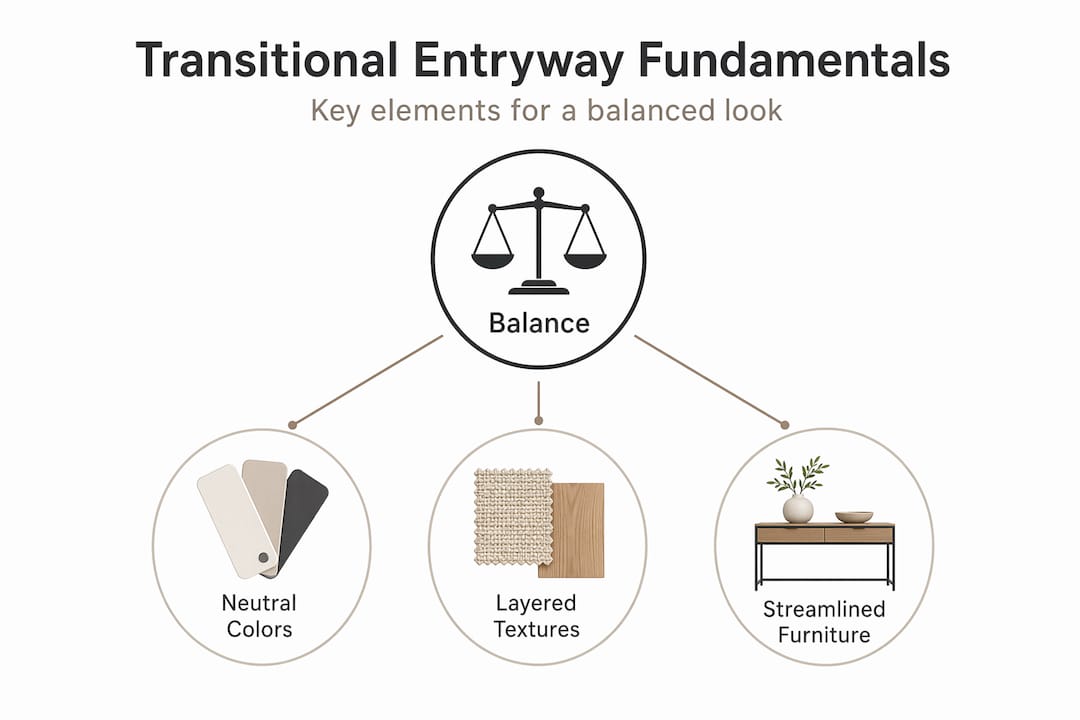
At its core, transitional entryway style is about balance. It pairs the comfort and warmth of traditional design with the clean lines and restraint of modern design, creating a space that feels welcoming without looking dated and current without feeling cold. The style resists hard trends, which is precisely why it holds its value across decades.
The transitional style fundamentals are straightforward: neutral color palettes, layered textures, and furniture that mixes curves with straight edges. As StoneGable puts it, transitional style merges traditional charm and modern simplicity through neutral colors, balanced textures, and simple lines. The result is an entryway that reads as neither stuffy nor stark.
Here is what defines transitional style in an entryway:
- Neutral color base. Soft grays, warm whites, and creamy beiges form the foundation rather than dramatic jewel tones or stark black and white.
- Restrained ornamentation. Furniture may have a turned leg or subtle molding, but carvings are simplified and kept to a minimum.
- Mixed materials. Wood, metal, and fabric coexist without competing. Think an oak bench with brushed nickel hardware and a linen cushion.
- Balanced proportions. Pieces feel substantial but not heavy. Nothing dominates the room visually.
- Functional elegance. Storage is built in, concealed, or visually quiet. The entryway works hard without looking like it does.
The challenge most homeowners face is that custom furniture masterpieces require a clear brief before a single board is cut. Transitional style gives craftsmen exactly that: a consistent, defined aesthetic with enough flexibility to tailor each piece to your specific space.
Key design elements and the 70-20-10 color rule in transitional entryways
Color is where most transitional entryway projects either succeed or stall. The 70-20-10 color rule gives you a precise, psychologically grounded framework: 70% neutral base, 20% deeper neutrals for accents, and 10% accent color for statement pieces.
Here is what that looks like in practice:
- 70% neutral base. Warm white or soft gray on walls, a large console in creamy oak, a painted wainscot panel. This is the visual breathing room of the space.
- 20% deeper neutral accents. Charcoal or navy in an upholstered bench cushion, a darker wood tone in a framed mirror, or a wrought-iron coat hook. These add definition without drama.
- 10% accent color. A single piece of artwork with warm terracotta tones, a ceramic bowl in dusty sage, or a textured throw in a muted blue. This is the personality of the room, kept intentionally quiet.
Texture layering is equally critical. A transitional entryway in a Maryland colonial home might combine wide-plank white oak flooring, a linen-upholstered bench, a matte black pendant light, and a woven jute runner. Each material is different, but none fights for attention. The effect is rich without being busy. You can find color palette ideas that align with this approach across a wide range of interior styles.
Pro Tip: When selecting accent color, pick it last. Choose your 70% and 20% materials first, then let the accent color emerge from what is already in the space, a tone pulled from the wood grain, the stone flooring, or artwork you already own.
Furniture and layout best practices for Maryland transitional entryways
Understanding color and texture prepares you to make smart furniture and layout decisions. In Maryland homes, entryways range from tight colonial foyers to wide farmhouse mudrooms, and transitional style scales well across all of them.
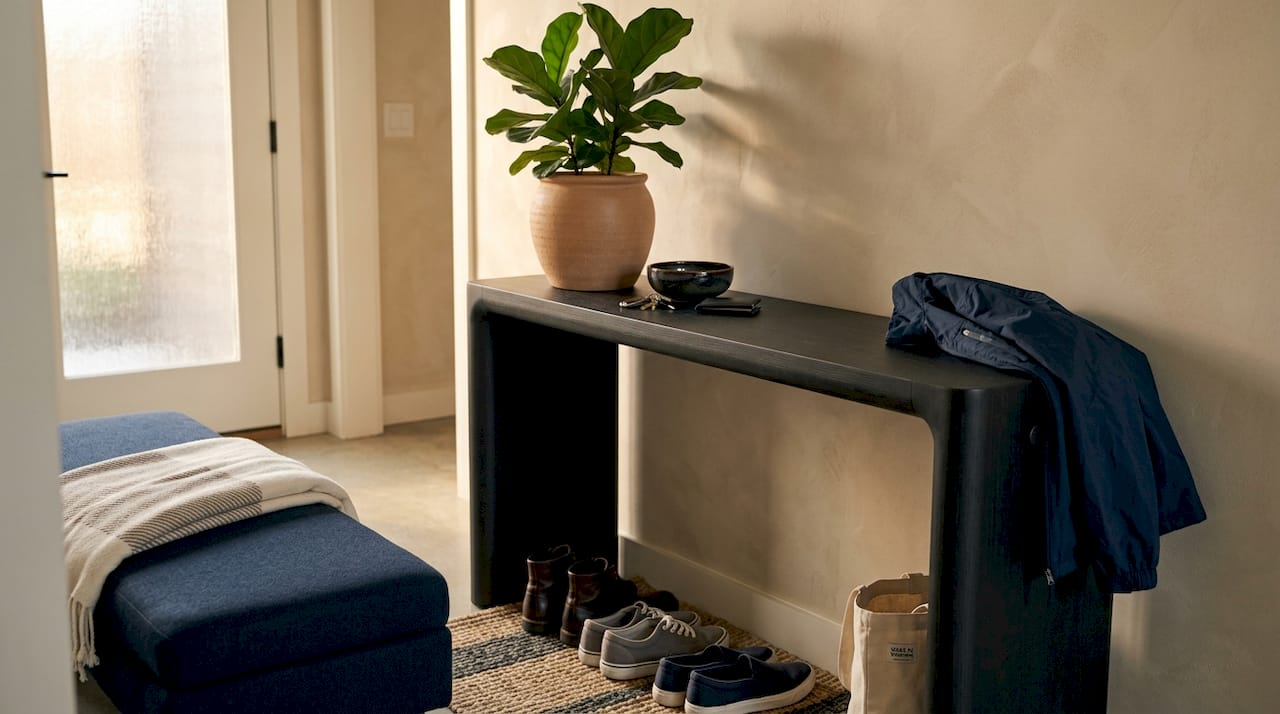
The starting point is your console table or built-in storage. Look for pieces that blend a softened silhouette (a gentle curve at the apron, a tapered leg) with practical storage at the base. Pair it with a bench that has an upholstered seat and a lower shelf for shoes or baskets.
For spatial planning, the numbers matter:
| Element | Recommended sizing | Why it matters |
|---|---|---|
| Built-in bench depth | 18 to 20 inches | Comfortable seating without blocking traffic |
| Walkway clearance | 24 to 30 inches minimum | Open flow prevents congestion |
| Console table height | 30 to 32 inches | Standard ergonomic reach for keys and mail |
| Mirror height above console | 6 to 8 inches | Visual proportion and reflected light |
| Overhead pendant height | 7 feet minimum from floor | Clearance without feeling low |
Modular built-in storage with 24 to 30 inches of clearance offers practical storage and seating while maintaining an open flow in transitional entryways. That clearance number is not arbitrary: it matches the ADA minimum for accessible passage and also happens to be what the human eye reads as “breathable” in a corridor space.
Key furniture choices for your transitional entryway:
- Console tables in neutral-toned wood with brushed metal hardware
- Upholstered benches in performance fabric (linen or textured weave holds up to Maryland winters)
- Built-in cubbies or mud lockers with solid-panel doors to conceal shoes and backpacks
- Layered lighting: one pendant overhead, two wall sconces flanking a mirror
Pro Tip: If your Maryland entryway is narrower than 5 feet, skip a freestanding console entirely and go straight to a shallow built-in with a depth of 12 to 14 inches. You recover floor space and still get full storage function through custom furniture services designed to your exact dimensions.
Distinguishing transitional from traditional and contemporary styles
With furniture and layout clear, it helps to understand exactly where transitional style sits relative to its neighbors. Confusion between these three styles is the most common reason homeowners end up with an entryway that feels “off.”
Transitional interiors use streamlined furniture and neutral palettes versus traditional’s ornate carvings and jewel tones, offering significantly more flexibility for custom craftsmanship. Here is a direct comparison:
| Feature | Traditional | Transitional | Contemporary |
|---|---|---|---|
| Color palette | Rich jewel tones, dark woods | Soft neutrals, warm whites | High contrast, bold black and white |
| Furniture lines | Ornate, carved, curved | Mixed: soft curves and straight | Strictly geometric, minimal |
| Ornamentation | Heavy moldings, fringe, tassels | Subtle molding, restrained detail | None or purely structural |
| Warmth | High, sometimes heavy | Balanced | Low, can feel cold |
| Adaptability over time | Low (trend-sensitive) | High (timeless) | Moderate (shifts with design trends) |
| Best for custom work | Requires skilled carvers | Highly flexible for craftsmen | Requires precision fabrication |
The practical distinction comes down to this:
- Traditional demands commitment to a period or aesthetic. It looks extraordinary when done fully, but one wrong piece can undermine the whole effect.
- Contemporary rewards restraint and precision. A single mismatched texture or color temperature breaks the logic of the room.
- Transitional has the widest tolerance. It absorbs a family heirloom, a new custom bench, and a contemporary pendant light and makes them coexist. That flexibility is not a weakness. It is the style’s greatest design strength.
Practical tips and expert insights for perfecting your transitional entryway
Now that you know the core principles and comparisons, here are the specific moves that separate a good transitional entryway from a great one.
Mirrors and visual expansion. A large mirror placed opposite a window or above a console can expand the perceived width of a narrow Maryland hallway significantly. The effect is not just cosmetic: reflected light makes the space feel more open and welcoming before a guest even removes their coat.
Material pairing. The most reliable transitional combination for furniture is oak wood with nickel or brass finishes. Oak reads warm and natural. Brushed nickel reads clean and modern. Together, they hit the exact midpoint the style aims for. Avoid pairing cold materials like chrome and glass with dark stained wood; the contrast tips into contemporary rather than transitional.
Storage depth discipline. Keep built-in storage between 18 and 24 inches deep. Shallower than 18 inches and bags and boots won’t fit properly, defeating the function. Deeper than 24 inches and the unit starts projecting into the entryway, making the space feel consumed by storage rather than organized by it.
“Layering wall sconces with pendants avoids harsh shadows, which is critical for spaces with low natural light.” ND Interiors
This is especially relevant for Maryland homes, where many older colonial and craftsman-style foyers have no exterior-facing windows and rely entirely on artificial light. A single overhead fixture creates a flat, harsh pool of light. Layered sconces with pendants wrap the walls in warm, even illumination that feels intentional rather than institutional.
Additional expert moves:
- Add a low-profile tray on your console top for keys and mail. It adds containment without adding visual weight.
- Choose hardware finishes that match across all pieces. Inconsistent finishes are the fastest way to make a transitional space feel accidental.
- Bring in one natural element: a small plant, a stone bowl, a wooden tray. It softens the engineered quality of the room.
Pro Tip: When selecting materials for custom furniture craftsmanship, ask your craftsman for samples of the wood finish, hardware, and fabric together before any production begins. Approving materials in isolation is one of the most common and costly mistakes in custom furniture projects.
Why transitional entryway style is the smarter, lasting choice for Maryland homes
Here is an opinion we hold firmly after more than 20 years crafting entryway furniture for Maryland homes: most homeowners underestimate how expensive chasing trends really is.
A fully contemporary entryway built around the ultra-minimalist aesthetic of 2019 looks dated now. A fully traditional entryway loaded with ornate millwork and hunter green walls requires a complete overhaul if a homeowner’s taste shifts even slightly. Transitional style does not have this problem. Because it is built on balance rather than a specific moment in design culture, it absorbs change rather than resisting it.
Transitional style’s timeless appeal and balanced design are projected to grow annually through 2027 due to its lasting sophistication. That sustained growth is not driven by fashion. It is driven by function. Homeowners and designers keep returning to transitional style because it works across architectural contexts, family needs, and resale considerations.
For Maryland specifically, the regional housing stock makes transitional style a natural fit. Colonial revivals, craftsman bungalows, and newer construction all coexist in neighborhoods across Baltimore, Bethesda, Annapolis, and Frederick. A single design language that bridges traditional and modern reads comfortably in all of them.
The deeper argument for transitional style is this: when you invest in custom transitional furniture, you are buying a piece that was made for your specific home, your specific dimensions, and your specific life. It is not going out of style because it was never built around a trend. It was built around enduring principles of proportion, material, and craft. That is a fundamentally different and better investment.
Explore custom transitional entryway furniture by Furniture Design Group
You now have a clear picture of what makes transitional entryway style work and what it takes to get it right. The next question is who builds it.

At Furniture Design Group, we have spent over 20 years crafting custom entryway furniture for Maryland homeowners and interior designers who refuse to settle for stock solutions. Every console, bench, and mud locker we build is designed to your exact dimensions, in the materials and finishes you select, with joinery built to last decades. Browse our furniture gallery to see transitional entryway work that has been installed in homes across the state. When you are ready to discuss your project, our team handles everything from initial design through final installation, and we welcome visits to our Maryland showroom. The craft is local. The results are permanent. Explore our custom furniture masterpieces and start the conversation.
Frequently asked questions
What defines transitional entryway style?
It blends traditional warmth with modern simplicity using neutral colors, balanced textures, and streamlined furniture to create a timeless, comfortable look. Transitional furniture combines curves with straight lines, warmth with simplicity, and texture with restraint for a balanced result.
How does the 70-20-10 color rule work in transitional entryways?
70% of the space uses neutral base colors on walls and large furniture, 20% uses deeper neutrals in accents, and 10% is reserved for subtle pops of accent color in artwork or a statement piece. The 70-20-10 rule creates psychological calm and texture balance simultaneously.
What furniture works best in a transitional entryway?
Streamlined console tables with soft curves, neutral upholstered benches, and custom built-in storage that blends traditional warmth with modern simplicity all work well. Transitional entryway furniture uses soft curves and straight lines together to hit the right balance.
How do you optimize lighting in a transitional entryway with little natural light?
Layer wall sconces with pendant lighting to avoid harsh shadows and create even, welcoming illumination throughout the space. Layering sconces with pendants is especially important in Maryland homes where many foyers have no exterior-facing windows.