
TL;DR:
- Luxury furniture is characterized by high-quality materials, precise craftsmanship, and restrained design that ages gracefully. Genuine pieces develop character over time through rich materials like full-grain leather and solid hardwoods, with construction details revealing true quality. Assessment includes tactile testing, evaluating joinery, finish depth, and material weight, reinforcing that genuine luxury emphasizes longevity and thoughtful intentionality.
Luxury furniture is defined by the convergence of superior materials, expert construction, and purposeful design that delivers enduring beauty and performance over decades of daily use. Price alone does not determine this category. Brands like Poltrona Frau, Cassina, and B&B Italia have built their reputations not on cost but on the measurable quality of every component, joint, and finish. What defines luxury furniture is a commitment to longevity and sensory refinement that standard production simply cannot replicate. Understanding these distinctions helps you invest wisely rather than pay a premium for marketing alone.
What defines luxury furniture: the core qualities
Luxury furniture sits at the intersection of material integrity, construction discipline, and design restraint. These three pillars work together. A piece built from walnut with imprecise joinery is not luxury. A beautifully proportioned sofa filled with low-density foam fails the same test. True high-end furniture delivers on all three dimensions simultaneously, and that coordination is rare.
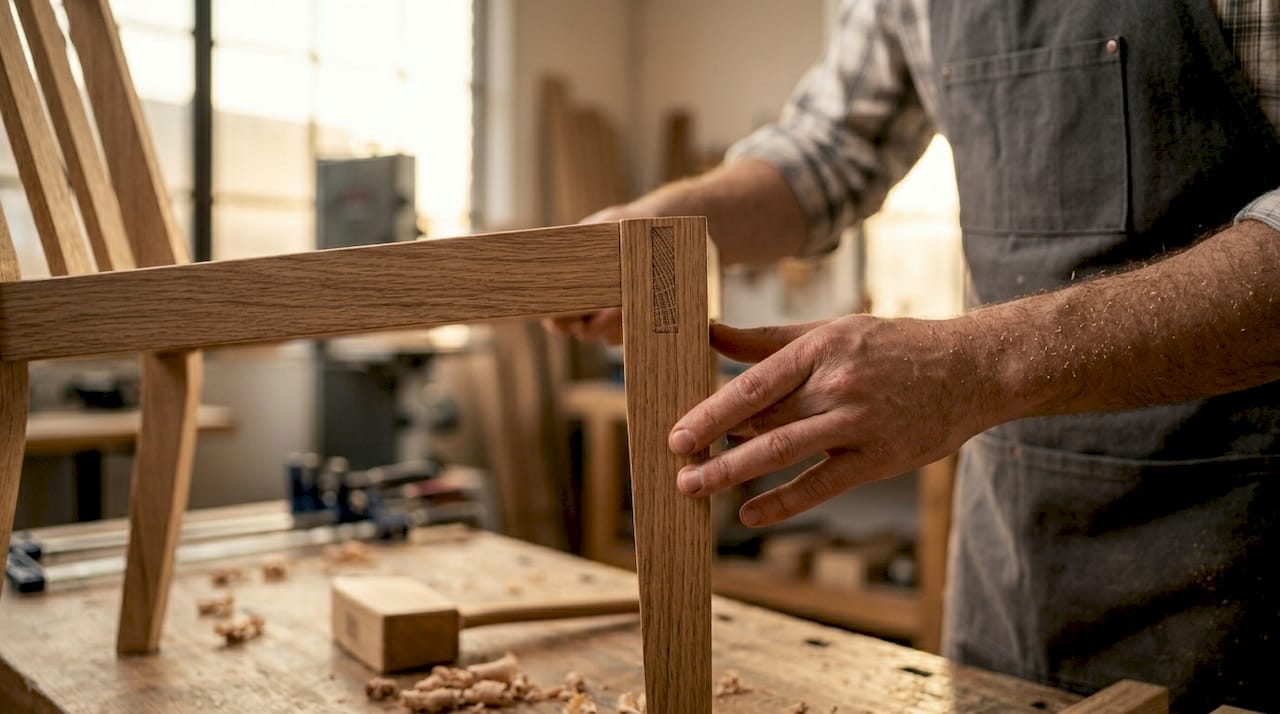
The industry term for this category is “bespoke” or “contract-grade” furniture, depending on context. Bespoke refers to made-to-order pieces crafted to specification. Contract-grade describes furniture built to withstand commercial use standards, which often exceeds residential quality benchmarks. Both terms signal a level of specification and accountability that mass production avoids.
What makes furniture luxurious is also its relationship with time. Standard furniture deteriorates. Luxury furniture develops. A full-grain leather chair from Poltrona Frau darkens and softens with use, acquiring character rather than showing damage. That distinction is the clearest signal of genuine quality.
What key materials set luxury furniture apart from standard furniture?
Materials are the foundation of every quality claim in high-end furniture. The difference between luxury and standard is not always visible at first glance. It becomes apparent over years of use.
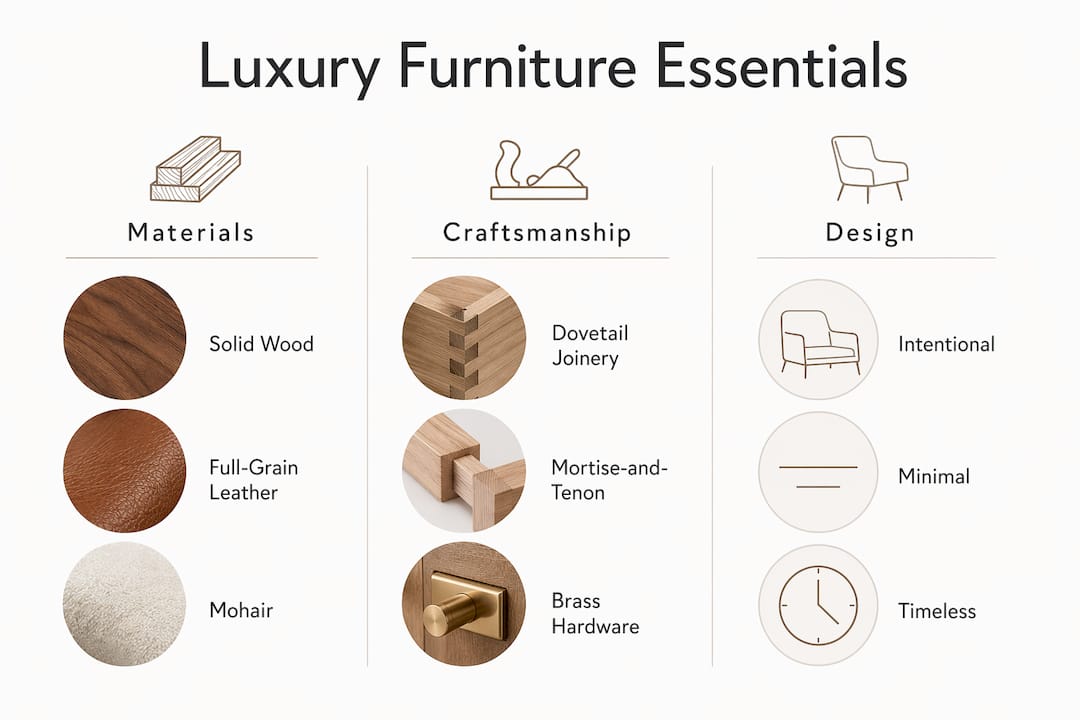
Full-grain leather is the highest grade available, retaining the hide’s natural surface and grain. Corrected-grain leather sands away imperfections and applies a uniform coating, which looks consistent initially but cracks and peels within years. Synthetics like bonded leather or PU degrade faster still. Luxury finishes develop patina over time, enhancing visual depth and tactile warmth, unlike commodity coatings that merely show wear.
Hardwoods define the structural character of luxury case goods and frames:
- Walnut offers a rich, dark grain that deepens under UV exposure over years.
- Mahogany provides exceptional stability and a fine, straight grain suited to precision joinery.
- Rosewood delivers density and natural oils that resist warping and insect damage.
These species age with dignity. Medium-density fiberboard and particleboard, common in standard furniture, swell with moisture and chip at edges within a few years of normal use.
Metal hardware and structural elements also separate categories. Solid brass oxidizes warmly, developing a living patina that reads as quality. Coated steel or zinc alloy hardware looks similar initially but corrodes or chips under daily contact. The difference is tactile before it is visual.
Luxury upholstery textiles include mohair, bouclé wool, and cashmere blends. These fabrics have complex fiber structures that resist pilling and hold color depth far longer than polyester or low-grade cotton weaves. Mohair in particular has a natural luster that shifts with light, giving a piece visual complexity that synthetic alternatives cannot produce.
Pro Tip: When evaluating upholstery fabric, run your palm firmly across the surface three times. Luxury textiles show no pilling or fiber disturbance. Standard fabrics often show micro-fuzz immediately.
How does craftsmanship and construction quality define luxury furniture?
Construction quality is where the characteristics of luxury furniture become measurable rather than subjective. You can test most of these indicators in a showroom within five minutes.
Here are the primary construction signals to evaluate:
- Frame joinery. Mortise-and-tenon and dovetail joints resist racking forces that cause wobbling over time. Stapled or glued butt joints, common in mass production, fail under repeated stress.
- Foam density. High-density foam at or above 1.8 PCF is the standard for luxury residential cushions. Foams in the 1.0 to 1.5 PCF range compress and sag within 18 to 24 months of regular use.
- Hardware weight. Drawer slides, hinges, and pulls in luxury pieces use solid metal components with smooth, damped action. Lightweight hardware rattles and loosens.
- Seam discipline. Upholstery seams on luxury pieces run straight, with consistent stitch density and no puckering at corners. Sloppy seams signal rushed production.
- Finish application. Oil, wax, and catalyzed lacquer finishes on wood produce complex, layered patinas. Finishing selection matches material aging properties, unlike uniform polyurethane coatings that yellow and peel.
Pro Tip: Sit in any sofa or chair you are considering and shift your weight laterally. A luxury frame produces no flex, creak, or movement. Any audible response signals frame weakness.
| Feature | Luxury furniture | Standard furniture |
|---|---|---|
| Frame joinery | Mortise-and-tenon, dovetail | Stapled butt joints, glue |
| Foam density | 1.8+ PCF with layered fill | 1.0–1.5 PCF, single layer |
| Wood species | Solid walnut, mahogany, rosewood | MDF, particleboard, pine veneer |
| Upholstery fabric | Mohair, bouclé, cashmere | Polyester, bonded leather |
| Finish type | Oil, wax, catalyzed lacquer | Polyurethane spray coat |
Weight and material substance serve as reliable proxy indicators. Heavier solid wood pieces resist racking and hold a calm, grounded presence in a room. If a piece claiming solid wood construction feels light enough to move with one hand, the claim is almost certainly false.
Craftsmanship details such as seam straightness and hardware quality distinguish true luxury from marketing language. A piece that holds up under daily use without chipping, squeaking, or loosening is the practical definition of quality construction.
What role do design aesthetics and intentionality play?
Design is the third pillar of luxury furniture, and it is the most misunderstood. Many buyers equate luxury with ornamentation: carved details, gilded edges, or dramatic silhouettes. The opposite is closer to the truth.
Design aesthetics in luxury furniture emphasize intentionality and restraint, producing timeless appeal that transcends seasonal trends. A piece designed with restraint reads as composed and confident. A piece loaded with decorative detail often looks dated within a decade.
The qualities of high-end furniture design include:
- Proportion. Leg height, seat depth, and back angle work together to create visual balance and physical comfort simultaneously.
- Silhouette clarity. The outline of a piece reads cleanly from across a room, without visual noise from unnecessary detail.
- Material behavior in light. Walnut grain shifts from warm amber to deep chocolate as daylight moves across it. Mohair changes sheen with viewing angle. These qualities give a room life that painted MDF cannot.
- Spatial integration. Luxury pieces relate to their surroundings rather than competing with them. Scale, color, and texture are chosen to work with architecture, not against it.
“Luxury is connected to the feeling of care and longevity. The most refined pieces are those where you sense the maker’s attention in every surface, not just the visible ones.”
This principle applies directly to how you evaluate a purchase. A piece that photographs well but feels hollow or lightweight in person has prioritized appearance over substance. Genuine luxury furniture rewards physical interaction. The tactile experience confirms what the eye suspects.
How to practically assess and choose luxury furniture
Choosing luxury furniture that delivers real long-term value requires moving past brand names and price tags. The evaluation process is hands-on and specific.
Red flags to avoid:
- Vague material descriptions like “wood frame” or “leather-look” without species or grade specification
- Pieces that feel light relative to their size, suggesting hollow construction or MDF cores
- Upholstery with visible seam inconsistency or fabric that pills on first contact
- Hardware that wobbles, rattles, or requires force to operate smoothly
- Finishes that look uniform and plastic-like rather than showing depth or grain variation
Questions to ask before purchasing:
- What is the foam density in PCF, and is it layered with different ILD ratings for comfort and support?
- What joinery method is used in the frame, and is the wood solid or veneered over engineered core?
- What finishing process was applied to wood surfaces, and how should it be maintained?
- Is this piece made to order, or pulled from standing inventory?
Transparency about materials and construction details reflects authenticity. Manufacturers who cannot or will not answer these questions directly are signaling that the answers would not support the price.
Made-to-order furniture integrates with architectural space, treating joinery as part of the interior architecture rather than as standalone objects. This is the defining advantage of bespoke over off-the-rack. A custom mud locker or entryway unit built to your ceiling height, wall width, and material preferences does not just fit the space. It becomes the space. That level of integration is impossible with mass-produced pieces.
Pro Tip: Ask for a material sample before committing to any upholstered piece. Live with the fabric swatch in your home for 48 hours, observing how it reads in your specific light conditions at different times of day.
When you explore bespoke furniture options, the customization process itself reveals quality. A maker who asks detailed questions about your space, usage patterns, and material preferences is operating at a different level than one who offers a catalog with fixed configurations.
Key takeaways
Luxury furniture is defined by the simultaneous delivery of superior materials, precise construction, and restrained design, with each element reinforcing the others to produce pieces that improve with age rather than deteriorate.
| Point | Details |
|---|---|
| Materials determine longevity | Full-grain leather, solid hardwoods, and mohair develop patina rather than showing wear. |
| Foam density is measurable | Cushions at 1.8+ PCF resist sagging under daily use; anything below 1.5 PCF fails within two years. |
| Construction reveals truth | Mortise-and-tenon joinery, straight seams, and solid hardware distinguish real quality from marketing claims. |
| Design restraint signals luxury | Timeless proportion and silhouette clarity outlast trend-driven ornamentation by decades. |
| Bespoke delivers integration | Made-to-order furniture becomes part of the architecture, not just an object placed within it. |
Why luxury furniture is felt before it is seen
I have spent over two decades working with materials, makers, and clients who care deeply about what they bring into their homes. The single most consistent observation I can share is this: genuine luxury furniture announces itself through touch, not sight.
Clients who walk into our showroom at Furnituredesigngroup often reach out and run a hand across a surface before they say a word. That instinct is correct. The weight of a drawer, the resistance of a hinge, the temperature of solid brass hardware. These are the signals that confirm quality before the eye has processed proportion or finish.
The furniture industry produces a lot of beautiful photography. A piece can look extraordinary in a styled shoot and feel hollow and lightweight in person. I have seen pieces priced at significant premiums that failed every hands-on test. I have also seen modest-looking custom work that revealed extraordinary quality the moment you sat in it or opened a door.
My honest view is that transparency is the clearest indicator of genuine luxury. A maker who can tell you the foam density, the joinery method, the wood species, and the finishing process without hesitation is a maker who has nothing to hide. That confidence comes from knowing the work is right. Anything less than that level of specificity should make you cautious, regardless of the brand name on the label.
Bespoke furniture, built to your space and specifications, is where this transparency is most natural. When we build a piece at Furnituredesigngroup, every decision is documented and discussed. That process is itself a form of quality.
— Donovan
Experience true craftsmanship with Furnituredesigngroup
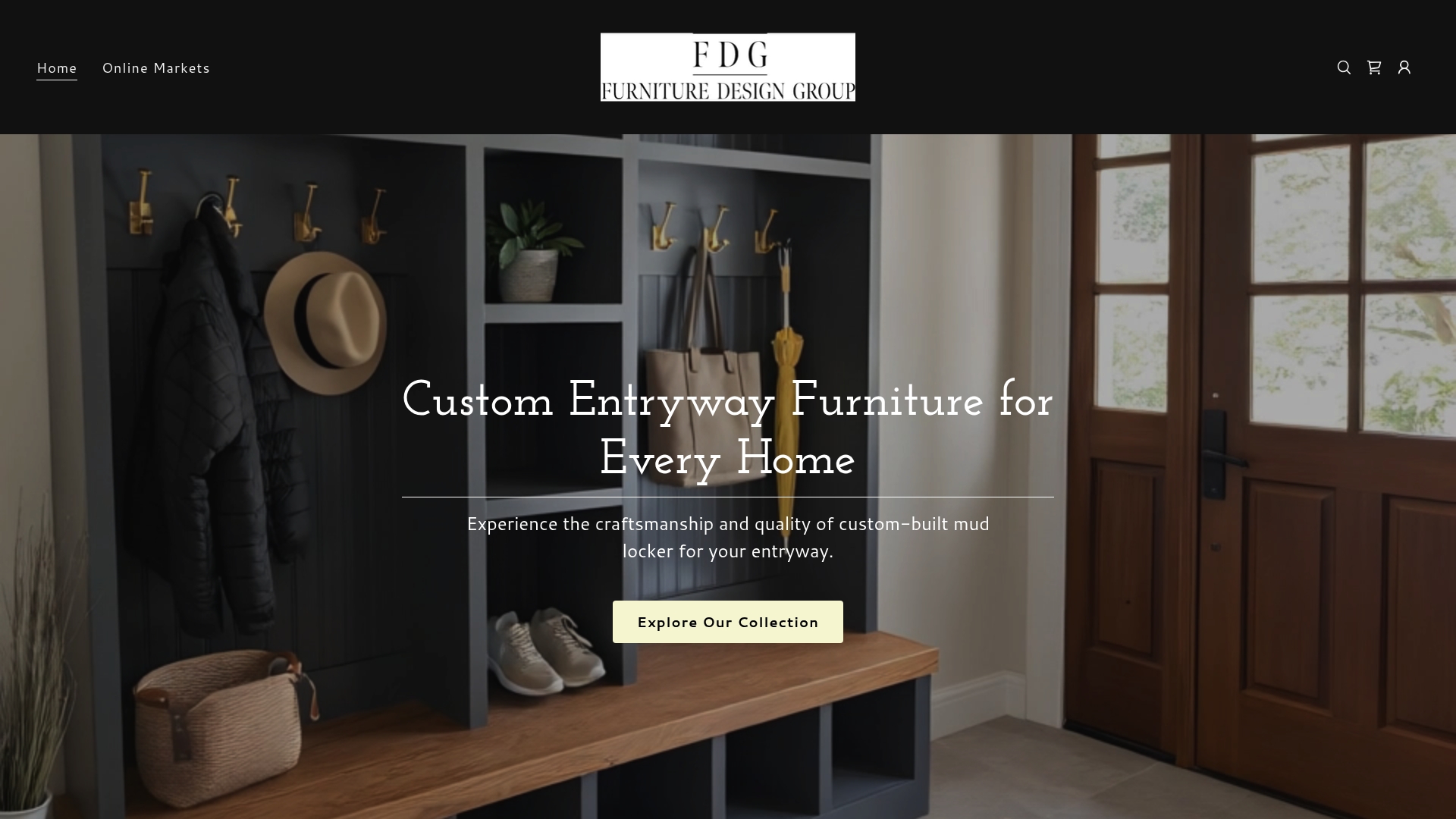
Furnituredesigngroup brings over 20 years of hands-on craftsmanship to every piece we build. Based in Maryland, we specialize in custom-crafted furniture built to the material and construction standards this article describes: solid hardwood frames, precision joinery, and finishes selected to age beautifully rather than simply look good on day one. Every piece is made to order, which means it is built for your space, your specifications, and your long-term satisfaction. If you are ready to see what genuine craftsmanship looks like in practice, visit our furniture gallery or contact us directly to discuss your project. We welcome showroom visits and are happy to walk you through materials, construction details, and design options in person.
FAQ
What defines luxury furniture beyond price?
Luxury furniture is defined by material grade, construction precision, and design intentionality rather than cost alone. Full-grain leather, solid hardwood joinery, and high-density foam are the measurable indicators that separate genuine quality from premium pricing.
What foam density should luxury furniture cushions have?
Residential luxury cushions start at 1.8 PCF and often use layered fill combining different density and ILD ratings for both durability and comfort. Foam below 1.5 PCF compresses and sags within 18 to 24 months of regular use.
How does luxury furniture age differently from standard furniture?
Luxury finishes develop patina over time, with full-grain leather softening, brass oxidizing warmly, and hardwood deepening under UV exposure. Standard furniture with corrected-grain leather or polyurethane finishes cracks, chips, and fades instead.
What are the most reliable construction signals to check in a showroom?
Sit in the piece and shift your weight laterally to test for frame flex or creaking. Open any drawers or doors to assess hardware smoothness. Examine upholstery seams for consistent stitch density and straight lines. Luxury furniture holds up under daily use without flexing, squeaking, or showing sloppy finishing.
Is bespoke furniture worth the investment over off-the-rack luxury pieces?
Custom furniture integrates with architectural space in ways that mass-produced pieces cannot, controlling sightlines, scale, and material continuity throughout a room. For spaces where fit and longevity matter, bespoke delivers measurably better results than selecting from fixed catalog configurations.