
TL;DR:
- Heirloom-quality furniture is crafted with lasting materials, expert joinery, and timeless design to endure generations of daily use.
- Choosing such furniture for your Maryland home provides long-term value, environmental benefits, and a legacy for future families.
Most people assume “heirloom-quality” is just a price tag in disguise. They picture expensive antiques collecting dust in a formal living room or a grandfather’s old rocker that nobody actually uses. That assumption misses the entire point. True heirloom-quality furniture is about craftsmanship built to outlast trends, materials chosen for strength over convenience, and design so timeless it belongs in any era. For Maryland homeowners thinking about their entryways, understanding this distinction can completely change how you invest in your home and what you leave behind for the next generation.
Table of Contents
- Defining heirloom-quality furniture
- Core elements: Craftsmanship, materials, and design
- The value of heirloom furniture in your Maryland home
- How to care for and maintain heirloom-quality furniture
- Why heirloom-quality matters more now than ever
- Discover custom heirloom-quality options with Furniture Design Group
- Frequently asked questions
Key Takeaways
| Point | Details |
|---|---|
| Clear definition | Heirloom-quality furniture is defined by expert craftsmanship, premium materials, and lasting design. |
| Durability advantage | These pieces far outlast typical mass-market furniture, reducing replacement needs and costs. |
| Family legacy | Choosing heirloom-quality pieces helps create lasting memories and value for future generations. |
| Smart care tips | With proper maintenance, heirloom-quality furniture remains beautiful and valuable for decades. |
| Local expertise | Maryland homeowners can access custom heirloom-quality entryway furniture tailored to their needs. |
Defining heirloom-quality furniture
With the stage set, let’s unpack what “heirloom-quality” genuinely means.
The word “heirloom” gets thrown around so loosely that it has lost some of its power. You will see it on flat-pack furniture assembled with Allen wrenches and on pieces that start warping after two winters. That kind of labeling is misleading. Real heirloom-quality furniture is defined by lasting craftsmanship, fine materials, and the ability to be passed through generations, not just a higher price or an older date stamp.
Three pillars hold up any genuine heirloom piece:
- Expert craftsmanship: Joints fitted by hand, surfaces sanded to perfect smoothness, and structural details that hold together under decades of daily use.
- Premium materials: Solid hardwoods, natural finishes, and hardware chosen for function and longevity rather than appearance alone.
- Timeless design: Proportions and silhouettes that feel at home in a 1940s farmhouse or a 2026 Maryland colonial without ever looking dated.
A common misconception is that age alone creates heirloom status. A 50-year-old piece of poorly made furniture is still poorly made furniture. Another misconception is that heirloom pieces are always formal or decorative, sitting untouched in a parlor. In reality, the best heirloom furniture earns its status through daily use. An entryway mud locker that absorbs 20 years of boots, backpacks, and winter coats and still looks beautiful is the definition of an heirloom in action.
“The furniture most likely to be passed down is the furniture most likely to survive every day you actually live in your house.”
Our custom furniture services at Furniture Design Group are built around exactly this idea. Every piece we create is designed to function hard and still look stunning decades from now.
Pro Tip: When shopping for any furniture described as “heirloom-quality,” ask the maker to show you the joinery. Dovetail joints, mortise and tenon connections, and hand-fitted dowels are signs of real craftsmanship. Staples and glue blocks are not.
Core elements: Craftsmanship, materials, and design
Now that you understand what defines heirloom-quality, let’s examine what makes these pieces stand out in everyday settings.
Craftsmanship: Handmade versus mass-produced
The difference between hand-crafted and mass-produced furniture becomes clear the moment you open a drawer. In a mass-produced piece, the drawer slides on plastic glides and the bottom panel is stapled to a thin frame. In a hand-crafted heirloom piece, the drawer is fitted with wooden runners, the bottom floats inside a groove to allow natural wood movement, and every surface is finished by hand. That extra care adds hours to the build. It also adds decades to the life of the piece.
Skilled furniture makers still use techniques developed hundreds of years ago because those techniques simply work. Hand-cut dovetail joints, for example, create mechanical interlocking connections that actually grow tighter over time. No amount of mass production can replicate that without losing the precision that makes it effective.
Materials: What actually matters
Premium woods, joinery, and finishes are the foundation of heirloom-quality furniture. When we talk about premium woods, we mean species like white oak, cherry, walnut, and hard maple. These are dense, stable hardwoods that resist denting, warping, and splitting over time. They also accept stains and finishes beautifully, which means refinishing 30 years from now will reveal gorgeous grain instead of a blotchy surface.
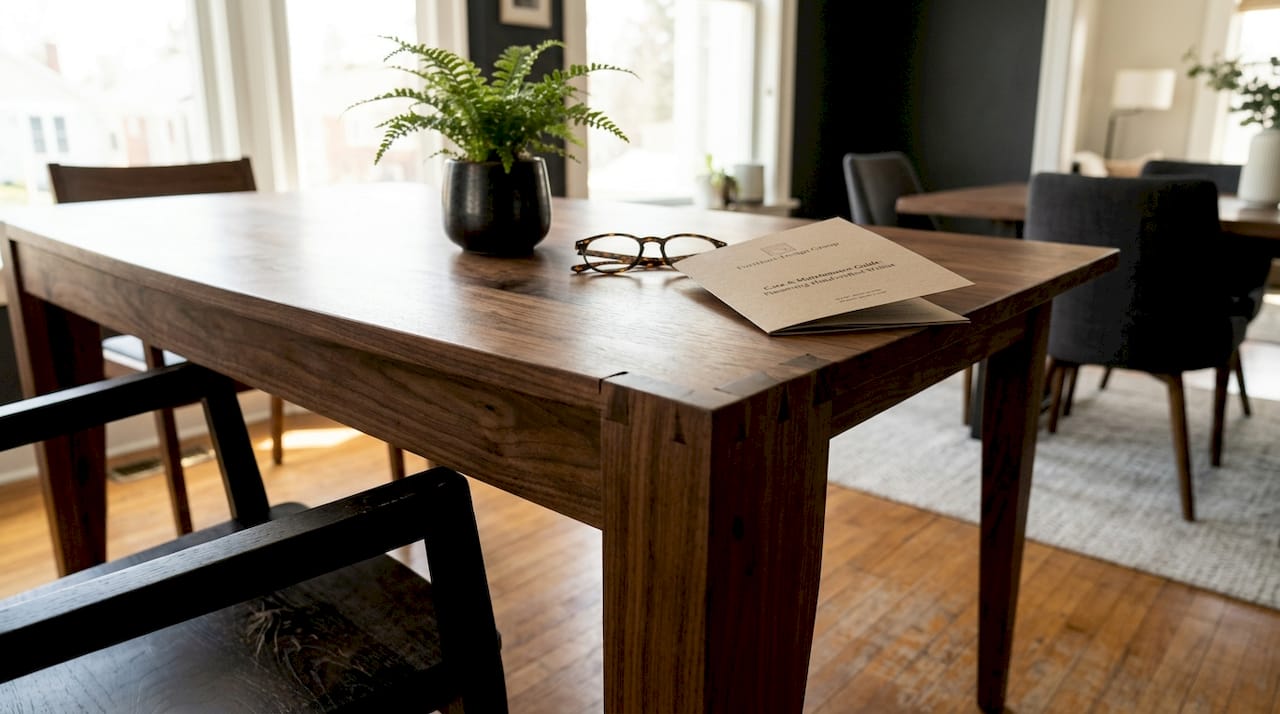
Hand-applied finishes are another marker of quality. A brush-on or hand-rubbed oil finish soaks into the wood rather than sitting on top of it like a plastic film. This protects the wood from within and allows it to breathe with seasonal humidity changes, which is especially important in Maryland’s climate with its humid summers and dry winters.
Design: Timeless versus trendy
Trends in furniture come and go fast. Farmhouse style replaced mid-century modern, which replaced coastal, which will be replaced by something else by the time you read this. Heirloom design sidesteps all of that by focusing on proportion, balance, and function. A well-proportioned bench with clean lines and solid joinery will look right in your entryway whether it was built in 1985 or built this year. That is the power of crafting custom masterpieces with timeless intent.
Comparison table: Heirloom-quality vs. mass-market furniture
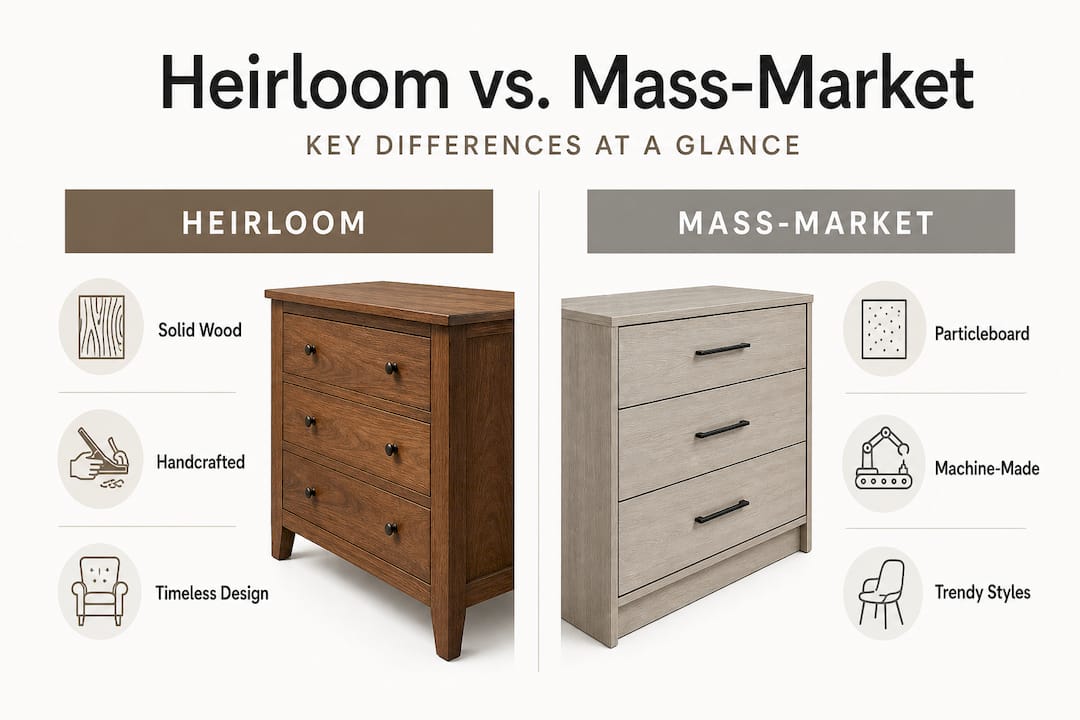
| Feature | Heirloom-quality | Mass-market |
|---|---|---|
| Construction method | Hand-crafted, traditional joinery | Machine-assembled, staples and glue |
| Materials | Solid hardwoods, natural finishes | Particle board, veneers, MDF |
| Lifespan | 50 to 100+ years | 5 to 15 years |
| Repairability | Fully repairable and refinishable | Difficult to repair, usually disposable |
| Value over time | Retains or increases | Depreciates rapidly |
| Customization | Built to your specifications | Limited to available stock options |
Buyer checklist for real heirloom pieces:
- Check for solid wood construction, not veneer over particle board
- Look at the drawer bottoms and backs for plywood or solid wood panels
- Ask about the joinery method used at stress points
- Confirm that the finish is hand-applied rather than spray-lacquered at volume
- Request information about the wood species and its origin
Pro Tip: Lift the piece slightly off the ground. A solid hardwood construction has a satisfying weight to it. Lightweight furniture, regardless of how it looks, is almost always a sign of hollow cores or low-density materials underneath.
The value of heirloom furniture in your Maryland home
Knowing the elements, let’s see how heirloom-quality positively impacts your home and long-term investment.
Practical longevity and family legacy
Maryland homeowners deal with a specific set of conditions: humidity swings between seasons, busy family entryways that take a beating from muddy boots and wet umbrellas, and homes that often carry real historical character worth honoring. An entryway mud locker or storage bench built to heirloom standards handles all of this without flinching.
Heirloom-quality furniture outlasts standard pieces by decades and retains value over time. That is not just a selling point. It is a practical financial reality. When you replace a mass-market bench every 8 to 10 years, you spend more money over a 40-year period than you would have on a single well-built piece that needs only occasional refinishing.
Steps to bring heirloom pieces into your Maryland entryway:
- Assess your entryway’s daily demands. How many people use it? Does it need hooks, cubbies, a bench seat, or enclosed storage?
- Choose a wood species that fits your home’s existing style. White oak pairs beautifully with traditional Maryland architecture. Walnut adds warmth to more contemporary spaces.
- Work with a custom maker to specify dimensions that actually fit your space rather than working around a stock size.
- Select a finish that suits your household’s lifestyle. A hand-rubbed oil finish is easy to touch up, while a harder lacquer offers more surface protection in very high-traffic entries.
- Plan for the long term by asking about refinishing options and how the piece can evolve if your family’s needs change.
Sustainability and value retention
Choosing an heirloom piece is also an environmental decision. Disposing of furniture is a significant source of household waste, with millions of tons of furniture ending up in landfills annually across the United States. A piece built to last 80 years simply does not contribute to that cycle.
Solid hardwood can be refinished professionally to look brand new, refreshed to match updated decor, or repaired after damage that would destroy a lesser piece entirely. The ability to restore rather than replace is one of the most powerful financial and environmental advantages of heirloom-quality construction.
Value comparison over time:
| Furniture type | Initial cost | Replacements over 40 years | Total 40-year cost |
|---|---|---|---|
| Mass-market bench | $400 | 4 to 5 replacements | $1,600 to $2,000 |
| Heirloom-quality piece | $1,800 | 1 to 2 refinishes | $2,000 to $2,200 |
| Net difference | Roughly equal or less |
The numbers tell a clear story. The true cost of “affordable” furniture is often higher than the upfront investment in quality. Visit Furniture Design Group to explore what custom craftsmanship looks like at the entry level of your home.
How to care for and maintain heirloom-quality furniture
To get the full value and legacy from your heirloom furniture, smart care is essential.
Caring for heirloom furniture does not require a professional on speed dial or a complicated schedule. Most of what keeps these pieces looking great is simple, consistent, and takes almost no time at all.
Daily and weekly care:
- Dust with a soft, dry or slightly damp cloth. Microfiber works well for lifting dust without scratching surfaces.
- Avoid placing wet items directly on wood surfaces. Use trays or mats in entryways where boots and umbrellas arrive wet.
- Keep the piece out of direct sunlight over long periods. UV exposure fades finishes and dries out wood fibers over time.
- Use furniture coasters or felt pads under any items placed on the surface regularly.
Climate and placement in Maryland homes:
Maryland’s climate creates real challenges for wood furniture. Humidity levels shift significantly between July and January. Wood expands when it absorbs humidity and contracts when the air dries out. Heirloom furniture is built with this movement in mind, but extreme swings still stress any wood piece. Maintaining indoor humidity between 40 and 55 percent year-round protects both the finish and the structural integrity of the wood.
When to refinish versus touch up:
Minor scratches and small dings can often be addressed with wood touch-up markers, a matching wax stick, or a light sanding and spot finish application. But when a piece starts showing overall dullness, deep scratches, or uneven color across large areas, it is time to consider professional refinishing services. Proper care and refinishing are essential for maintaining heirloom pieces over time, and a professional refinish done correctly can make a 40-year-old piece look like it was built last week.
Getting professional support:
For Maryland homeowners, local craftspeople and finishing specialists understand regional wood behavior and can recommend finishes suited to the local climate. Furniture Design Group works closely with finishing experts and can advise on the best care routine for any piece we build.
Pro Tip: Once a year, apply a thin coat of paste wax or food-grade mineral oil to wood surfaces on your heirloom pieces. This takes about 15 minutes and adds a meaningful layer of protection that keeps the finish looking fresh between refinishing cycles.
When preserving custom furniture built from premium materials, the investment in periodic professional care is always worth it compared to the cost of replacing something irreplaceable.
Why heirloom-quality matters more now than ever
Stepping back, let’s consider why choosing heirloom-quality is about more than just furniture.
We live in an era where furniture is treated like fast fashion. A new sofa every three years. A replacement entry bench when the previous one starts wobbling. This cycle feels normal because the industry has made cheap, replaceable furniture the default. But there is a growing cost to that approach, and it goes beyond the landfill.
When you fill your home with disposable pieces, you also fill it with things that carry no real weight. Nothing in that category becomes meaningful. Nothing gets passed down. Nothing earns a story.
Heirloom furniture pushes back against that. A custom mud locker built in 2026 for a Maryland family becomes the piece that generations of kids hung their backpacks on before school. That is not sentimental marketing. That is what happens when you choose quality deliberately.
We have been building custom entryway furniture for Maryland families for over 20 years, and we have seen this play out. Clients come back years later not to replace a piece but to have us build a second one for a grown child moving into their own home. That is the real measure of heirloom-quality.
The sustainability argument also cannot be ignored. Buying one well-made piece versus four cheap replacements is a straightforward environmental win. Maryland homeowners who care about their homes and their community are in a natural position to lead by example here. Choosing heirloom-quality through exploring custom services is one of the most tangible ways to align your purchasing decisions with values that actually last.
The furniture industry will keep making things faster and cheaper. But some Maryland homeowners are choosing differently, and they are setting traditions that their families will carry forward for decades.
Discover custom heirloom-quality options with Furniture Design Group
Ready to bring timeless quality into your home? Here’s how to get started.
At Furniture Design Group, we have spent more than two decades building custom entryway furniture for Maryland homeowners who want something built to last. Every piece we craft starts with your space, your family’s needs, and your vision for what a beautiful, functional entryway should feel like.
Browse our custom furniture services to see the range of options we offer, from bespoke mud lockers to custom entry benches and storage systems. Our gallery of heirloom pieces showcases real Maryland homes where our work has become part of the family. When you are ready to talk specifics, our team will walk you through every decision involved in crafting masterpieces built around your home. Reach out today and let’s start building something worth passing down.
Frequently asked questions
What makes furniture heirloom-quality instead of just vintage or antique?
Heirloom-quality furniture is defined by superior craftsmanship and durability, not just age. It is built intentionally to last and be passed down, which means a new custom piece can qualify just as much as a century-old one.
Are custom entryway benches or cabinets suitable as heirloom pieces?
Absolutely. Custom entryway furniture built with premium woods and joinery meets every standard for heirloom quality and is well suited to becoming a lasting fixture in Maryland homes.
How do you maintain heirloom-quality wood furniture?
Regular dusting, protecting the surface from moisture, and scheduling periodic professional refinishing are the core practices that keep heirloom wood furniture looking great for generations.
Is heirloom-quality furniture a good investment?
Yes. These pieces outlast standard furniture by decades, reduce the cost and hassle of repeated replacements, and often hold or increase their value when properly maintained.