
TL;DR:
- Artisanal craftsmanship combines manual skill, material knowledge, and cultural tradition to produce high-quality, durable objects. It emphasizes control over the entire process, low-volume production, and unique variations as signs of authenticity. Supporting such craftsmanship helps preserve skills, promotes sustainability, and results in items with lasting value.
Most people assume artisanal craftsmanship simply means something made by hand. That assumption misses almost everything that matters. What is artisanal craftsmanship, really? It’s the intersection of specialized skill, material knowledge, cultural tradition, and a deliberate refusal to let speed win over quality. Whether you’re a DIY enthusiast trying to sharpen your eye, a homeowner choosing furniture that will outlast a decade of trends, or a designer sourcing pieces with real substance, understanding what separates true artisanal work from imitation is worth your time.
Table of Contents
- Key takeaways
- What is artisanal craftsmanship, exactly?
- Artisanal craftsmanship examples across disciplines
- Why artisanal craftsmanship matters today
- The artisanal process up close
- My take on what artisanal craftsmanship really means
- Custom furniture that embodies artisanal quality
- FAQ
Key takeaways
| Point | Details |
|---|---|
| More than handmade | Artisanal craftsmanship combines manual skill, process control, and material transparency — not just hand involvement. |
| Quality over volume | Low-volume, high-value production means each piece carries genuine human attention from raw material to final finish. |
| Built-in sustainability | Durable artisanal goods resist disposability and reduce long-term waste compared to mass-produced alternatives. |
| Imperfections signal authenticity | Slight variations in artisanal goods are signatures of human involvement, not flaws to avoid. |
| Identifiable in practice | True artisanal work shows specific techniques, material honesty, and traceable maker involvement you can learn to spot. |
What is artisanal craftsmanship, exactly?
The definition of artisanal craftsmanship starts with three things: manual skill, control over the entire production process, and a low-volume, high-value output. That’s not just a description of effort. It’s a different philosophy about what objects should be.
An artisan is a skilled craft worker who produces material objects partly or fully by hand using traditional methods. That definition from Merriam-Webster sounds simple, but the implications run deep. Control over the full process means the maker chooses materials, sets the pace, adjusts technique based on what the material is telling them, and bears responsibility for the outcome at every step. There is no assembly line dividing those decisions among strangers.
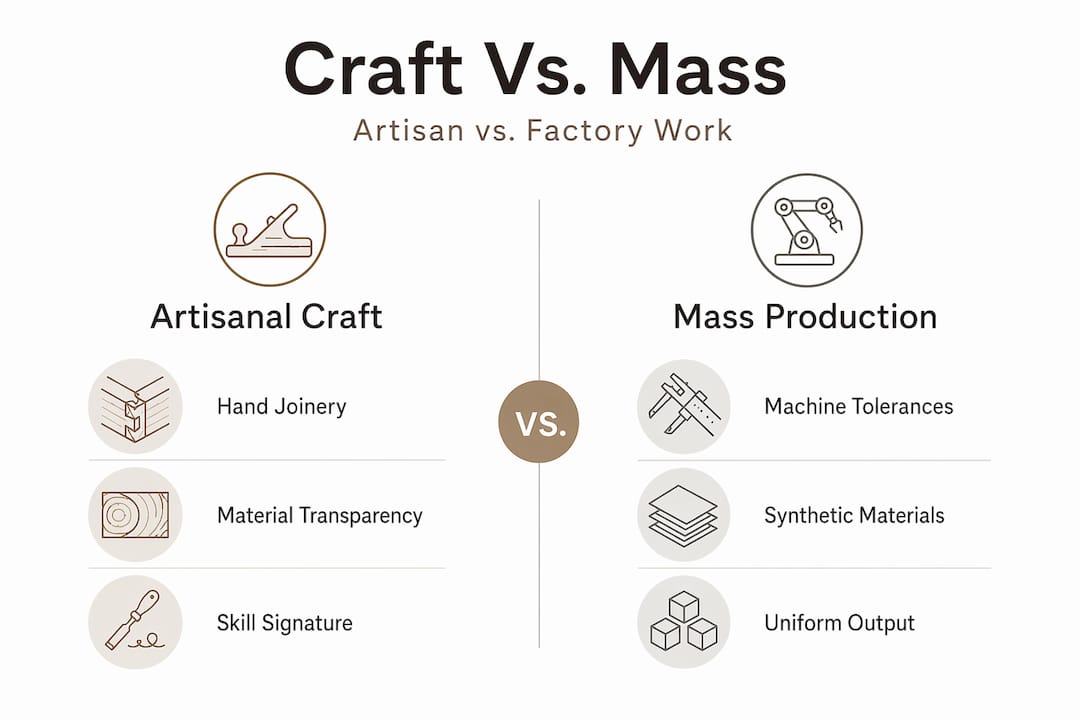
What defines artisanal craftsmanship most sharply is the contrast with mass production. Industrial manufacturing prioritizes speed and uniformity. Its goal is to make the 10,000th unit identical to the first. Artisanal work accepts that the 10th piece will carry slight differences from the first, and treats that as proof of human involvement rather than a quality failure.
“Artisanal craftsmanship connects maker and user beyond the economic transaction, investing objects with labor stories and a human imprint that machines cannot replicate.”
The practical result is a price premium that reflects skill and material transparency, not marketing. When you pay more for a hand-jointed cabinet or a hand-thrown ceramic mug, you’re paying for a person who knew exactly what they were doing at every moment of production.
What separates artisanal from just “handmade”
Not everything made by hand qualifies as artisanal craftsmanship. A child finger-painting is using their hands. Artisanal work requires:
- Specialized technical knowledge built through years of training or apprenticeship
- Deliberate material selection based on performance, origin, and long-term behavior
- Process ownership from raw input to final product
- Intentional technique that serves function as much as appearance
- Low batch size where individual attention is possible and expected
The difference matters when you’re deciding what to bring into your home or workspace.
Artisanal craftsmanship examples across disciplines
The range of artisanal craftsmanship examples is wider than most people expect. Furniture gets the most attention, but the same principles show up across dozens of trades.
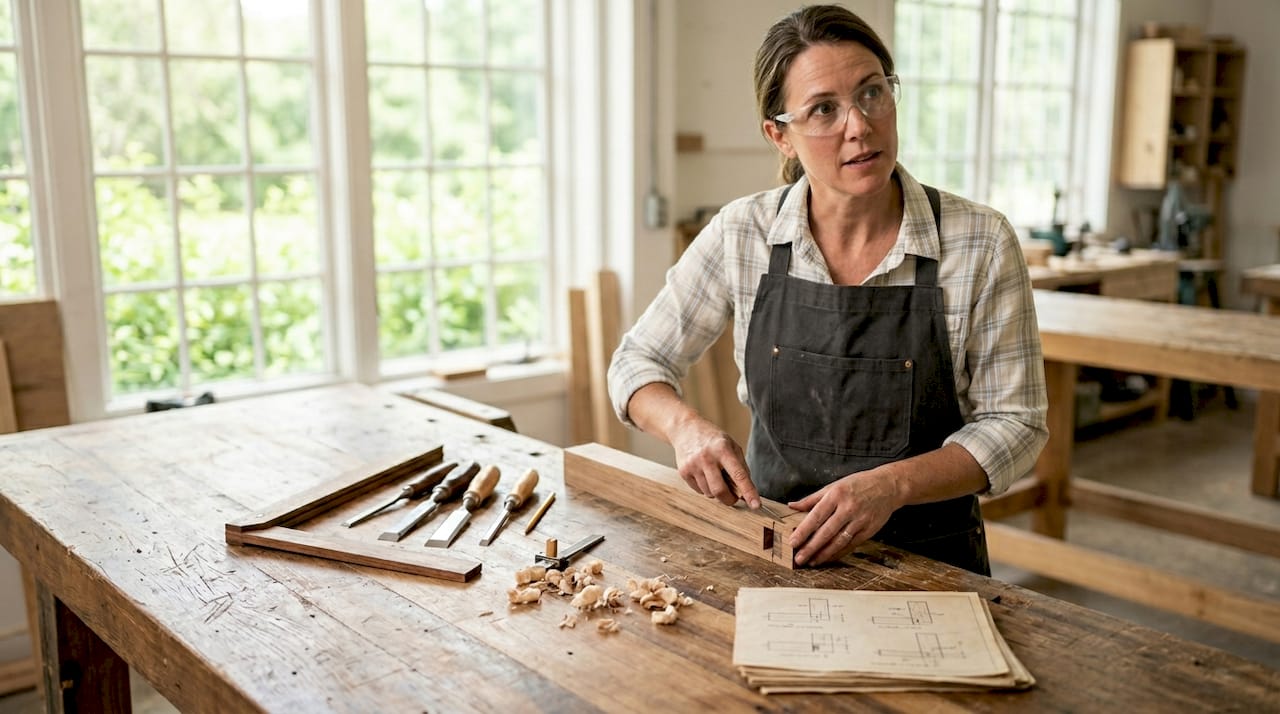
In woodworking, the clearest marker of artisanal quality is joinery. Traditional techniques like mortise-and-tenon or dovetail joints provide structural integrity that mechanical fasteners simply cannot match over time. Japanese nail-free joinery takes this further, using interlocking wood geometry to create connections that tighten under load rather than loosen. A piece built this way can outlast the house it sits in.
Here’s a quick comparison that shows how artisanal techniques stack up against mass production methods in furniture:
| Feature | Artisanal craftsmanship | Mass production |
|---|---|---|
| Joinery method | Mortise-and-tenon, dovetail, hand-cut | Screws, staples, cam locks |
| Material selection | Chosen per piece based on grain and behavior | Standardized, sourced for cost |
| Quality control | Continuous throughout production | Final inspection only |
| Output volume | Small batches, high individuality | Thousands of identical units |
| Lifespan | Decades to generations | Often 5 to 10 years |
Beyond woodworking, textile arts offer equally rich examples. Hand-weaving on traditional looms, block printing with carved wooden stamps, and natural dyeing with plant-based pigments all fall under the artisanal umbrella. Each technique requires a maker who reads the material rather than running it through a preset machine cycle.
Other disciplines worth knowing:
- Blacksmithing: Shaping metal by hand at the forge to create hardware, tools, or decorative elements with forms impossible to replicate by casting
- Bookbinding: Stitching signatures by hand and applying covers with techniques that keep books intact for centuries
- Clockmaking: Fitting mechanical movements by hand, with each component adjusted to the tolerances of its specific neighboring part
- Artisanal chocolate making: Discarding up to 20% of cocoa beans to maintain flavor standards, followed by multi-day refining processes focused entirely on taste and texture
The common thread across all of these is that the maker’s judgment replaces the machine’s preset parameters. Every decision is made with the specific material in hand, not from a standardized formula.
Why artisanal craftsmanship matters today
The importance of artisanal craftsmanship goes well beyond aesthetics. It sits at the center of two pressing concerns: sustainability and cultural preservation.
Human skill and time substituted for industrial energy represents a concrete intervention against the linear consumption model that fast fashion and disposable furniture have normalized. An artisanal piece produced in small batches uses less industrial energy, generates less waste, and produces an object designed to last rather than to be replaced.
Durability is the key sustainability argument. A hand-jointed oak bench doesn’t end up in a landfill after five years because the cam locks gave out. Artisanal goods and sustainable home choices reinforce each other: buying fewer, better things is the most direct path to reduced consumption.
The cultural dimension is just as significant. Many artisanal skills risk disappearing as industrial economies make them economically impractical. When a traditional weaving technique or a regional joinery method disappears, it doesn’t just affect aesthetics. It removes a form of knowledge that took generations to develop.
Pro Tip: When buying artisanal goods, ask the maker or retailer about the specific techniques used. A maker who can explain their joinery method, their dye source, or their material selection process is the real thing. Vague answers about “handcrafted quality” without specifics are a warning sign.
Imperfections in artisanal goods are signatures of human involvement, not defects. A slight variation in weave density, a small asymmetry in a hand-carved leg, a unique grain pattern in a solid wood top: these are the marks that prove a person was present and attentive throughout the process. Mass production eliminates these variations. Artisanal work celebrates them.
The benefits of artisanal craftsmanship extend to the buyer’s experience too. Owning something made with intention changes your relationship to it. You use it differently, care for it differently, and are far less likely to treat it as disposable.
The artisanal process up close
Understanding how artisanal goods are actually made helps you recognize the real thing when you see it. The artisanal process is defined by one characteristic above all others: quality control is not a final step. It is continuous throughout production, with the maker adjusting at every stage based on what the material is doing.
Here’s what that looks like in practice for a hand-built piece of furniture:
- Material selection: The maker examines individual boards for grain direction, moisture content, and structural integrity before cutting anything. A board that looks right but feels wrong gets set aside.
- Fitting and adjustment: Joints are cut, tested dry, adjusted, and tested again. The fit must be correct before any finish or adhesive is applied.
- Surface preparation: Hand planing and scraping reveal the wood’s natural character in ways that machine sanding obscures. Each pass is judged by touch and eye.
- Finishing: Finish is applied in thin coats, with the maker evaluating each layer before adding the next. The goal is depth and protection, not just surface coverage.
- Final assessment: The finished piece is inspected for structural integrity, surface quality, and overall coherence. Any piece that doesn’t meet the maker’s standard gets reworked, not shipped.
Pro Tip: Ask about drying times and finishing schedules when commissioning artisanal furniture. Traditional pasta makers, for example, dry at low temperatures over days rather than hours, because rushing creates weakness. The same principle applies to wood finishing. A maker who rushes the cure is compromising the result.
Artisanal scarcity is a direct result of this process. You cannot run the same method at industrial scale without destroying the quality that defines it. That scarcity is not a marketing tactic. It’s a structural feature of how the work is done. For those exploring artisanal craftsmanship in modern design, understanding this limitation is the difference between informed buying and being misled by branding.
My take on what artisanal craftsmanship really means
I’ve spent years working alongside furniture makers, woodworkers, and craftspeople across different disciplines, and the one thing that consistently surprises clients is how much of artisanal quality is invisible. The mortise-and-tenon joint hidden inside a cabinet door frame. The hand-scraped surface under a finish coat. The selective grain matching across a tabletop. None of it is visible once the piece is complete, but all of it is felt in how the piece behaves over time.
The uncomfortable truth is that mass production has become so technically sophisticated that it can mimic artisanal appearance almost perfectly. What it cannot mimic is the judgment behind the process. Machine-cut joints fit within tolerance. Hand-cut joints fit to the specific piece. That difference is not visible at the point of sale. It shows up five years later when the machine-cut piece starts to loosen and the hand-cut piece hasn’t moved.
What I’ve learned is that the best way to appreciate artisanal craftsmanship is to find a maker willing to show you their process, not just their finished work. The confidence to let someone watch them work is itself a form of quality assurance.
Supporting artisans today is not nostalgia. It is a deliberate choice to keep knowledge alive that took centuries to develop, and to own objects that were made by someone who cared about the outcome personally.
— Donovan
Custom furniture that embodies artisanal quality
If this guide has clarified what you’re actually looking for in a piece of furniture, the next step is finding makers who deliver it without compromise. Furnituredesigngroup has spent over 20 years building custom furniture with precisely the techniques and material standards described here.

Their custom furniture services cover bespoke entryway furniture, mud lockers, and other residential pieces built to your specifications using quality materials and traditional joinery. Every piece starts with a conversation about your space and how you use it. If you want to see the work before committing, their furniture gallery shows finished pieces with the material detail and craftsmanship you’ve been reading about. Reach out directly to Furnituredesigngroup and start that conversation.
FAQ
What is the definition of artisanal craftsmanship?
Artisanal craftsmanship is the production of goods using manual skill, specialized knowledge, and control over the full process from raw material to finish, with an emphasis on low volume and high quality rather than speed or uniformity.
How do you identify true artisanal craftsmanship?
Look for specific techniques like hand-cut joinery, traceable materials, small batch production, and a maker who can explain their process in detail. Slight natural variations in the finished piece are a positive sign, not a flaw.
How does artisanal craftsmanship compare to mass production?
Mass production prioritizes identical output at scale, using mechanical fasteners, preset machine tolerances, and end-point quality checks. Artisanal craftsmanship uses hand techniques, maker judgment throughout, and methods like mortise-and-tenon joinery that produce stronger, longer-lasting results.
Is artisanal craftsmanship sustainable?
Yes. Artisanal production substitutes human skill and time for industrial energy and generates durable goods designed to last decades rather than years. Fewer replacements mean less waste, making artisanal goods a direct alternative to disposable consumption.
What are some common artisanal craftsmanship techniques in furniture?
The most recognized techniques include mortise-and-tenon joinery, dovetail joints, hand planing, traditional wood finishing, and nail-free Japanese joinery. Each method requires practiced skill and produces structural results that machine methods cannot replicate.