
TL;DR:
- Artisanal woodworking is a centuries-old craft that combines deep material knowledge, refined techniques, and deliberate craftsmanship to create durable, heirloom-quality objects. It emphasizes traditional joinery, hand tools, and natural finishes, with skill transfer through apprenticeship, rather than machine-driven mass production. Today, it blends tradition with innovation, promoting sustainable sourcing and fostering a renewed appreciation for objects that gain character over time.
Artisanal woodworking is not simply making something by hand. It is a centuries-old practice where deep material knowledge, refined technique, and deliberate craftsmanship converge to create objects that outlast their makers. Most people encounter the term and picture a hobbyist with a few chisels. The reality is far more demanding and far more rewarding. Master woodworker Robby Pedersen describes the craft as a “zen” experience that reconnects makers with the physical world in ways no screen ever could. This guide unpacks what artisanal woodworking actually is, how it works, why it matters, and how you can engage with it.
Table of Contents
- Key Takeaways
- What is artisanal woodworking, really
- Historical roots and traditional principles
- Core artisanal woodworking techniques
- Modern artisanal woodworking: tradition meets innovation
- Benefits of artisanal woodworking vs. mass production
- How to start or buy artisanal woodworking
- My perspective on why this craft still matters
- Experience artisanal craftsmanship with Furnituredesigngroup
- FAQ
Key Takeaways
| Point | Details |
|---|---|
| More than handmade | Artisanal woodworking requires generational technique, not just hand tools and good intentions. |
| Joinery defines longevity | Traditional joints like mortise-and-tenon allow wood to move naturally, preserving pieces for centuries. |
| Modern meets traditional | Younger craftspeople now blend digital design tools with hand finishing to keep the craft alive and relevant. |
| Real value has a real price | Bespoke artisanal pieces reflect 30 to 40% raw material costs plus skilled labor, producing heirloom quality. |
| Anyone can begin | Starting with a small project, quality hand tools, and a willingness to learn from experienced woodworkers is all it takes. |
What is artisanal woodworking, really
The short answer: artisanal woodworking is the practice of creating wood objects using skilled, often hand-driven methods grounded in traditional technique and deep material understanding. The longer answer is that “artisanal” carries specific weight. Skill passed down through generations via apprenticeship or family tradition is what separates true artisan work from casual hobbyist woodworking. You are not just cutting and joining wood. You are reading grain patterns, anticipating seasonal wood movement, selecting species for specific structural roles, and applying finishing methods that took years to master.
What artisanal woodworking is not is equally useful to understand. It is not defined solely by the absence of power tools. Many respected artisans use table saws and routers for roughing out material. The distinction lies in whether skill, judgment, and technique drive the outcome, or whether a machine does. Mass production removes the craftsperson from most decisions. Artisanal work puts the craftsperson at the center of every one.
Historical roots and traditional principles
Artisanal woodwork traces back thousands of years, from Egyptian furniture found in royal tombs to the elaborate lacquered cabinetry of Tang Dynasty China. In medieval Europe, woodworking guilds formalized training through strict apprenticeship systems. A young craftsman would spend years under a master, learning not just technique but the judgment that technique alone cannot teach: when a piece is ready, when a joint is truly tight, when a surface has been planed enough.
Several traditional principles have defined the craft across cultures:
- Joinery over fasteners. Mortise-and-tenon joinery allows wood to expand and contract with humidity changes, preventing splitting and enabling furniture to last centuries. Nails and staples fight the wood’s natural movement. Traditional joinery works with it.
- Species selection. Artisans choose wood species based on grain, hardness, and intended use. White oak for tabletops, cherry for case pieces, walnut for rich visual depth.
- Hand-applied finishes. Historic finishing methods included natural ingredients like walnut husks and plant-based oils, which created protective layers with a depth that polyurethane cannot replicate.
- Surface preparation. Scraping and hand planing rather than sanding created surfaces that caught light differently, giving antique pieces their distinctive visual character.
“The wood tells you what it wants to be. Your job is to listen carefully enough to hear it.” This philosophy, common among master woodworkers, captures why artisanal woodworking cannot be reduced to a set of steps in a manual.
The apprenticeship model is also worth understanding as more than tradition. It is a delivery system for tacit knowledge: the kind of understanding that cannot be written down, only demonstrated and practiced. How much pressure to apply when pushing a plane. How a dovetail feels when it is just snug enough. These things transfer person to person, not page to screen.
Core artisanal woodworking techniques
Technique is where artisanal woodwork becomes visible. These are the methods that define what separates a handcrafted piece from a factory product.
- Mortise-and-tenon joinery. A tenon cut at the end of one piece fits into a mortise cavity cut in another. When fitted correctly, this joint creates a mechanical lock that prevents wood splitting and holds for generations without glue alone.
- Dovetail joints. The interlocking fan-shaped cuts used in drawer construction are both structural and visual. A clean, tight dovetail is the most recognized mark of a skilled woodworker.
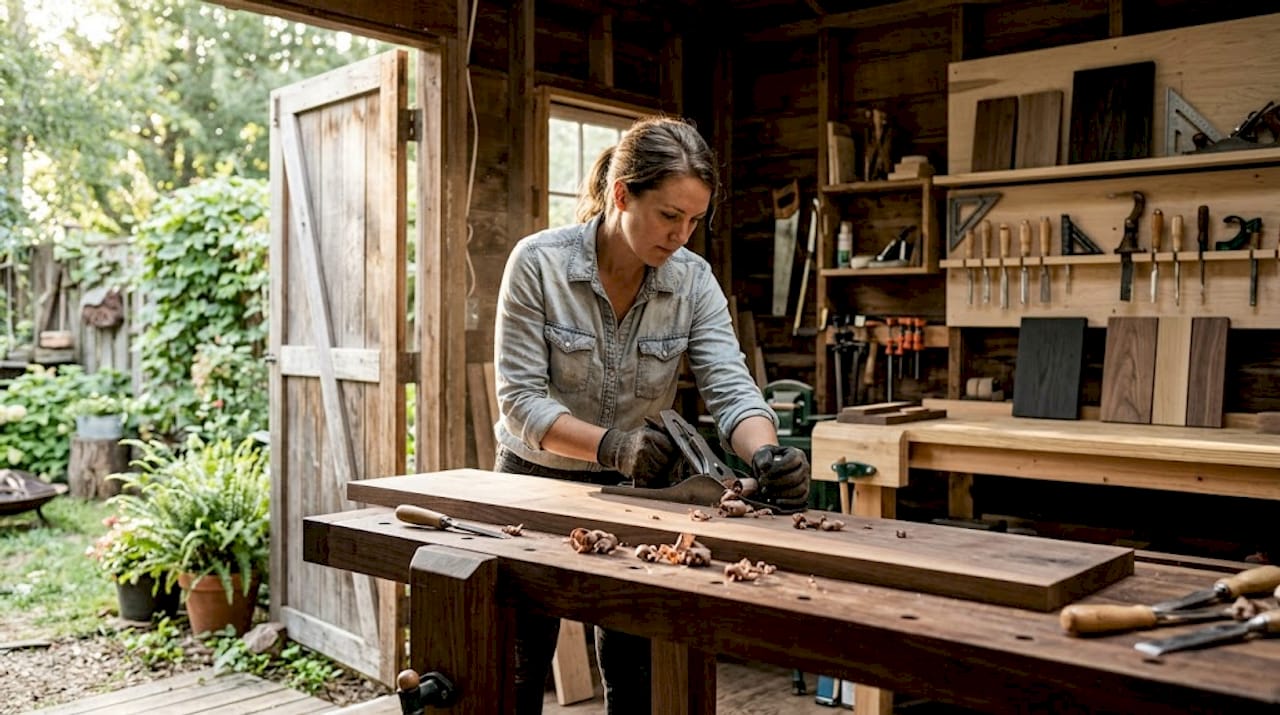
- Hand planing. Wooden hand planes give experienced woodworkers tactile feedback that power sanders cannot match. The craftsperson feels the blade engage the wood, detecting grain direction, tension, and surface quality through their hands.
- Card scraping. A thin steel card, flexed and pushed across wood, shears fibers cleanly rather than abrading them. The result is a surface that reflects light more evenly than any sandpaper can produce.
- Coopered construction. Curved panels built from multiple angled staves, like a barrel, require precise fitting and deep understanding of how wood behaves under tension. You see this technique in cabinet doors and curved chair backs.
- Natural finishing. Wire brushing to expose grain texture, layered stain applications, and hand-applied oil finishes are labor-intensive processes that define the final character of a piece. These steps cannot be rushed or automated without losing the result entirely.
Pro Tip: If you want to evaluate the quality of an artisanal piece, look at the drawer joinery first. A hand-cut dovetail with tight, even spacing and no filler tells you everything you need to know about how the rest of the piece was built.
Each of these techniques requires years of repetition before a craftsperson develops genuine fluency. That is not a discouragement. It is an explanation of why artisanal work costs what it does and why it performs the way it does over decades.
Modern artisanal woodworking: tradition meets innovation
The idea that artisanal woodworking is a relic of the pre-industrial past is simply wrong. Craftsmen under 30 are pioneering hybrid approaches that integrate CNC routing, parametric design software, and digital grain analysis with traditional hand finishing and joinery. The machine handles rough dimensioning. The human handles everything that matters.
Several shifts define where the craft stands today:
- Sustainable sourcing. Contemporary artisans increasingly source from certified forests, reclaimed urban timber, and local sawyers. A dining table built from a reclaimed Maryland white oak carries a story no imported particleboard piece ever could.
- Eco-friendly finishes. Water-based oils, beeswax compounds, and zero-VOC hard-wax oils are replacing petroleum-based lacquers without sacrificing protection or beauty.
- Community and education. Woodworking schools, maker spaces, and online workshop communities have expanded access dramatically. Someone in a small apartment can start learning hand tool skills before ever touching a piece of furniture-grade lumber.
- Design-forward thinking. Younger artisans are not just replicating Shaker or Arts and Crafts forms. They are using traditional techniques to build contemporary, minimal furniture that fits modern interiors while lasting generations.
The cultural revival aspect is real and growing. After decades of disposable furniture dominating the market, buyers and makers alike are returning to objects that reward long ownership. A handcrafted piece that improves with age, develops a patina, and can be repaired rather than replaced is the opposite of every trend that dominated retail furniture for the past 40 years.
Benefits of artisanal woodworking vs. mass production
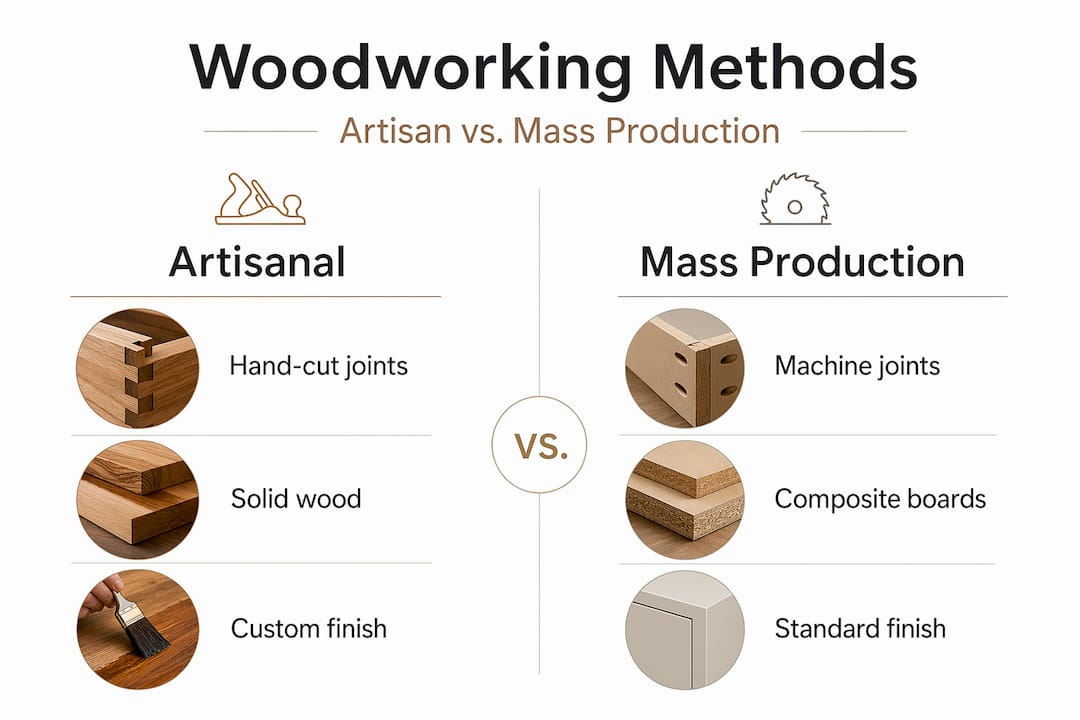
This is where the practical case for artisanal work becomes concrete.
| Feature | Artisanal woodworking | Mass production |
|---|---|---|
| Joinery method | Traditional mortise-and-tenon, dovetail | Staples, pocket screws, dowels |
| Material quality | Solid hardwood, chosen for grain and species | MDF, particle board, veneers |
| Lifespan | Decades to centuries with maintenance | 5 to 15 years typical |
| Customization | Fully bespoke to space and need | Fixed catalog options |
| Finishing | Hand-applied, layered, labor intensive | Spray-applied, uniform, fast |
| Price range | CAD 1,500 to 3,500+ for accent pieces | Under $300 for equivalent form |
The price gap is real. Raw materials alone account for 30 to 40% of manufacturing costs in artisanal furniture, and skilled labor adds significantly on top. Lead times of six to twelve weeks are standard because there is no way to rush hand joinery and hand finishing without destroying what makes them valuable.
What you get for that investment is not just a piece of furniture. It is an object with structural integrity that improves through use, a surface that develops character over years, and dimensions matched to your actual space rather than a retail floor plan. The emotional connection that owners form with a handcrafted piece is not incidental. It is part of the product.
Custom cabinetry installations, like those offered through artisan cabinetry specialists, demonstrate how artisanal techniques translate directly into built environments that feel fundamentally different from contractor-grade work.
How to start or buy artisanal woodworking
Whether you want to make or purchase, here is how to engage seriously with artisanal woodwork.
If you are buying:
- Ask the maker specifically about their joinery methods. A true artisan can explain their choices. Someone who cannot describe their process likely did not make the piece the way they claim.
- Look for hand tool marks on interior surfaces. Perfect machine uniformity on every hidden face is a sign of production-line work, not handcraft.
- Request to see previous commissions and ask for production timelines. A six to twelve week lead time is a feature, not a flaw.
- Consider working with a custom furniture specialist who can help you think through proportions, materials, and finishes before commissioning a piece.
If you are starting out:
- Begin with hand tools before power tools. A set of chisels, a hand saw, a marking gauge, and a wooden mallet will teach you more about wood in a month than a year of router use.
- Start with a small box or a simple shelf. These projects teach fitting, joinery, and finishing without overwhelming complexity.
- Seek out a local woodworking guild, community college program, or experienced mentor. Tactile knowledge transfers in person, not through video alone.
Pro Tip: Your first hand plane purchase matters more than most beginners realize. A vintage Stanley No. 4 or No. 5, tuned and sharpened properly, outperforms most new budget planes and teaches you blade adjustment in a way a power sander never will.
The most common mistake beginners make is buying too much equipment too early. Artisanal woodworking rewards depth over breadth. Ten hours with one hand plane beats ten minutes each with ten tools.
My perspective on why this craft still matters
I have spent years watching clients describe furniture they want to keep forever. The piece almost always has a story. A grandmother’s writing desk. A dining table built by a neighbor. Objects that outlasted the people who made them.
What I have come to believe is that artisanal woodworking is not really about furniture at all. It is about our relationship with the things we make and own. The therapeutic, soulful dimension of working wood with your hands is something that gets dismissed in polite conversation about design trends. It should not be.
When you work a piece of walnut with a hand plane, you are in a conversation with the material. That conversation has no shortcut. And the object that results from it carries the record of every choice you made. Mass production removes the maker from the object entirely. Artisanal work is the opposite: the maker is in the piece, in the joint gaps and the finish layers and the proportions that only work because someone decided they should.
My honest take: the craft’s future is bright, specifically because disposable culture has run its course. People are looking for things worth keeping. Artisanal woodworking is the most direct answer to that hunger that exists.
— Donovan
Experience artisanal craftsmanship with Furnituredesigngroup

Furnituredesigngroup has spent over 20 years building bespoke entryway furniture from Maryland, using the same principles of material selection, traditional joinery, and hand-applied finishing that define genuine artisanal woodwork. Every piece is built to your space, your specifications, and your timeline. If this guide has given you a clearer sense of what to look for in a handcrafted piece, the next step is seeing it in person. Explore Furnituredesigngroup’s custom furniture services to commission a piece built the way furniture was always meant to be built. You can also browse their furniture portfolio to see finished work up close before reaching out.
FAQ
What is artisanal woodworking?
Artisanal woodworking is the practice of creating wood furniture and objects using skilled, often hand-driven techniques rooted in traditional craftsmanship, material knowledge, and joinery methods passed down through generations. It prioritizes durability, uniqueness, and craftsmanship over production speed.
What techniques define artisanal woodwork?
Core artisanal woodworking techniques include mortise-and-tenon joinery, dovetail joints, hand planing, card scraping, and hand-applied natural finishes. These methods require years of practice and produce results that power tools and factory processes cannot replicate.
What materials are used in artisanal woodworking?
Artisanal woodworkers use solid hardwoods like white oak, walnut, and cherry, selected for grain pattern and structural properties. Finishes typically include natural oils, beeswax, and plant-based compounds rather than synthetic lacquers.
How does artisanal woodworking compare to mass production?
Artisanal pieces use solid hardwood and traditional joinery that lasts for decades, while mass-produced furniture typically uses MDF, particle board, and stapled connections with a lifespan of 5 to 15 years. The price difference reflects material quality, skilled labor, and production time.
How do I start artisanal woodworking as a beginner?
Start with basic hand tools including chisels, a hand saw, and a hand plane, then practice on small projects like boxes or shelves. Seeking mentorship or joining a local woodworking guild accelerates learning significantly, since much of the skill knowledge transfers best in person.