
Every Maryland homeowner with a uniquely shaped entryway knows the struggle of finding furniture that actually fits and looks right. Off-the-shelf pieces often leave awkward gaps or clash with your home’s character. That’s where bespoke furniture makes the difference, offering tailored solutions like custom mud lockers that match your style and solve everyday challenges. Discover how craftsmanship, personal vision, and perfect fit come together to transform your entryway into a space that truly works for you.
Table of Contents
- Bespoke Furniture Defined And Common Myths
- Distinct Types And Variations Explained
- Inside The Crafting Process And Key Features
- Financial Considerations: Pricing And Value
- Comparing Bespoke, Custom, And Ready-Made
Key Takeaways
| Point | Details |
|---|---|
| Bespoke Furniture is Custom-Made | Unlike mass-produced options, bespoke furniture is tailored to fit your unique space and style needs perfectly. |
| Myths Surrounding Cost | While bespoke furniture often requires a higher initial investment, its durability provides long-term value, making it a wise choice. |
| Consultation is Key | Engaging with skilled craftsmen during the consultation ensures your vision is accurately captured, making the process straightforward. |
| Choose Based on Space Needs | For irregular entryways or specific requirements, bespoke or custom solutions are ideal, while ready-made works best for standard spaces. |
Bespoke Furniture Defined and Common Myths
Bespoke furniture means custom-made pieces built specifically for your home, not mass-produced items sitting in warehouses. Unlike off-the-shelf options, bespoke pieces optimize space, integrate seamlessly with your existing decor, and reflect your personal style completely.
Think of it this way: mass-produced furniture follows a template. Bespoke furniture follows you. Every dimension, material choice, and design detail gets customized to your specific needs and preferences.
What Makes Bespoke Different From Everything Else
Mass-produced furniture comes from factories with predetermined sizes and finishes. Bespoke starts with a blank slate, shaped entirely by your vision and requirements.
Key differences include:
- Custom dimensions: Pieces fit your entryway perfectly, not the other way around
- Material selection: You choose wood types, finishes, hardware, and upholstery
- Design flexibility: Every detail, from shelf placement to drawer configuration, gets customized
- Quality craftsmanship: Artisans build each piece by hand, not assembly lines
- Sustainability focus: Minimal waste and made-to-order production reduce environmental impact
For Maryland homeowners with uniquely shaped entryways or specific mudroom challenges, bespoke solutions solve problems that standard furniture simply cannot address.
Common Myths About Bespoke Furniture
Myth #1: Bespoke costs three times more than regular furniture.
Not necessarily true. While bespoke requires higher upfront investment, the durability and perfect fit often provide better long-term value. You’re paying for quality that lasts decades, not replaceable pieces lasting five years.
Myth #2: You need interior design experience to order bespoke pieces.
False. Skilled craftsmen guide you through dimensions, materials, and styles. They ask the right questions to understand your needs, making the process straightforward even if you’ve never customized furniture before.
Myth #3: Bespoke furniture is just luxury for wealthy people.
Bespoke serves anyone with specific space requirements or quality preferences. A custom mud locker that solves your family’s organizational chaos provides genuine value beyond pure luxury.
Myth #4: Custom furniture takes forever to arrive.
While timelines vary, experienced craftspeople work efficiently. Most projects complete within reasonable timeframes when expectations are clear from the start.
Custom furniture reflects your home’s unique character in ways mass-produced pieces never can—it’s built for you, not at you.
Why This Matters for Your Maryland Home
Mary land’s historic homes often feature irregular entryways, awkward corners, and custom space constraints. Bespoke mud lockers and entryway furniture transform these challenges into opportunities for perfectly fitted, beautiful storage solutions.
Your home deserves pieces that work with its character, not against it.
Here’s how bespoke features impact Maryland homes uniquely:
| Feature | Unique Benefit for Maryland Homes | Practical Impact |
|---|---|---|
| Custom dimensions | Fits irregular entryways | Maximizes usable space |
| Material options | Matches historic aesthetics | Maintains home’s character |
| Design flexibility | Solves storage challenges | Enhances organization |
| Sustainability | Reduces waste | Supports local craftsmanship |
Pro tip: Visit the showroom and discuss your specific entryway challenges before committing to any design—seeing samples and talking through your space eliminates guesswork and ensures the final piece matches your vision exactly.
Distinct Types and Variations Explained
Three main furniture categories exist, and understanding the differences helps you choose what works best for your Maryland home. Each offers distinct advantages depending on your budget, timeline, and customization needs.
Bespoke Furniture: Built From Scratch
Bespoke furniture is crafted entirely from scratch without constraints, reflecting your exclusive vision. Nothing exists before your project begins—artisans design and build each piece specifically for you.
Bespoke characteristics include:
- Complete design freedom: Every element responds to your exact needs
- Perfect fit: Dimensions match your entryway precisely
- Unique pieces: No one else owns identical furniture
- Premium materials: You select every wood, finish, and hardware option
- Highest craftsmanship: Artisans dedicate time to your vision
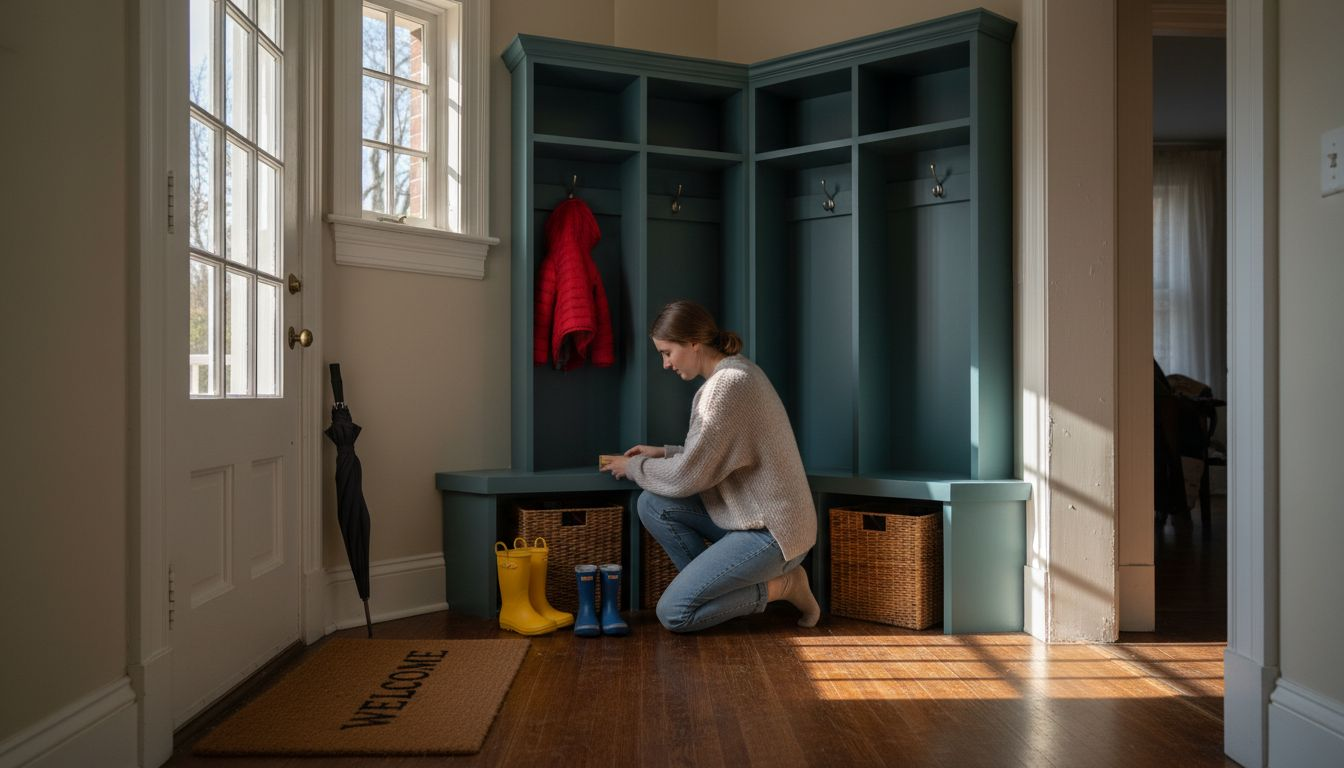
For a Maryland mudroom with an odd corner layout or a narrow entryway, bespoke mud lockers solve what standard furniture cannot.
Custom Furniture: Adapted Designs
Custom furniture involves adapting existing designs to fit your specific needs. It’s personalization within pre-existing templates, not starting from zero.
Custom furniture offers:
- Faster production: Based on proven designs
- Moderate cost: Less expensive than bespoke, more than ready-made
- Good flexibility: Modify dimensions, colors, or configurations
- Reasonable timeline: Quicker than fully bespoke projects
This option works well if you like a proven design but need it tweaked for your space.
Ready-Made Furniture: Off-the-Shelf Options
Ready-made furniture is mass-produced in standardized sizes and styles, available for immediate purchase. Think typical showroom pieces—convenient but one-size-fits-all.
Ready-made benefits include:
- Affordability: Lowest price point
- Instant availability: Buy and take home today
- Wide variety: Countless styles to choose from
- No design involvement: Nothing to customize
The trade-off? Limited personalization and often poor fit for irregular spaces.
Comparing All Three Options
| Factor | Bespoke | Custom | Ready-Made |
|---|---|---|---|
| Design freedom | Complete | Moderate | None |
| Cost | Highest | Medium | Lowest |
| Timeline | Longest | Medium | Immediate |
| Perfect fit | Yes | Possible | Unlikely |
| Uniqueness | One-of-a-kind | Somewhat unique | Mass-produced |
Custom furniture balances personalization with cost, making it ideal for homeowners wanting more than ready-made but less expense than full bespoke.
Which One Matches Your Needs?
Choose bespoke if your entryway has unique dimensions, you want complete control, or standard furniture never fits quite right.
Choose custom if you found a design you love but it needs tweaking for your space.
Choose ready-made only if your entryway has standard dimensions and you prioritize budget over fit.
Most Maryland homeowners with older homes benefit most from bespoke or custom options, since historic properties rarely have standard-sized spaces.
Pro tip: Request detailed measurements of your entryway before meeting with craftspeople—providing width, height, depth, and any obstructions helps determine whether custom adaptations work or if true bespoke design becomes necessary.
Inside the Crafting Process and Key Features
Bespoke furniture creation follows a structured yet flexible journey from your initial idea to the finished piece in your entryway. Understanding each stage helps you appreciate the craftsmanship involved and manage expectations throughout the project.
The Consultation: Where It All Begins
The bespoke furniture making process begins with detailed conversation between you and the craftsman. This isn’t a quick sales pitch—it’s a discovery meeting about your needs, preferences, and budget.
During consultation, craftspeople ask:
- How will you use this mud locker daily?
- What organizational challenges do you face now?
- What’s your entryway style—traditional, modern, rustic?
- Which materials appeal to you visually and functionally?
- What’s your realistic timeline and budget?
This foundation shapes everything that follows. The better your communication now, the fewer surprises later.
Design and Material Selection
Design concepts emerge from your consultation. Craftspeople create sketches or digital renderings showing your mud locker, refined through feedback rounds until it matches your vision.
Material selection happens in parallel. You’ll examine wood samples, hardware finishes, and upholstery options. This is where bespoke truly shines—you’re not choosing from a catalog of pre-selected colors.
Key decisions include:
- Wood type: Oak, maple, walnut, or cherry each bring different character
- Finish: Natural stain, paint, or specialty treatments
- Hardware: Knobs, handles, hinges that reflect your style
- Interior features: Shelving, hooks, benches, drawers
The Crafting Stage
Skilled artisans meticulously craft each piece using traditional techniques combined with precision tools. This isn’t assembly-line work—experienced hands guide every cut, joint, and assembly.
Crafting involves:
- Milling materials to exact dimensions
- Hand-cutting joints for structural integrity
- Assembling components with care
- Testing functionality repeatedly
- Sanding and surface preparation
This stage takes longest because rushing creates inferior results. Quality craftsmanship demands time.
Finishing Touches and Delivery
Once the structure is complete, finishing begins. Stain or paint is applied, hardware is installed, and final adjustments ensure everything works perfectly.
This table summarizes key steps in the bespoke furniture creation process:
| Step | Main Activity | Customer Role |
|---|---|---|
| Consultation | Discuss needs and preferences | Share usage, style, budget |
| Design | Review concepts, refine sketches | Provide feedback |
| Material Selection | Choose wood, hardware, finishes | Select samples |
| Crafting | Artisan builds piece | Approve progress updates |
| Finishing & Delivery | Apply stain, install hardware, deliver | Inspect and receive furniture |
Before delivery:
- Final inspection: Every detail checked against your design
- Protective wrapping: Furniture protected during transport
- Professional delivery: Installation in your entryway
- Final walkthrough: Explaining care and maintenance
The entire process transforms raw materials into a functional piece reflecting your personal vision and the craftsperson’s skill.
Key Features That Define Quality
Bespoke mud lockers typically include:
- Solid wood construction: Real wood, not veneer or particleboard
- Joinery precision: Mortise and tenon joints, dovetails, or dados
- Custom dimensions: Built to your exact entryway measurements
- Integrated design: Hooks, benches, cubbies exactly where you need them
- Durable hardware: Quality hinges, catches, and handles
- Professional finishes: Multiple coats of stain or paint for longevity
Pro tip: Ask to see examples of previous projects and request detailed photos of joinery details—this reveals the level of craftsmanship and helps you understand what quality actually looks like before your piece begins.
Financial Considerations: Pricing and Value
Bespoke furniture costs more upfront than ready-made pieces, but understanding the pricing structure helps you make informed decisions about your investment. Cost reflects customization, craftsmanship, and materials—not arbitrary markup.
Why Bespoke Furniture Costs More
Pricing in bespoke furniture manufacturing is complex, influenced by unique customization, high craftsmanship, and material quality. Each piece requires design time, skilled labor, and premium materials—factors absent in mass production.
Cost drivers include:
- Design consultation: Hours discussing your needs and preferences
- Custom materials: Premium wood and hardware, often sourced specifically
- Skilled labor: Experienced artisans charge appropriately for expertise
- Quality control: Rigorous standards catch imperfections others miss
- Small production runs: No economies of scale like factories achieve
- Timeline flexibility: Accommodating your schedule adds complexity
You’re not overpaying—you’re paying for actual value delivered.
Understanding the Price Range
Bespoke mud lockers for Maryland homes typically range from $3,000 to $12,000+ depending on size, complexity, and materials. A simple entryway bench costs less than a full wall-mounted system with integrated seating.
Factors affecting your specific price:
- Dimensions: Larger pieces require more material and labor
- Wood selection: Walnut costs more than oak; premium finishes add cost
- Features: Drawers, shelving, and seating increase complexity
- Hardware quality: Solid brass hardware outweighs budget alternatives
- Timeline: Expedited projects typically cost more
Get detailed quotes breaking down materials, labor, and finishing separately.
The Long-Term Value Argument
A $5,000 bespoke mud locker built to last 25 years costs about $200 annually. That same $1,500 ready-made piece lasting 7 years costs about $215 yearly, plus replacement hassle.
Value extends beyond cost-per-year:
- Perfect fit: No wasted space or awkward gaps
- Durability: Solid wood withstands decades of family use
- No replacement cycle: You’re not shopping for furniture again soon
- Resale appeal: Quality custom pieces increase home value
- Personal satisfaction: Living with something designed specifically for you
Most homeowners who invest in bespoke furniture report satisfaction lasting decades.
Payment and Timeline Planning
Most craftspeople require a deposit—typically 30-50% of the total cost—to begin work. The remainder is due upon delivery or completion.
Payment considerations:
- Deposit secures your project: Non-refundable but locks in pricing
- Payment schedule: Discuss installment options if needed
- Timeline clarity: Longer projects may have mid-point payments
- Warranty coverage: Confirm what’s covered post-delivery
Quality that lasts 25 years justifies higher initial investment compared to replaceable furniture lasting 5-7 years.
Comparing Total Cost of Ownership
| Aspect | Bespoke | Custom | Ready-Made |
|---|---|---|---|
| Initial cost | $3,000-12,000+ | $1,500-5,000 | $500-2,000 |
| Expected lifespan | 20-30 years | 10-15 years | 5-8 years |
| Replacements needed | 1 (initial) | 2-3 times | 3-5 times |
| Cost per year | $100-600 | $100-500 | $62-400 |
| Perfect fit | Yes | Mostly | No |
Pro tip: Request a detailed proposal itemizing design fees, materials costs, and labor hours—this transparency helps you understand pricing and identify where quality investments benefit your specific project most.
Comparing Bespoke, Custom, and Ready-Made
You’ve learned what each furniture type offers individually. Now let’s compare them directly so you can see which truly works best for your Maryland entryway needs.
Design Origins: The Fundamental Difference
Bespoke furniture starts with no pre-existing design and is fully personalized from concept to completion. Custom furniture adapts existing models with selected changes. Ready-made furniture is manufactured in bulk with no customization possible.
Think of it this way:
- Bespoke: Blank canvas. You and the artisan create everything together.
- Custom: Menu selection. Choose from options on an existing design.
- Ready-made: Off-the-shelf. Take it exactly as produced or leave it.
This distinction shapes everything else that follows—cost, timeline, uniqueness, and satisfaction.
Control and Personalization Levels
Bespoke offers complete control. You decide dimensions, materials, finishes, hardware, interior layout, and aesthetic details. Nothing gets decided without your input.
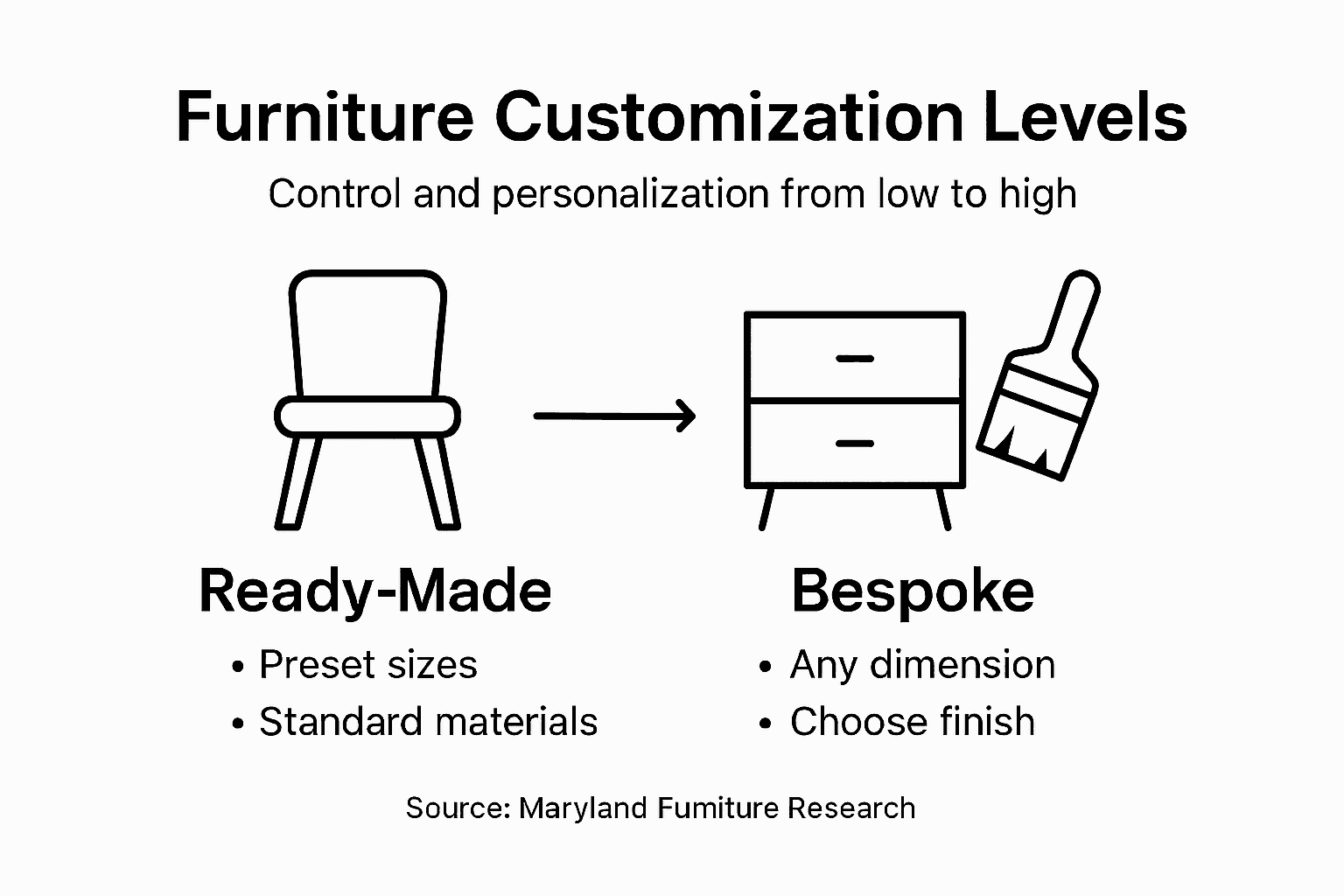
Custom provides limited personalization while reducing time and cost. You modify existing designs rather than create new ones. Options exist but within predetermined boundaries.
Ready-made offers zero personalization. You choose color or style from available inventory, but the piece itself doesn’t change.
Control comparison:
- Dimensions: Bespoke (custom), Custom (limited), Ready-Made (none)
- Materials: Bespoke (complete choice), Custom (selected options), Ready-Made (none)
- Interior features: Bespoke (designed for you), Custom (modify existing), Ready-Made (fixed)
- Finishes: Bespoke (unlimited), Custom (preset options), Ready-Made (inventory only)
Timeline and Availability
Bespoke takes longest. Design consultation, refinement, material sourcing, and crafting typically require 8-16 weeks or more. No shortcuts without compromising quality.
Custom moves faster. Starting with existing designs reduces production time to 6-12 weeks typically. Design phase shortens considerably.
Ready-Made is immediate. Purchase today, take home today. Zero wait.
For Maryland homeowners, timeline matters. If your entryway situation is urgent, ready-made works. If you can wait for something perfect, bespoke delivers.
Cost Reality Check
Bespoke costs most. Budget $3,000 to $15,000+ depending on complexity and materials. You’re paying for design time, custom materials, and skilled labor.
Custom offers middle ground. Expect $1,500 to $6,000 for most projects. Adapting existing designs reduces costs compared to full bespoke.
Ready-Made costs least. Most pieces fall between $500 and $2,500. Factories achieve economies of scale impossible for custom work.
Choosing between them isn’t about finding the cheapest option—it’s selecting the right tool for your specific situation.
Quick Decision Matrix
| Your Situation | Best Choice | Why |
|---|---|---|
| Irregular entryway, non-standard dimensions | Bespoke | Only way to get perfect fit |
| Liked a design but need adjustments | Custom | Faster and cheaper than bespoke |
| Standard space, budget-conscious | Ready-Made | Works fine for predictable spaces |
| Older Maryland home, character matters | Bespoke | Historic homes need custom solutions |
| Timeline urgent, any solution acceptable | Ready-Made | Immediate availability critical |
| Want investment piece lasting 20+ years | Bespoke | Only bespoke delivers true longevity |
Making Your Final Choice
Ask yourself these questions:
- Does my entryway have unusual dimensions or awkward features?
- How many years do I want this furniture to last?
- What’s my realistic budget range?
- Can I wait 10-16 weeks for perfection?
- Do I want something no one else owns?
Most Maryland homeowners with older homes answer “yes” to questions one, two, and five—pointing clearly toward bespoke as the best investment.
Pro tip: Schedule consultations with both ready-made showrooms and bespoke craftspeople—seeing actual samples and discussing your specific space reveals which option truly solves your entryway challenges most effectively.
Discover Custom Entryway Solutions That Fit Your Maryland Home Perfectly
Every unique entryway deserves furniture that embraces its distinct character and solves your daily organizational challenges. If you have irregular spaces or want lasting quality, bespoke furniture offers a perfect fit crafted entirely around your needs. At Furniture Design Group, we specialize in creating custom-crafted mud lockers and entryway solutions that reflect your style and optimize your space.
Ready to transform your entryway with handcrafted quality you can trust from a Maryland-based family business with over 20 years of experience? Explore our personalized options and expert craftsmanship at Furniture Design Group. Contact us today to schedule a consultation or visit our showroom to see how bespoke furniture can make your home more beautiful and functional.
Frequently Asked Questions
What is bespoke furniture?
Bespoke furniture is custom-made pieces created specifically to fit the unique dimensions and style of your home. Unlike mass-produced furniture, bespoke items are tailored to your preferences and needs.
How does bespoke furniture differ from custom and ready-made furniture?
Bespoke furniture is crafted from scratch based on your unique design, offering complete freedom in customization. Custom furniture adapts existing designs to fit your needs, while ready-made furniture is mass-produced in standardized sizes without personalization.
Is bespoke furniture worth the investment?
Yes, while bespoke furniture typically comes with a higher upfront cost, its durability, perfect fit, and unique design often provide better long-term value compared to mass-produced items that may need to be replaced more frequently.
How long does it take to receive bespoke furniture?
The timeline for bespoke furniture projects can range from 8 to 16 weeks or more, depending on the complexity of the design and the craftsmanship involved. It’s essential to communicate your needs and expectations clearly to ensure timely delivery.