
TL;DR:
- Custom millwork involves tailor-made woodwork designed to meet exact client specifications, enhancing architectural coherence and functionality. It differs from stock options through full customization of profiles, dimensions, and materials, making it essential for historical renovations and bespoke projects. Proper material selection and thorough shop drawing review are critical for project success and long-term performance.
Custom millwork is defined as tailor-made woodwork produced to exact client specifications, covering everything from crown molding and wainscoting to built-in cabinetry and architectural trim. Unlike stock profiles pulled from a warehouse shelf, custom millwork is fabricated to fit a specific room, match a precise finish, and serve both decorative and functional purposes within a home. The term comes from the traditional “mill” where wood was shaped and profiled, but today it encompasses sophisticated shop workflows, digital drafting, and material science. Whether you are a homeowner renovating a historic brownstone, an interior designer specifying a bespoke library wall, or a builder finishing a luxury spec home, understanding what custom millwork is and how it works will sharpen every decision you make on a project.
What is custom millwork and how does it differ from stock options?
Custom millwork is architectural woodwork fabricated to a specific design, dimension, and material specification rather than selected from a manufacturer’s standard catalog. The distinction matters because stock millwork limits you to available profiles, standard lengths, and pre-set wood species. Custom millwork removes those constraints entirely.
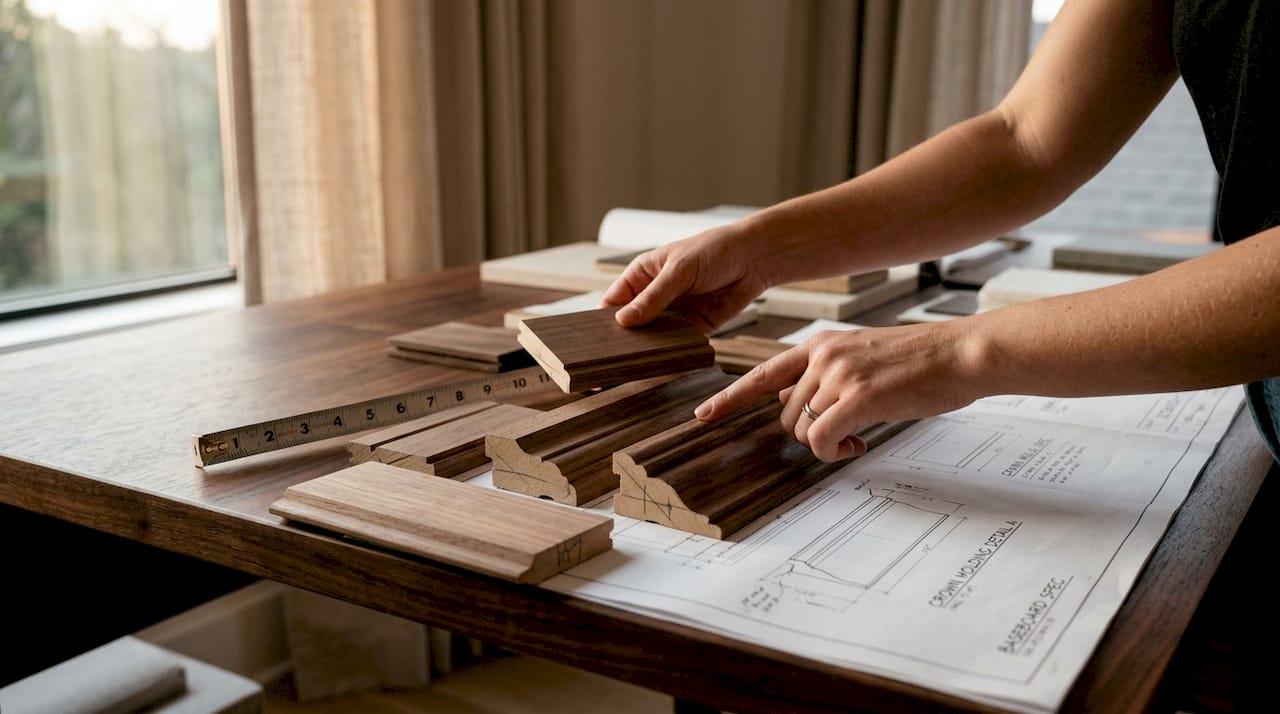
Custom millwork enables perfect matches for older architectural profiles that are simply not available as stock, which makes it indispensable for historic renovations or any project where design coherence cannot be compromised. That specificity is the core custom millwork benefit: you get exactly what the room requires, not the closest approximation a catalog offers.
There is also a terminology distinction worth knowing. Millwork versus casework refers to two different categories of woodwork. Millwork covers decorative and architectural woodwork such as trim, molding, paneling, and built-in shelving. Casework refers to functional cabinetry boxes, the carcasses that hold drawers and doors in kitchens and bathrooms. Understanding this split is essential for accurate budgeting because the two categories are priced and procured differently.
| Category | Custom millwork | Stock millwork | Casework |
|---|---|---|---|
| Primary role | Decorative and architectural | Decorative, off-the-shelf | Functional storage |
| Customization | Full: dimensions, species, profile | Limited to catalog options | Moderate: sizes and finishes |
| Lead time | 4 to 12 weeks typical | Days to 2 weeks | 2 to 6 weeks |
| Best for | Historic, luxury, or unique projects | Budget renovations | Kitchen and bath storage |
Key differences that drive the decision to go custom include:
- Profile matching: Replicating an existing 1890s baseboard profile that no manufacturer stocks.
- Scale control: Specifying a 7-inch baseboard for a room with 11-foot ceilings rather than accepting a 3.5-inch stock option.
- Species selection: Choosing quartersawn white oak for a specific grain pattern rather than settling for standard red oak.
- Finish compatibility: Ordering primed MDF profiles for painted applications where grain telegraphing would be a problem.
What materials are used in custom millwork fabrication?
Material selection is the decision that most directly affects the long-term performance and appearance of any custom millwork project. The choice is not purely aesthetic. Moisture resistance and finish compatibility are practical factors that must drive the selection before any design conversation begins.
Common material categories include:
- Solid hardwoods such as white oak, maple, walnut, and cherry. These are preferred for stained applications where grain is part of the design intent. They machine cleanly, hold detail well, and accept both oil and film finishes.
- Solid softwoods such as poplar and pine. Poplar is the industry standard for painted millwork because it is stable, takes primer well, and costs less than hardwood. Pine is common in traditional and farmhouse styles.
- Primed MDF (medium-density fiberboard). MDF produces a perfectly smooth surface for painted profiles and resists seasonal movement better than solid wood. It is not appropriate for high-moisture environments.
- Composites and PVC profiles. These are specified for bathrooms, mudrooms, and exterior applications where moisture exposure would degrade wood over time.
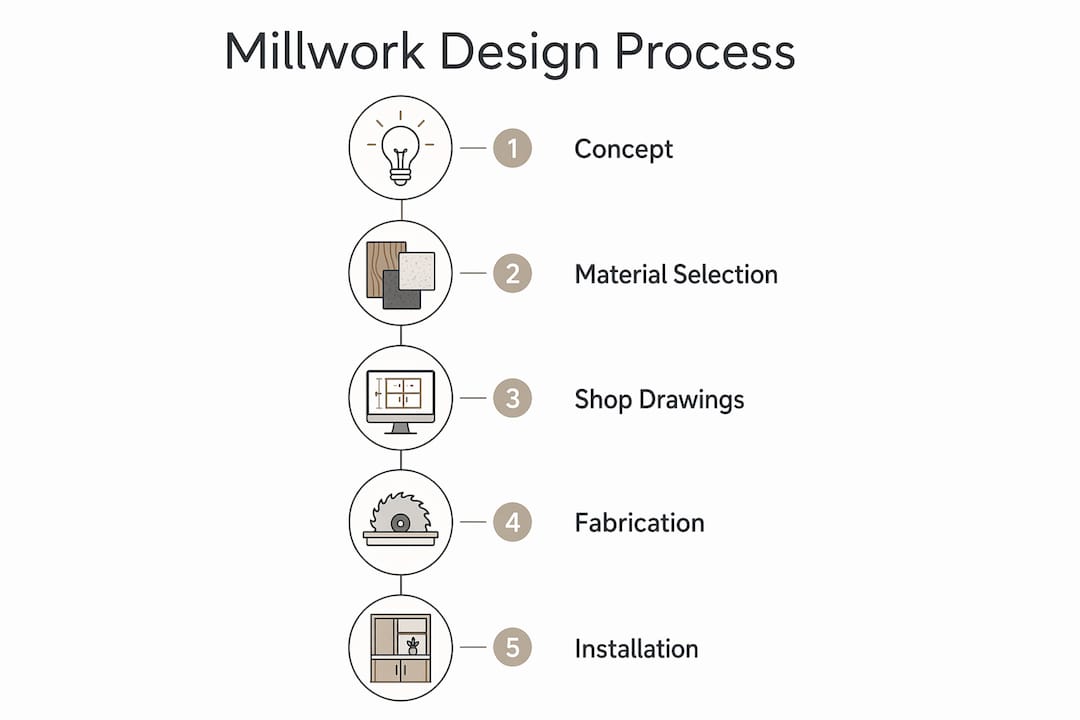
The fabrication workflow for quality custom millwork follows a defined sequence. It begins with shop drawings, moves through material procurement and milling, then prototyping, and finally finish sampling before full production runs. Professional fabrication includes prototyping and finish sampling to de-risk production and guarantee finish matches before full-scale fabrication begins. That step alone prevents the most expensive category of mistake in millwork: discovering a color or sheen mismatch after 200 linear feet of molding has been sprayed.
Pro Tip: Match your material to both the room’s moisture level and the intended finish. Use solid poplar or primed MDF for painted trim in living areas, PVC or composite for bathrooms and mudrooms, and solid hardwood only where you plan to stain or apply a clear finish. Mixing categories on the same project without a plan creates finishing headaches that cost more to fix than the material savings were worth.
How do design principles shape millwork ideas for your home?
Millwork design is not decoration applied after the fact. It is architecture. The profiles, proportions, and placement of trim and paneling define how a room reads spatially, and getting those decisions wrong is visible to anyone who walks through the door.
Millwork profiles should relate to the architectural style of the home to maintain cohesion. A chunky craftsman baseboard with a heavy back band reads correctly in a bungalow but looks out of place in a Federal-style townhouse, where a more refined, layered profile with a plinth block is appropriate. Mixing incompatible styles does not read as eclectic. It reads as unfinished.
Proportion is the other governing rule. Baseboard height should be approximately one-tenth of ceiling height for visual balance, a proportion-based rule that prevents trim from disappearing in a tall room or overwhelming a low one. A room with 10-foot ceilings calls for a baseboard in the 4 to 5-inch range. A room with 8-foot ceilings works with 3 to 3.5 inches.
Here are five design principles that prevent the most common millwork mistakes:
- Establish a hierarchy. Crown molding should be the most complex profile in the room. Baseboards are secondary. Door and window casings are tertiary. Reversing that hierarchy makes rooms feel top-heavy or visually chaotic.
- Use the rule of thirds for wainscoting. Wainscoting that terminates at one-third of wall height feels grounded. At two-thirds, it creates a formal, paneled room. Stopping at the midpoint rarely works in either direction.
- Carry profiles consistently. If you specify a particular casing profile on one door in a room, use it on every door and window in that room. Inconsistency reads as a budget cut, not a design choice.
- Scale crown to room volume, not just ceiling height. A large open-plan room with 9-foot ceilings may need a more substantial crown than a small study with 10-foot ceilings because the visual field is wider.
- Test profiles in context before committing. Order a 12-inch sample of any profile and hold it in place in the actual room under the actual lighting before approving production. Paint color, natural light, and wall color all change how a profile reads.
You can explore custom furniture masterpieces for visual reference on how millwork integrates with furniture to create cohesive interiors.
How to choose the right custom millwork professional
Choosing a custom millwork provider is a procurement decision with long-term consequences. The fabricator you select determines not just the quality of the finished product but the accuracy of the installation and the smoothness of the entire project timeline.
The workflow from design intent to finished installation typically follows this path: design documentation, shop drawing development, material procurement, fabrication, finish application, delivery, and installation. Collaborative design-trade workflows help ensure that custom millwork is fabricated accurately and installed smoothly, preserving design intent throughout the process. Providers who manage both fabrication and installation under one roof reduce the coordination risk that causes most project delays.
Shop drawings translate design intent into exact fabrication and installation instructions, providing detailed dimensions, materials, and joinery specifications. These are not casual sketches. They are the legal and technical document that governs what gets built. AWI grading standards require shop drawings to precisely show material, grade, and installation details, and following those standards reduces rework by up to 50%. Review and approval of shop drawings before fabrication starts is the single most important step a client or designer can take to protect the project.
Ask any prospective provider these questions before signing a contract:
- Do you produce full shop drawings for client approval before fabrication?
- What is your prototyping and finish sampling process?
- Who manages installation, and is it included in your scope?
- What is your lead time from approved drawings to delivery?
- How do you handle field conditions that differ from the drawings?
Pro Tip: Never approve fabrication without reviewing and signing off on the shop drawings first. Skipping shop drawings is the most common cause of costly field rework. Even a single missed dimension on a built-in bookcase can mean the unit does not fit the wall, and fixing that after fabrication costs far more than the time spent reviewing drawings before the first cut.
For homeowners planning a renovation, pairing millwork decisions with interior renovation planning early in the project timeline prevents the scheduling conflicts that push millwork installation to the end of a job, where it gets rushed.
Key takeaways
Custom millwork delivers architectural precision and design coherence that stock profiles cannot replicate, making shop drawing approval and material selection the two decisions that most directly determine project success.
| Point | Details |
|---|---|
| Definition is specific | Custom millwork is tailor-made architectural woodwork fabricated to exact dimensions, species, and finish specifications. |
| Millwork versus casework | Millwork covers decorative trim and paneling; casework covers functional cabinet boxes. Budget and procure them separately. |
| Material drives performance | Match wood species or composite to moisture exposure and finish type before any design decision. |
| Shop drawings are non-negotiable | Approve detailed shop drawings before fabrication starts to reduce rework risk by up to 50%. |
| Proportion governs design | Set baseboard height at one-tenth of ceiling height and carry profiles consistently across every room. |
Why shop drawings changed how I think about millwork projects
Most clients focus on the wood species and the profile. I understand why. Those are the visible decisions. But after working on projects where the millwork was beautiful and still failed, I am convinced that the shop drawing review is where a project actually succeeds or falls apart.
I have seen a stunning walnut library wall arrive at a job site a full inch too tall because the ceiling height in the drawings did not account for a beam that was added during framing. The fabrication was perfect. The measurement was wrong. Nobody caught it because the shop drawings were reviewed casually, not carefully. The fix cost more than the original fabrication.
What I tell every homeowner and designer now is this: treat the shop drawing review like a contract negotiation, because it is one. Every dimension you approve is a commitment. Every material specification you sign off on is a decision you cannot reverse after the wood is cut.
The other thing I have watched shift significantly in 2026 is material selection away from solid wood in high-traffic and moisture-adjacent spaces. Composite and PVC profiles have improved to the point where a painted mudroom baseboard in PVC is genuinely indistinguishable from painted poplar, and it will outlast it by a decade in that environment. The resistance to composites in premium projects is mostly habit, not logic.
The best millwork projects I have seen share one trait: the client and the fabricator had a detailed conversation about the shop drawings before a single board was ordered. That conversation is where the real design work happens.
— Donovan
How Furnituredesigngroup brings custom millwork to life

Furnituredesigngroup is a Maryland-based, family-owned company with over 20 years of experience crafting bespoke furniture and architectural woodwork for residential spaces. The team specializes in custom-built pieces designed to exact specifications, with particular depth in entryway furniture, built-ins, and custom cabinetry options that integrate with a home’s existing millwork and architectural character. Every project begins with a design conversation and moves through material selection, detailed fabrication, and managed installation. If you are ready to move from concept to finished woodwork, explore custom furniture services from Furnituredesigngroup and see how their craftsmanship translates design intent into permanent, precise results. You can also browse the project gallery to see finished examples across a range of styles and spaces.
FAQ
What is custom millwork in simple terms?
Custom millwork is architectural woodwork fabricated to a specific design, dimension, and material specification for a particular project. It includes trim, molding, paneling, built-ins, and cabinetry produced to order rather than selected from a standard catalog.
What is the difference between millwork and casework?
Millwork refers to decorative and architectural woodwork such as crown molding, baseboards, and wainscoting. Casework refers to functional cabinet boxes used for storage in kitchens and bathrooms. The two categories are priced and procured separately.
What is bespoke millwork?
Bespoke millwork is a term used interchangeably with custom millwork, emphasizing that every element is designed and fabricated specifically for one client and one project, with no off-the-shelf components.
Why are shop drawings important in custom millwork?
Shop drawings translate design intent into exact fabrication instructions covering dimensions, materials, and joinery. Reviewing and approving them before fabrication starts reduces rework risk by up to 50% and prevents costly field modifications.
How do I choose the right millwork for my home?
Match the millwork profile to your home’s architectural style, scale baseboard height to approximately one-tenth of ceiling height, and select materials based on the room’s moisture exposure and intended finish. Always review shop drawings before approving fabrication.