
TL;DR:
- Custom built-ins precisely fit Maryland homes’ unique architectural quirks for optimal use.
- Professional installation with careful measurement and shimming ensures durable, seamless built-in fits.
- Thoughtful design enhances entryway mood, functionality, and long-term household organization.
Walk into most hardware or home goods stores and you’ll find rows of identical storage benches, coat racks, and cubby units. They look fine in the showroom. But bring one home to your 1940s Colonial in Annapolis or your craftsman bungalow in Frederick, and suddenly nothing lines up. The ceiling is too low, the wall jogs at an odd angle, or there’s a heating vent right where the unit needs to sit. Maryland homes are full of these quirks, and standard furniture simply wasn’t designed to handle them. This guide explains why custom built-ins are often the sharper, more satisfying solution for entryways that actually work.
Table of Contents
- Understanding the custom built-in advantage
- How the installation process ensures a perfect fit
- Smart built-in design for Maryland homes: Not just storage, but harmony
- The true value of custom built-ins: Usability vs. ROI
- What most guides miss: Built-ins as entryway mood-setters
- Ready to transform your entryway with custom built-ins?
- Frequently asked questions
Key Takeaways
| Point | Details |
|---|---|
| Tailored to fit | Custom built-ins make the most of every corner and niche, especially in Maryland homes with unique entryways. |
| Expert installation matters | Precision measuring and professional anchoring ensure your built-ins look and perform perfectly. |
| Value is usability | While custom built-ins may not yield immediate returns, they offer daily convenience and enduring home appeal. |
| More than storage | Well-designed built-ins can set the mood, maintain airflow, and harmonize your entry’s overall feel. |
Understanding the custom built-in advantage
With the problem set, let’s break down exactly why built-ins solve it better than any big-box solution.
Pre-made furniture is designed for a theoretical average space. It assumes flat walls, standard ceiling heights, and perfectly square corners. If you’ve lived in a Maryland home for any length of time, you know that’s rarely what you’re dealing with. Older rowhouses in Baltimore, Victorian-era homes in Takoma Park, and mid-century ranchers across Montgomery County all come with their own spatial personalities. That means irregular angles, shallow vestibules, or awkward alcoves where nothing standard ever quite fits.
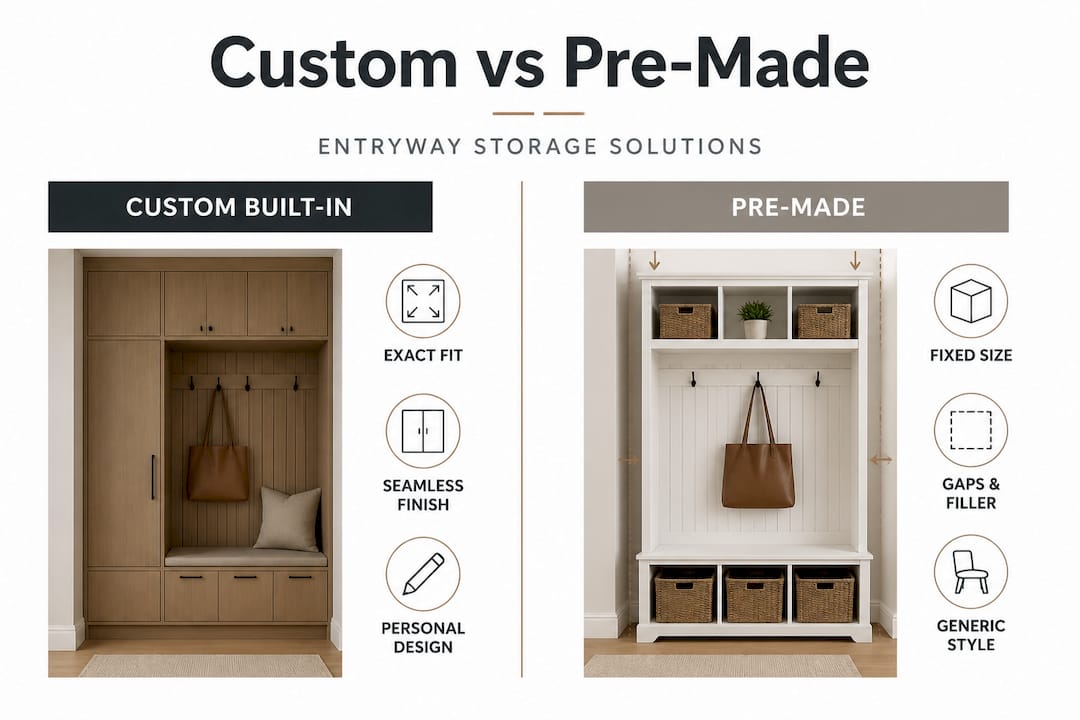
Custom built-ins are built specifically to your space. Every measurement is taken on-site, and the unit is crafted to match your wall’s actual dimensions, not an assumed average. As Realtor.com explains, built-ins maximize space and fit along asymmetrical walls and narrow entryway niches, something no off-the-shelf piece can claim. That kind of precision transforms an awkward corner into a fully functional coat storage zone, a charging station, or a row of cubbies perfectly sized for your family’s gear.
When you invest in custom furniture design, you’re also choosing function that fits your daily routines. Do you need extra-deep shelves for hockey bags? A dedicated spot for four pairs of shoes per kid? A hidden dog leash hook? Standard pieces give you fixed options. Custom built-ins give you a setup designed entirely around how your household operates.
Why custom built-ins outperform standard furniture:
- They fill every inch of available space without gaps or overhangs
- They can wrap around structural columns or work beside HVAC units
- Finishes and hardware are matched to your home’s existing style
- Shelving heights are set to your actual items, not a generic size
- They anchor to the wall, making them stable and safe for homes with kids
“The entryway is the first impression of your home. A built-in that fits perfectly tells every guest something deliberate and thoughtful went into this house.” — A principle that guides every project at Furniture Design Group
The home furnishing expertise needed to design and execute a truly custom built-in is meaningfully different from selecting something off a website. It requires understanding how your home flows, where natural light falls, and how the entryway connects to the spaces beyond it.
| Feature | Custom built-ins | Pre-made furniture |
|---|---|---|
| Fit to space | Exact dimensions | Approximate |
| Style matching | Fully customizable | Limited options |
| Corner/niche use | Yes | Rarely |
| Wall anchoring | Standard | Often not included |
| Adjustment for uneven walls | Built into process | Not possible |
| Long-term durability | High (built-in materials) | Variable |
How the installation process ensures a perfect fit
Knowing why built-ins are functionally superior, it’s important to understand how skilled installation unlocks those benefits.
Here’s something most homeowners don’t realize: even a beautifully designed built-in can fall apart in execution if the installation process isn’t handled with precision. Maryland homes, especially those built before 1980, often have walls that aren’t plumb, floors that have settled unevenly, and stud spacing that doesn’t follow modern standards. A cabinet installed without accounting for these variables will show gaps, misaligned doors, and shelves that tilt over time.
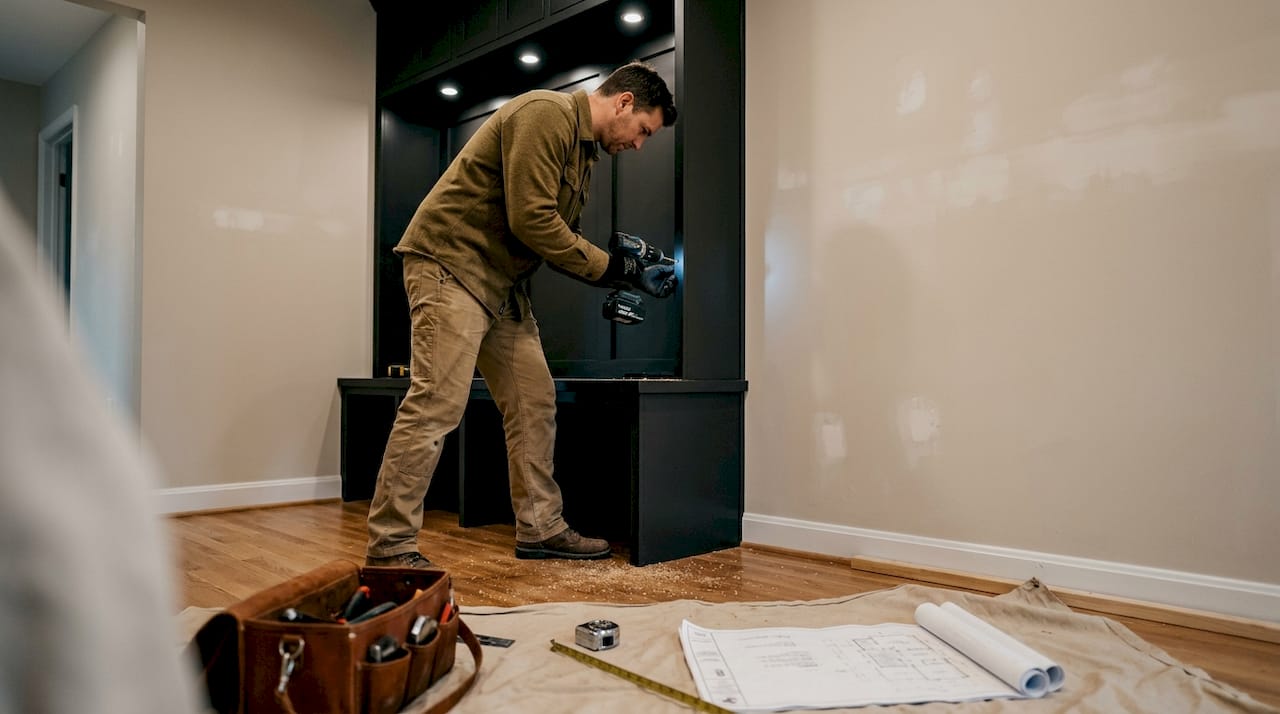
Professional installation follows a deliberate sequence that eliminates these problems before they happen. Here’s how it works in practice:
- Initial site survey. Every wall is measured at multiple heights, not just once at the center. This reveals bows, slopes, and irregularities that a single measurement would miss.
- Floor level check. The floor’s slope is mapped across the entire installation footprint. Even a quarter-inch variation can throw off a full wall of cabinets.
- Stud location. Every anchor point is mapped before a single screw goes in. Anchoring to drywall alone eventually leads to sagging or, in worst cases, collapse.
- Shimming. This is the unsung hero of built-in installation. Shims are thin wedges that compensate for uneven floors and walls, keeping units level and visually seamless even when the surface behind them isn’t.
- Scribing. Where a cabinet meets a wall at an angle or curve, the edge is custom-cut to follow that exact profile. This eliminates visible gaps and creates a truly built-in appearance.
- Final alignment check. Doors, drawer fronts, and any adjustable shelves are checked and tuned before the job is considered complete.
Pro Tip: If you’re evaluating any installer, ask them specifically how they handle shimming and scribing. A confident, detailed answer signals real experience. A vague response is a warning sign.
As the professionals at Woodworker Express note, professional results depend on anchoring units to studs, careful shimming, and meticulous leveling. Walls and floors are rarely perfectly straight, and cutting corners at any one of these steps creates visible, frustrating problems that get worse over time. The difference between a built-in that looks installed and one that looks like it grew there is almost entirely in the installation process.
Smart built-in design for Maryland homes: Not just storage, but harmony
Beyond fit and installation, the artistry and problem-solving behind built-in design makes them truly transformative for Maryland entryways.
Maryland’s housing stock is wonderfully diverse. You might have a Federal-style townhome in Annapolis with a narrow vestibule, a 1960s split-level in Silver Spring with a half-wall that makes no sense, or a new construction in Columbia where the builder left the entryway completely bare. Each of these scenarios calls for a different design approach.
One of the biggest challenges in older Maryland homes is HVAC placement. Builders in earlier decades weren’t thinking about how their ductwork would affect future homeowners’ decorating decisions. Registers and returns often end up on walls that would otherwise be perfect for built-in storage. The good news is that thoughtful built-in design can conceal awkward structures while preserving an open entry sequence, using careful depth and proportional design to work around obstructions rather than ignoring them.
Depth matters more than most homeowners expect. A built-in that’s too deep in a narrow entry makes the space feel like a corridor. One that’s too shallow doesn’t provide usable storage. Getting the proportions right requires looking at the entry as a whole, considering sightlines from the front door all the way to the rooms beyond. A well-proportioned built-in actually makes a small entryway feel larger because it brings order and visual calm to a space that might otherwise feel chaotic.
Check out organized entryway ideas for additional inspiration on how storage can transform how a home functions from the very first step inside.
Design considerations that make Maryland entryways truly work:
- Shallow upper cabinets to maintain visual openness in narrow spaces
- Integrated ventilation gaps when built-ins sit near heating or cooling registers
- Wiring channels for phone charging and smart home devices
- Bench height that’s comfortable for adults but still accessible for children
- Pull-out shoe drawers instead of open shelves for cleaner sightlines
- Consistent finish tones that connect the entryway to adjacent rooms
| Design element | Benefit | Common mistake to avoid |
|---|---|---|
| Cabinet depth | Balances storage and openness | Too deep in narrow halls |
| Lighting integration | Brightens dark entries | Forgetting switch placement |
| Material selection | Durability in high-traffic zones | Choosing finish-only over solid wood |
| Color continuity | Visual flow through the home | Disconnected palette from main rooms |
Explore the built-in photo gallery to see how these design decisions come together in real Maryland homes.
The true value of custom built-ins: Usability vs. ROI
Now, let’s talk about how these practical and design benefits translate into lasting real-world value.
It would be dishonest to tell you custom built-ins are a guaranteed financial investment. They almost never deliver a dollar-for-dollar return, and if a contractor promises you otherwise, treat that as a red flag. The real Maryland real estate market doesn’t assign a fixed premium to built-in entryway furniture the way it might for a kitchen remodel or bathroom addition.
That said, the value argument for custom built-ins is still compelling. It just needs to be framed correctly.
Where the real value lives:
- Daily usability. A well-designed entryway built-in makes mornings less chaotic and evenings more organized. Over five or ten years, that compound effect on daily life is genuinely significant.
- Perceived quality. Buyers touring your home will notice an entryway that looks considered and custom. It signals quality throughout, even before they’ve seen the kitchen.
- Reduced clutter costs. Homes with inadequate entryway storage often shift clutter into living areas. Built-ins contain the problem at the source.
- Longevity over replacement. Pre-made furniture typically lasts three to seven years before it shows wear. A well-built custom piece, properly maintained, can outlast the furniture in every other room in your house.
“Think of a custom built-in not as an expense to be recouped at closing, but as infrastructure for a calmer, more functional daily life.” — The mindset we encourage every Maryland homeowner to bring to this decision
Pro Tip: If resale value is part of your thinking, invest in finishes and styles that are classic rather than trendy. A shaker-style built-in in a neutral tone will appeal to a far wider range of future buyers than something highly specific to current design trends.
The Maryland market is competitive. A home that stands out during a showing often does so through atmosphere and attention to detail. A custom entryway built-in delivers both, and that’s the kind of quality that resonates with serious buyers even when it doesn’t show up as a line item in an appraisal.
What most guides miss: Built-ins as entryway mood-setters
Most articles about custom built-ins focus almost entirely on cubic feet of storage, number of cubbies, and how many shoe pairs fit in the bench. That’s useful. But it misses the deeper reason a great entryway built-in matters so much.
Your entryway is the emotional threshold of your home. It’s the first thing you see when you walk in from a stressful workday, and it’s the first thing your guests experience when they visit. A cluttered, awkward entry creates friction. A calm, well-designed one does the opposite: it tells everyone who walks through the door that order and intention live here.
We’ve seen Maryland homeowners invest in beautifully crafted built-ins that still don’t achieve this effect because the design prioritized storage quantity over spatial feeling. Units that are overbuilt for the space block natural sightlines, create a closed-in feeling, and actually make the entryway feel smaller than an open bench would have. Others choose designs that are generic and disconnected from the home’s architecture, so the built-in looks added on rather than integral.
The most successful projects we’ve worked on treat the entryway built-in as a mood-setter first and a storage solution second. That means thinking about what a guest sees the moment the door opens: the proportion of the unit relative to the wall, the warmth of the finish, the quality of the hardware, and whether the piece invites you further into the home or stops you in your tracks.
Browse Maryland home entry examples to see how this balance between function and feeling plays out in real installations. You’ll notice quickly that the projects that feel most successful are the ones where the built-in seems like it was always there.
Our advice to Maryland homeowners is to invest in movement and mood, not just capacity. Ask your designer not just how many hooks or cubbies you need, but how you want to feel when you walk through your own front door. That answer will guide every decision that follows.
Ready to transform your entryway with custom built-ins?
You now have a clear picture of what makes custom built-ins genuinely worth considering: precision fit, professional installation, thoughtful design, and lasting daily value. The next question is where to start turning that understanding into your actual entryway.
Furniture Design Group has spent over 20 years designing and building custom entryway solutions for Maryland homeowners. We understand the spatial quirks of older homes, the storage demands of busy families, and the design sensibility that makes a built-in feel like it belongs. Explore our custom entryway solutions to see the range of options available, or visit our project gallery to find a starting point that feels right for your home. Reach out through our contact form or stop by our showroom to begin a conversation. Your entryway deserves more than a store-bought guess.
Frequently asked questions
Are custom built-ins worth the investment in older Maryland homes?
Yes. Custom built-ins are specifically designed to maximize tricky spaces with unusual layouts, making them a smart and durable choice for the irregular dimensions common in older Maryland construction.
How do custom built-ins differ from pre-made storage options?
Custom built-ins are crafted to fit your exact dimensions, while pre-made options use fixed sizes that often leave awkward gaps or simply won’t fit asymmetrical or narrow spaces.
Do built-ins increase the resale value of my home?
They rarely provide a dollar-for-dollar financial return but consistently enhance buyer appeal by signaling quality and care throughout the home.
What preparation is needed for installing entryway built-ins?
Accurate measurements at multiple wall heights, floor-level checks, and stud mapping are all essential, because as installation experts confirm, proper leveling and stud anchoring are the foundation of any professional built-in result.