
TL;DR:
- Family-owned furniture makers prioritize craftsmanship, accountability, and long-term community relationships.
- Custom furniture offers precise fit, durability, and personalized design, unlike mass-produced options.
- Collaborating with family artisans ensures high-quality, lasting pieces tailored to your home’s unique space.
When most Maryland homeowners need entryway furniture, the instinct is to drive to the nearest big-box store and pick something off the floor. It feels practical. But that shortcut often ends with furniture that warps within two years, never quite fits your space, and looks identical to your neighbor’s mudroom. Family-owned furniture makers operate on a completely different philosophy, one rooted in accountability, genuine craftsmanship, and long-term relationships. This article will show you exactly why that difference matters, how custom craftsmanship works, and how to decide whether a family-owned maker is the right choice for your home.
Table of Contents
- The unique advantages of family-owned furniture makers
- What custom craftsmanship really means
- Custom vs. store-bought entryway furniture: Is it worth it?
- Personalized service and collaboration
- Why personalized craftsmanship beats mass-market solutions for Maryland homes
- Next steps: Connect with Maryland’s family-owned custom furniture experts
- Frequently asked questions
Key Takeaways
| Point | Details |
|---|---|
| Trust and loyalty | Family-owned furniture shops build lasting relationships and deliver reliable service you can count on. |
| Superior craftsmanship | Expert joinery and premium woods offer exceptional durability and bespoke designs for Maryland homes. |
| Personalized service | Homeowners enjoy collaborative design and responsive updates for custom entryway projects. |
| Real value | Custom-made furniture is an investment in quality, fit, and personal connection that mass-market stores can’t match. |
The unique advantages of family-owned furniture makers
There is a reason why some furniture shops have served the same communities for generations. It is not just nostalgia. It is performance. Family-owned businesses carry the full weight of their reputation on every single project they take on, because a poor result does not disappear into a corporate complaint queue. It comes back to the owner’s front door.
Family businesses foster trust via personal accountability, long-term relationships, and community ties, outperforming corporate competitors in customer loyalty. That finding from Harvard Business Review is not just feel-good data. It reflects a structural reality: when the person building your furniture is also the person answering the phone, signing the checks, and living in your community, their incentive to do excellent work is fundamentally different from a factory floor worker fulfilling a daily quota.
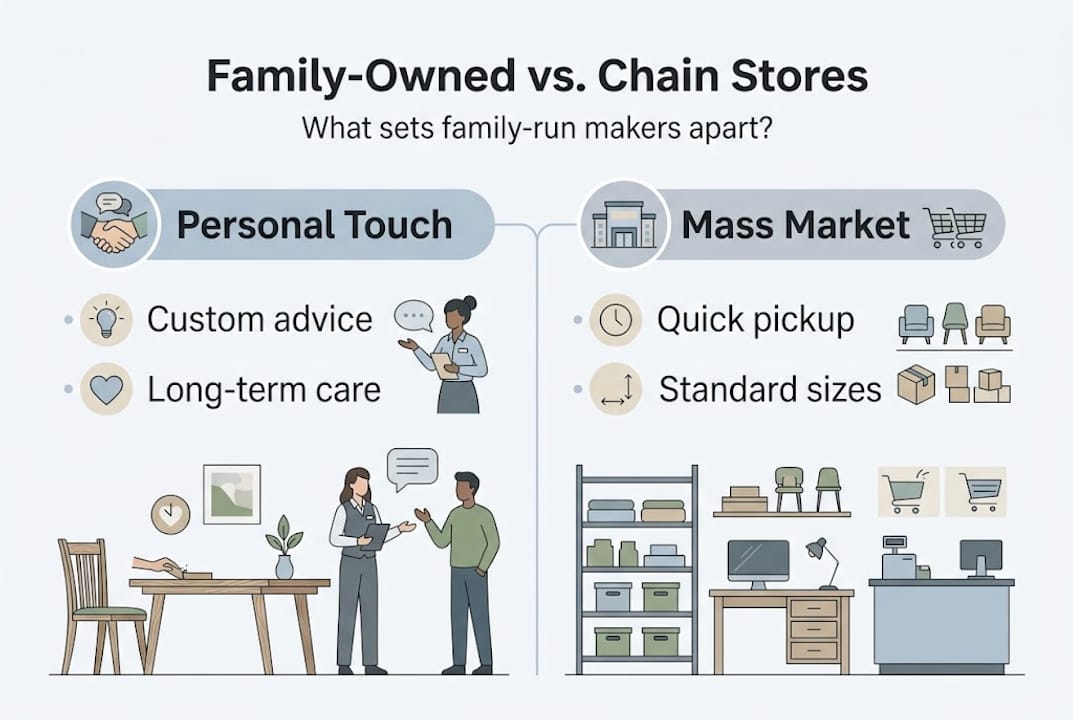
The relationship you build with a family-owned maker also continues well past delivery day. Unlike retail stores where post-sale support is often minimal, family-run shops stay connected. They remember your space, your preferences, and your style. If you decide to add a bench to your entryway two years later, they already know what wood species and finish will match seamlessly.
What does this look like in practice? Consider these real advantages Maryland homeowners regularly experience:
- Direct communication with the craftsperson who is actually building your furniture, not a sales rep relaying messages
- Flexibility to adjust designs mid-project without navigating layers of corporate approval
- Aftercare and maintenance support long after the furniture is installed
- Community accountability that motivates quality at every stage
- Personal investment in the finished result because their name is tied to it
Customer review data backs this up. Family-owned stores earn exceptional praise for quality craftsmanship, outstanding service, and dependability, with some reaching 4.9 out of 5 stars from over 1,000 verified reviews. That kind of rating does not happen by accident. It comes from consistent, people-first service that big retailers struggle to replicate at scale.
“The difference between a family-owned maker and a big-box store is the difference between someone who signs their work and someone who badges their shift.” — A Maryland homeowner reflecting on a custom mud locker project
When you explore custom furniture masterpieces built by family-owned artisans, you start to see this philosophy in every joint, every finish, and every carefully chosen detail. These are not products. They are commitments.
One often overlooked factor is fabric and material selection. Family-owned makers take the time to guide you through choices that suit both your aesthetic and your lifestyle. Understanding how to approach choosing fabric for custom furniture is part of the consultative process that separates artisan shops from showroom floors.
What custom craftsmanship really means
Craftsmanship is one of those words that gets used so often it starts to lose meaning. Let’s make it concrete.
When a family-owned furniture maker talks about craftsmanship, they are describing specific technical decisions that directly affect how long your furniture lasts and how well it performs. Two of the most important are joinery and wood selection.
Joinery refers to how pieces of wood are connected. Mass-produced furniture almost always relies on screws, staples, and glue. These joints weaken over time, especially in high-use furniture like an entryway mud locker that gets opened and closed dozens of times a day. Artisan makers use joinery techniques that have been tested for centuries. Joinery like dovetails strengthens over time, and when paired with kiln-dried hardwoods at 6 to 8 percent moisture content, the resulting piece resists warping and cracking for decades. A dovetail joint, for instance, actually becomes tighter as the wood naturally adjusts to humidity cycles in your home.
Wood selection is equally critical. The Janka hardness rating measures a wood’s resistance to denting and wear. For entryway furniture that takes daily abuse from shoes, bags, and coats, a Janka rating above 1,200 lbf is the practical threshold. Kiln drying ensures the wood has been brought to a stable moisture level before construction begins, which prevents the joint failures and surface checks that plague furniture made from improperly dried lumber.
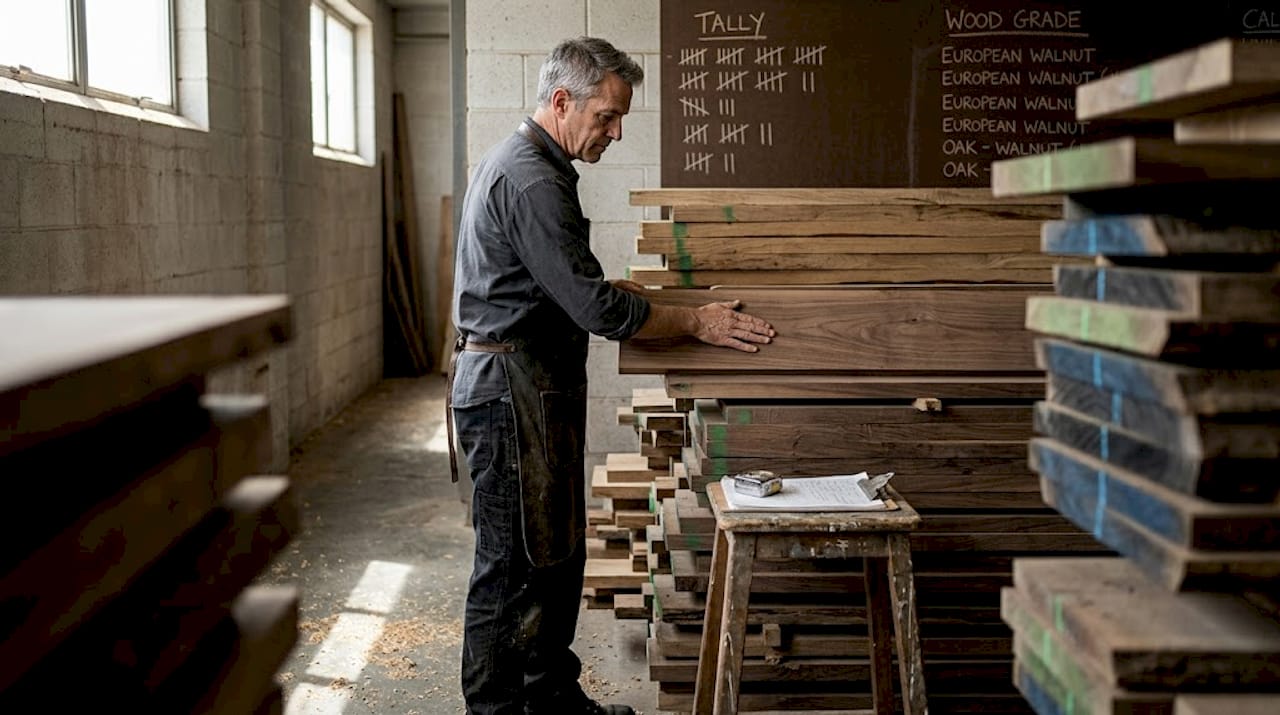
Here’s how the materials and construction methods compare:
| Feature | Family-owned custom | Mass-produced |
|---|---|---|
| Joinery method | Dovetail, mortise-and-tenon | Screws, staples, glue |
| Wood moisture content | 6-8% kiln dried | Variable, often inconsistent |
| Janka hardness (typical) | 1,200+ lbf | Often under 800 lbf |
| Finish quality | Hand-applied, multi-coat | Factory spray, single coat |
| Fit to your space | Measured to exact dimensions | Standard sizes only |
| Expected lifespan | 30 to 50+ years | 5 to 10 years |
Beyond the structural elements, skilled artisans also pay close attention to edge details and surface finishing. Hand-applied finishes build up in thin layers, each one sanded before the next is applied. This creates a depth and warmth that factory finishes simply cannot match. For an entryway that greets you and your guests every single day, that visual quality is not a luxury. It is part of the experience.
The custom craftsmanship insights that experienced family-owned makers bring to each project reflect decades of refining these techniques, not just following a production manual.
Pro Tip: Before committing to any furniture maker, ask two direct questions: “What joinery do you use?” and “What is the moisture content of your lumber?” A skilled artisan will answer both immediately and with confidence. Vague answers are a warning sign.
Custom vs. store-bought entryway furniture: Is it worth it?
This is the question most Maryland homeowners wrestle with, and the honest answer is: it depends on your priorities.
Store-bought entryway furniture has real advantages. You can often take it home the same day. The upfront price is lower. There is zero design effort required on your part. If you need something functional immediately and plan to replace it in five years, a retail piece might serve you fine.
But custom entryway furniture excels in scenarios that are actually very common among homeowners who care about their space. Custom furniture excels in non-standard spaces but carries longer lead times and higher upfront costs. It is the right choice for homeowners who value longevity and a precise fit over immediacy.
Consider this: most Maryland homes have entryways that are not exactly 36 inches wide or exactly 84 inches tall. Standard retail pieces leave gaps, look awkward, and often require workarounds that never fully satisfy. A custom mud locker built to your exact dimensions looks like it was always supposed to be there, because it was designed specifically for that space.
Here is a straightforward comparison:
| Factor | Custom family-owned | Store-bought |
|---|---|---|
| Upfront cost | Higher | Lower |
| Lead time | 6-8 weeks | Same day to 2 weeks |
| Fit to your space | Exact | Approximate |
| Durability | 30 to 50+ years | 5 to 10 years |
| Design flexibility | Unlimited | Limited to stock options |
| Long-term value | High | Lower |
To assess whether custom is right for you, work through these four steps:
- Measure your space carefully. Note the exact width, height, and depth available. If standard furniture leaves more than two inches of awkward gap, custom is worth strong consideration.
- Define your style and function needs. Do you need hooks, cubbies, a bench, shoe storage, or all four? Store-bought pieces rarely combine all these in one cohesive unit.
- Set a realistic budget. Custom costs more upfront but less over a decade when you factor in replacements.
- Consider your timeline. If you need furniture immediately, a retail piece can bridge the gap while you commission a permanent custom solution.
Understanding custom project timelines helps set realistic expectations. Most well-crafted custom pieces take six to eight weeks from design approval to delivery, a timeline that reflects genuine care, not delay.
Family-owned shops also give you something that retail simply cannot: the ability to see your custom furniture comparison evolve in real time, with direct input at every stage. That flexibility alone changes the entire decision calculus.
Personalized service and collaboration
The process of commissioning custom entryway furniture from a family-owned maker is not like placing an online order. It is a genuine collaboration, and that collaboration is often what homeowners value most in hindsight.
It starts with a consultation. A skilled craftsperson will visit your home or work from precise measurements and photos. They listen to how your family actually uses the entryway. Do backpacks pile up after school? Do you need deep cubbies for winter boots? Is there a pet whose leash and gear needs its own dedicated hook? These details shape every design decision in ways that a standardized product simply cannot accommodate.
Once the design direction is set, transparent communication continues throughout the build. You know which materials were selected and why, what the construction sequence looks like, and when to expect delivery. There are no surprises, and if your preferences shift slightly during the process, a family-owned maker has the flexibility to accommodate adjustments without routing your request through a customer service department.
Family-owned stores consistently earn recognition for quality craftsmanship, exceptional personal service, and reliability, a pattern that reflects genuine investment in each client relationship rather than transactional sales.
Here are the concrete service touchpoints Maryland homeowners should expect from a quality family-owned furniture maker:
- In-home or detailed remote consultation to understand your space, lifestyle, and style preferences
- Design drawings or sketches shared before production begins so you can visualize the finished piece
- Material samples for wood species and finish selection, so there are no color surprises
- Progress updates during the build, including photos of key construction stages
- White-glove delivery and installation so the piece is set up correctly from day one
- Post-delivery follow-up to address any questions about care, maintenance, or future additions
The local family-owned services that have built strong reputations in Maryland offer all of these touchpoints as standard practice, not as premium add-ons.
Pro Tip: During your initial consultation, ask for in-progress photos at the joinery stage. This gives you a clear window into the actual quality of construction before the piece is finished, and it shows you how seriously the maker takes their work.
Why personalized craftsmanship beats mass-market solutions for Maryland homes
After more than 20 years of building custom entryway furniture for Maryland homeowners, we have seen a clear pattern. The homeowners who choose mass-produced furniture because it feels safer or simpler often return to us two or three years later, frustrated. The furniture cracked, warped, or simply never felt right in the space.
The deeper issue is that mass-market furniture is designed for the statistical average, not for your actual life. It does not account for the humidity swings that Maryland winters and summers bring, the specific dimensions of your entryway, or the way your family actually moves through that space every day.
Custom, personalized furniture solutions built by family-owned craftspeople do something that no retail product can. They translate your specific life into a functional, beautiful object that grows more meaningful over time. These are pieces that get passed down. They hold the memory of the house, the family, and the craftsperson who built them with intention.
We believe strongly that Maryland homeowners deserve furniture that fits their homes the way a well-made suit fits a person. Close, intentional, and built to last a lifetime. That is not a marketing promise. It is the only standard we know how to work toward.
Next steps: Connect with Maryland’s family-owned custom furniture experts
If you’ve been weighing your options and this article has helped clarify the real difference between custom craftsmanship and off-the-shelf convenience, the next step is straightforward. Start a conversation.
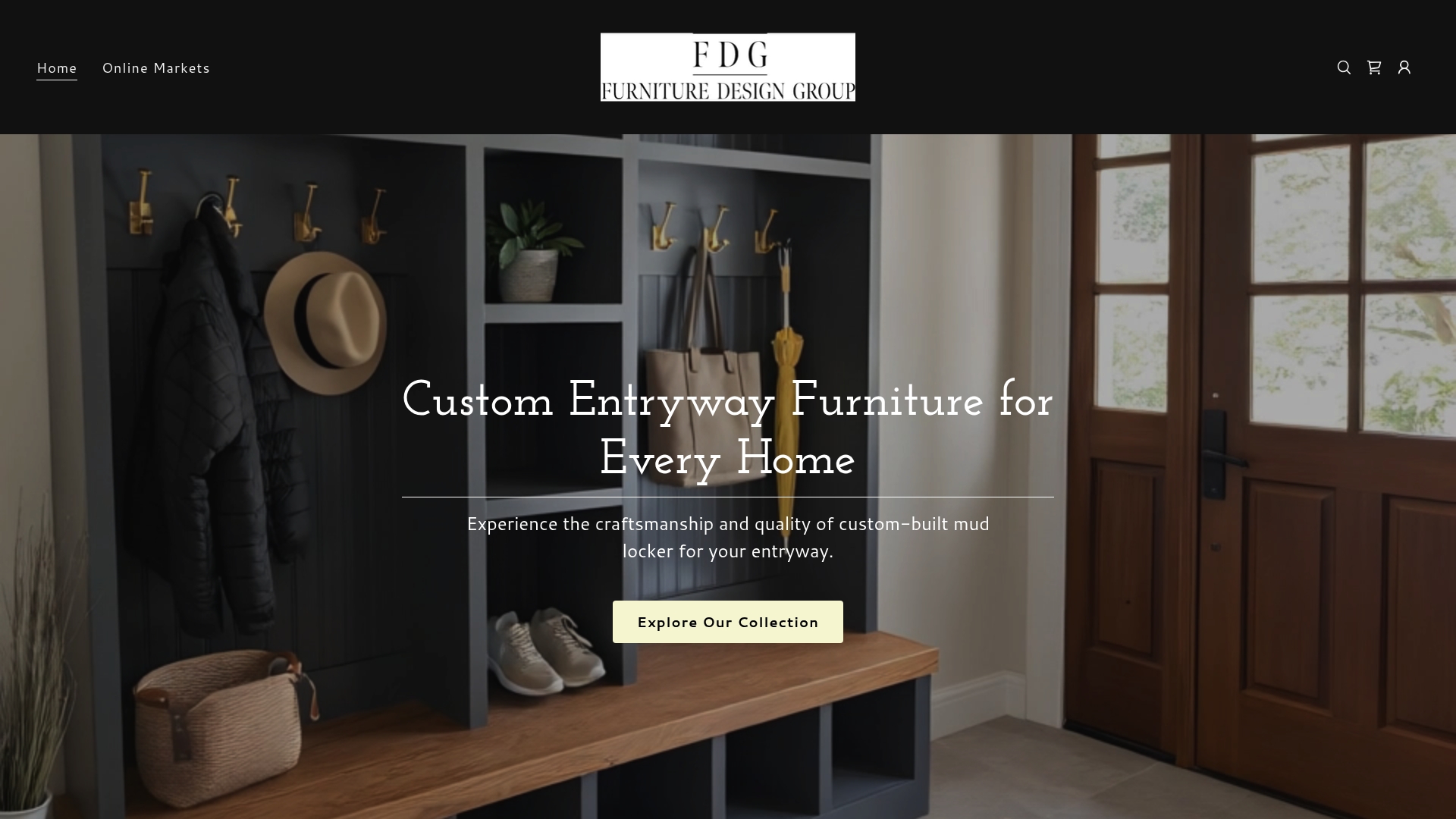
Furniture Design Group has spent over 20 years building custom entryway furniture for Maryland homeowners who want their space to feel purposeful and personal. Our custom furniture masterpieces showcase the range of what’s possible, from classic mud lockers to fully integrated entryway systems. When you’re ready to explore what a custom piece could look like in your home, the Maryland furniture experts at Furniture Design Group are ready to listen, measure, and build something made specifically for you.
Frequently asked questions
How long does custom entryway furniture from family-owned makers usually take in Maryland?
Custom entryway furniture typically requires 6-8 weeks from design approval to delivery, reflecting careful craftsmanship and close collaboration with the homeowner throughout the build process.
Are custom-made furniture pieces really more durable than store-bought?
Yes, custom pieces built with dovetail joinery and kiln-dried hardwoods at 6 to 8 percent moisture content resist warping, cracking, and joint failure far longer than mass-produced alternatives using screws and glue.
Do Maryland family-owned furniture makers offer after-sale support?
Most family-run shops provide ongoing support well after delivery because, as Harvard Business Review notes, family businesses build loyalty through personal accountability and long-term relationships that corporate retailers rarely sustain.
How can I ensure my entryway furniture fits my home’s unique space?
Schedule a design consultation so the maker can take exact measurements and plan around your specific dimensions, ensuring the finished piece looks intentional rather than approximated.