
TL;DR:
- A well-designed custom entryway transforms daily household function and enhances long-term home value.
- Tailored solutions ensure perfect fit, durability, and storage that adapts to Maryland families’ unique needs and climate.
Your entryway is the hardest-working room in your house. It absorbs muddy boots, backpacks, dog leashes, groceries, mail, and wet umbrellas every single day, yet most Maryland homeowners treat it as an afterthought. The problem is not just clutter — it’s that a poorly designed entry creates friction the moment you walk through the door. When that space works well, your whole day feels smoother. When it doesn’t, the chaos bleeds into every room. More Maryland families are now recognizing that a thoughtfully built custom entryway is one of the smartest investments they can make in both daily comfort and long-term home value.
Table of Contents
- The limitations of stock entryway solutions
- What sets custom entryways apart
- Maryland-style priorities: function as much as style
- Investment and value: ROI considerations for custom entryways
- The overlooked truth: why the best entryway isn’t about design alone
- Craft your perfect Maryland entryway with Furniture Design Group
- Frequently asked questions
Key Takeaways
| Point | Details |
|---|---|
| Perfect fit guaranteed | Custom entryways are measured and built for your specific home, solving layout challenges stock options can’t handle. |
| Built for Maryland life | Local homeowners prioritize durability and storage that manage mud, snow gear, and busy routines. |
| Long-term value | A custom entryway offers daily organization and can enhance resale value when tailored to your market. |
| Superior function and style | Custom designs blend seamless style with engineered features for real-life use. |
The limitations of stock entryway solutions
Walk into any big-box home goods store and you’ll find rows of pre-made benches, cubby units, and hall trees. They look appealing on the showroom floor. But once you get them home, the reality sets in fast. The bench is two inches too short for the wall space. The hooks are fixed in positions that don’t work for your family’s height range. The particle board starts swelling after one wet winter.
Maryland homes in particular present challenges that stock furniture simply was not designed to handle. Older colonial homes in Annapolis, narrow rowhouses in Baltimore, and craftsman-style properties throughout Montgomery County all carry architectural quirks, non-standard wall widths, uneven floors, or unique doorway placements. As noted in a detailed discussion on entryway design, non-standard openings and older construction make stock sizes far less likely to look or feel seamless. A custom approach can match these constraints for a truly cohesive finish.
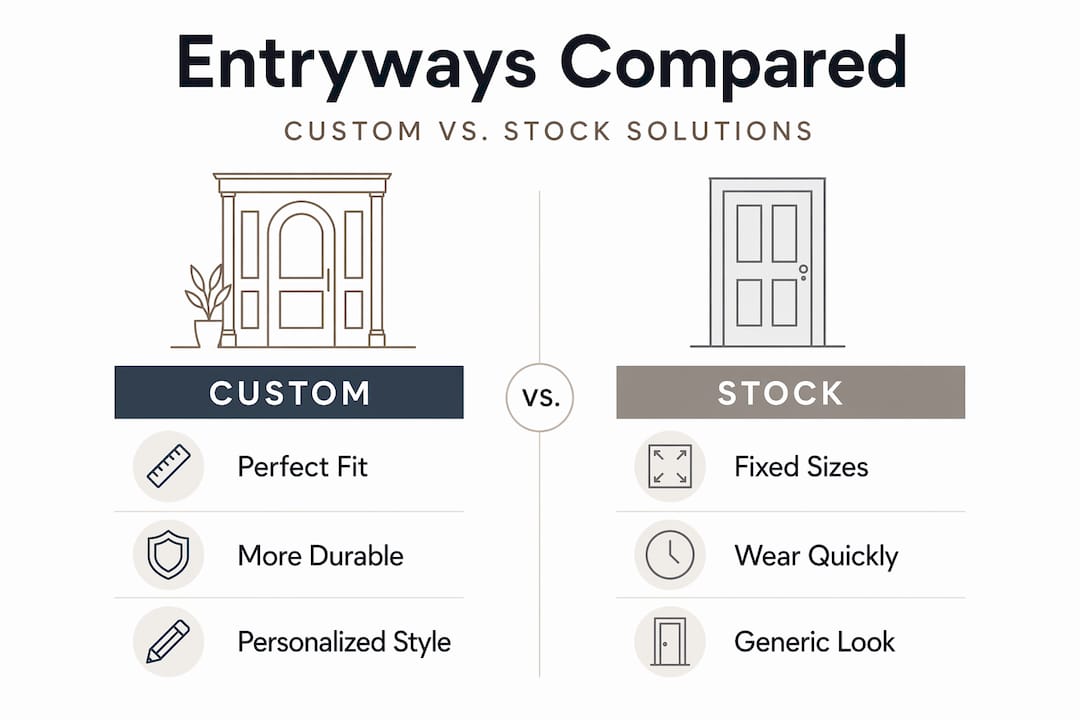
| Feature | Stock entryway furniture | Custom entryway furniture |
|---|---|---|
| Fit | Standard sizes only | Built to your exact dimensions |
| Materials | Often particle board or MDF | Solid wood, hardwood, or premium composites |
| Finish options | Limited color/style choices | Fully tailored to your home’s aesthetic |
| Storage configuration | Fixed compartments | Modular, adaptable to your lifestyle |
| Longevity | 3 to 7 years on average | 15 or more years with proper care |
| Installation | DIY assembly, often unstable | Professional anchoring and engineered mounting |
Beyond poor fit, generic storage just does not think ahead. A stock cubby unit has no way of knowing you have three kids in soccer cleats, a retriever who needs towels near the door, and a home office that generates a daily pile of mail. The result? You end up buying multiple pieces that don’t coordinate, use up floor space inefficiently, and still leave you frustrated.
“A well-designed entry is not a luxury — it’s the difference between a home that functions and one that constantly fights you.”
The custom furniture design benefits become obvious the moment you compare side by side. Pre-fabricated materials also frequently fall short on durability. Laminate surfaces chip, drawer slides loosen, and the visual appeal fades quickly under the punishment of daily traffic. Investing in tailored entryway solutions built for your specific layout means the furniture grows with your household rather than wearing out in a few years.
What sets custom entryways apart
Now that you see where stock options fall short, let’s talk about what goes into a truly custom entryway and why those details matter for Maryland families.
The foundation of any great custom entryway is precise measurement. Not just a rough estimate, but a detailed site survey that accounts for baseboard height, ceiling clearance, door swing radius, and even the direction your floors slope. According to one detailed overview of custom mudroom construction, the core value homeowners receive includes precise measurements for fit, engineered mounting and anchoring for load-bearing daily use, and modular storage layouts that reduce clutter at the point of entry. These are not extras. They are the foundation of a piece that will last decades.
Here’s what a professional custom entryway process typically looks like, step by step:
- Site consultation and measurement: A specialist visits your home, documents exact dimensions, notes architectural details, and discusses your family’s specific habits and storage needs.
- Design proposal: You receive a detailed plan showing materials, finish options, layout configurations, and hardware selections tailored to your space.
- Material selection: Choose from hardwoods, painted finishes, or custom laminates depending on your lifestyle and aesthetic goals.
- Fabrication: Your furniture is built off-site in a workshop environment, ensuring precision cutting, joinery, and finishing.
- Professional installation: The unit is anchored securely to wall studs, leveled, and fitted with precision so that gaps, wobbling, and loose panels are not an issue.
- Final walkthrough: Your builder reviews every element with you, adjusting hardware placement or adding last-minute touches.
Pro Tip: Before your consultation, spend one week observing exactly what gets dropped in your entryway and by whom. Make a list. That behavioral data will guide your builder toward storage solutions you’ll actually use every day, not just the ones that look good in a catalog.
The top features Maryland homeowners consistently request reflect both the region’s climate and busy household rhythms:
| Feature | Why Maryland homeowners want it |
|---|---|
| Bench with hidden shoe storage | Keeps floors clear, especially during rainy and snowy seasons |
| Adjustable hooks at multiple heights | Accommodates adults, children, and various coat lengths |
| Wipeable or painted surfaces | Easy to clean after muddy arrivals |
| Built-in cubbies with baskets | Contains backpacks, dog gear, and sports equipment |
| Charging stations or key hooks | Reduces morning scramble time |
| Integrated lighting | Helps when arriving home after dark |
Exploring entryway organization strategies from professional organizers reinforces what builders already know: a well-designed entry dramatically cuts the time families spend searching for lost items and managing daily chaos. When you work with expert custom entryway services, each of these features is engineered to fit your space rather than forced into a one-size-fits-all solution.
Maryland-style priorities: function as much as style
Understanding the construction mechanics is only half the picture. The other half is understanding what Maryland families actually live through every day and why those realities demand more than a pretty piece of furniture.
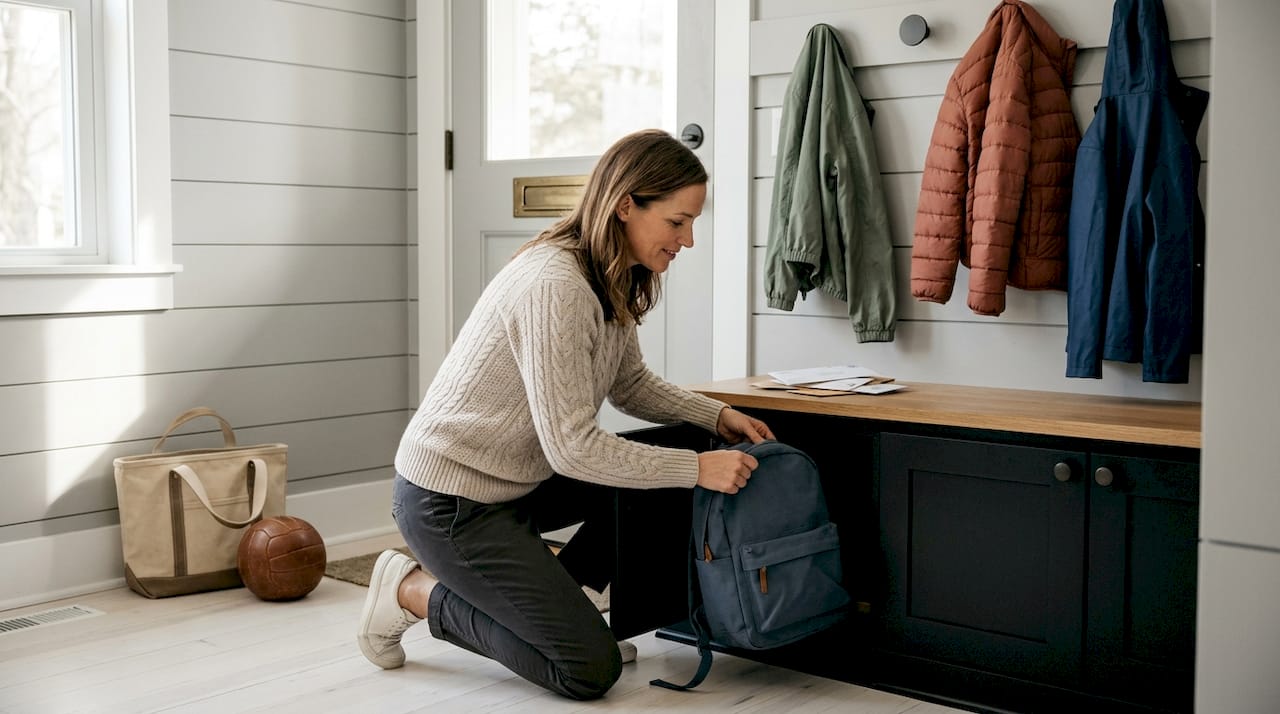
Maryland’s four-season climate is genuinely demanding. Summers bring humidity and heat. Fall drops layers of leaves and mud. Winter delivers sleet, road salt on boots, and thick coats. Spring means wet shoes and rain gear piling up near the door. Entry spaces in busy Maryland households function as a true “drop zone,” and as one expert source describes it, these spaces must handle winter gear and repeated arrivals and departures — so durability, storage containment, and ease of cleaning matter as much as appearance.
Here’s what experienced homeowners in Maryland tend to prioritize when designing their custom entry:
- Hidden bins or pull-out drawers for wet boots and sports shoes, keeping them out of sight but easy to access
- Removable, washable shoe trays made from rubberized materials that slide into built-in slots beneath the bench
- Wipeable bench surfaces in painted hardwood or sealed finishes that clean up with a quick swipe
- Wall-mounted hooks placed strategically so coats and bags don’t end up on the floor
- Ventilated cubbies that allow gear to dry without trapping moisture or odors
- Pet-friendly lower sections with dedicated space for leashes, towels, and feeding accessories
“The smartest Maryland entryways are the ones you barely have to think about. When storage is exactly where it should be, the whole household naturally falls into habits that keep things tidy.”
Pro Tip: When speaking with your custom builder, ask specifically about the finish on every surface. Request information on scratch resistance, moisture tolerance, and cleaning requirements. A beautiful painted surface that chips after six months is no better than the stock furniture you’re replacing. Ask for material samples and test them yourself before committing.
Thinking about smart entryway storage options can also help you generate ideas before your design consultation. The best builders welcome homeowners who arrive with a clear wish list because it speeds up the design process and ensures nothing important gets overlooked. Your Maryland custom entryway solutions should feel like they were designed for your household specifically, because they were.
Investment and value: ROI considerations for custom entryways
Once you know what makes a custom entryway practical, the natural next question is about budget and long-term value. This is where many homeowners get confused by the numbers they find online.
You’ll often see statistics claiming that entry door upgrades return 70% or even more of their cost at resale. Those figures are worth understanding in context. Published ROI figures for entry doors are typically about exterior upgrades and perceived curb appeal rather than interior custom furniture specifically. Homeowners should treat those numbers as directional and validate the impact with local real estate comps before expecting the same returns on an interior entryway project.
That said, the value of a custom entryway goes well beyond a simple resale calculation. Here’s what to consider when evaluating your investment:
- Daily quality of life: A space that eliminates morning chaos, reduces lost items, and makes arriving home feel calm has real value that a spreadsheet can’t fully capture.
- Finished appearance: Custom built-ins signal quality to home buyers in a way that a store-bought hall tree never will. Buyers recognize craftsmanship.
- Durability over time: A well-built custom piece made from solid materials will not need replacing for fifteen or more years, while stock furniture often needs replacing every three to seven years. Factor in those replacement costs.
- Storage efficiency: Custom entryways make use of every inch of available space, including corners, odd angles, and low-ceiling alcoves that standard furniture simply ignores.
Before you commit to a project, use this checklist of questions to ask your builder or designer:
- What materials do you recommend for high-traffic, high-humidity environments like Maryland?
- Can the design accommodate future changes, like adding a section when the family grows?
- How is the unit anchored to ensure it won’t tip or shift over time?
- What is the warranty on both materials and installation?
- Can you show me examples of similar projects you’ve completed in Maryland homes?
The crafting entryway value process is as much about asking the right questions as it is about selecting the right materials. Builders who welcome these conversations are the ones who will deliver results you’re proud of for years.
The overlooked truth: why the best entryway isn’t about design alone
After covering the practical details, the ROI considerations, and the construction methods, here’s something worth saying plainly: too many homeowners approach their entryway as a purely visual project.
They focus on matching the trim color, choosing the right hardware finish, and coordinating with the hallway rug. Those things matter. But the entryways we’ve seen truly transform a household are the ones that were designed around workflow, not just aesthetics.
The question isn’t “what will look beautiful when guests arrive?” The real question is “what will make coming home at 6:30 p.m. on a Tuesday, with wet boots, two kids, and grocery bags, feel effortless?” When you design for that moment, everything else follows naturally. A good-looking entry that creates daily friction is a missed opportunity.
We’ve worked with Maryland families long enough to know that the entryways that get raved about six months after installation are almost always the ones that solved a behavioral problem. A parent who used to trip over shoes every morning. A family that couldn’t find their keys three times a week. A homeowner who dreaded coming through the door because of the chaos waiting inside. The design fixed the problem, and the beauty became secondary.
Reviewing real-world custom entryway results from families who made this investment tells you everything. The common thread is not “it looks amazing,” though it usually does. It’s “I don’t think about it anymore,” which is exactly what great functional design is supposed to do.
Craft your perfect Maryland entryway with Furniture Design Group
Inspired to make your entryway a true asset to your home? Furniture Design Group has spent over 20 years designing and hand-crafting custom entryway furniture for Maryland homeowners just like you. Our family-owned workshop combines old-world craftsmanship with practical, modern storage thinking, and every piece we build is made specifically for your space, your family’s lifestyle, and your home’s unique architecture.
Whether you’re starting from scratch or replacing something that stopped working years ago, we make the process straightforward and genuinely enjoyable. Browse our custom entryway services to explore what’s possible, or take a look at our see our entryway portfolio to get inspired by real projects we’ve completed across Maryland. Reach out today for a consultation, and let’s build something that makes coming home the best part of your day.
Frequently asked questions
How do custom entryways handle odd-shaped or older Maryland homes?
Custom entryways are built from precise site measurements and flexible construction methods, so they fit seamlessly even in homes with non-standard openings or older architectural details that stock sizes can’t match.
Are custom entryways more durable than store-bought options?
Yes. Custom entryways use engineered mounting and anchoring for load-bearing daily use and quality materials that outlast typical stock furniture by years.
What are the top features Marylanders request in a custom entryway?
Most Maryland homeowners prioritize modular storage, easy-to-clean surfaces, and solutions that manage high-traffic wear, seasonal gear, and wet footwear throughout the year.
Does investing in a custom entryway increase home value?
A custom entryway improves resale appeal through quality craftsmanship and functional storage, but ROI figures for entry upgrades should always be validated against local Maryland real estate trends.
How long does it take to install a custom entryway in Maryland?
Installation typically ranges from one day to about one week depending on the complexity of the design and how much custom fabrication is involved in your specific project.