
TL;DR:
- Craftsmanship involves trained human skills, heritage techniques, and quality materials to produce durable objects. It offers repairability, cultural significance, and long-term value that mass-produced furniture cannot match, ultimately benefiting both owners and artisans. Recognizing authentic craftsmanship through joint quality, material choices, and maker signatures ensures better investment and preservation of heritage skills.
Craftsmanship is the disciplined production of quality objects through trained human skill, time investment, and heritage techniques. It is not a price tag, a marketing label, or a style category. The true definition of craftsmanship rests on six testable criteria: trained human labor, heritage technique, quality materials, limited scale, an authorial signature, and an irreplaceable maker. For homeowners and interior designers, understanding why prioritize craftsmanship means recognizing that the furniture you choose either compounds in value or quietly degrades. The difference shows up years later, in a joint that holds or a drawer that warps.
Why prioritizing craftsmanship matters for quality and durability
Craftsmanship creates structural advantages that mass production cannot replicate, and most of them are invisible at the point of purchase. The choice of joinery method, the direction of wood grain in a panel, the thickness of a tenon shoulder: none of these appear in a product photo, but all of them determine whether a piece lasts a decade or a lifetime. Craftsmanship decisions in home construction affect daily comfort and long-term satisfaction even when hidden behind walls or beneath surfaces, from window envelope quality to door installation tolerances.
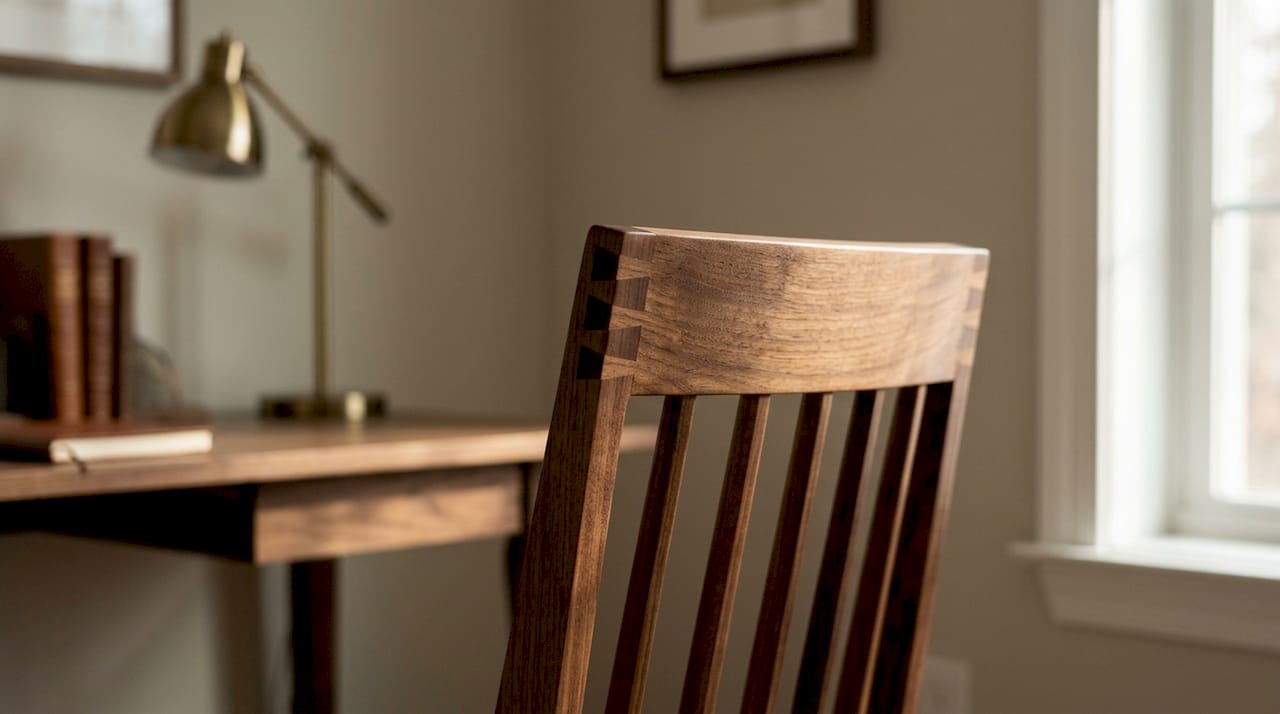
Repairability is the single most underrated benefit of quality craftsmanship, and it is built in at the design stage, not added later. A skilled maker considers component separability before cutting the first board. Serviceability and repair pathways designed into crafted objects extend ownership and shift the meaning of ownership from disposable to lasting. A mortise-and-tenon joint can be re-glued. A dovetail drawer can be re-fitted. A piece assembled with staples and particleboard cannot be saved.
Material science reinforces what traditional technique already knew. Research on wood modification shows that furfurylation and polyesterification significantly increase wood durability and resistance to fungi and termites, with vacuum-pressure impregnation enhancing treated wood properties for outdoor and high-stress applications. Separately, hybridized plywood with plant fiber composites can improve bending strength by up to 79% and increase fatigue life, delaying failure initiation under cyclic loading. These are not theoretical gains. They translate directly into furniture that survives real use.
The practical benefits of quality craftsmanship in furniture come down to three structural factors:
- Joinery integrity: Traditional joints distribute stress across larger surface areas than mechanical fasteners, reducing failure points under daily load.
- Material selection: Skilled craftsmen choose wood species and grain orientation for the specific stresses each component will face, not for visual uniformity.
- Finish depth: Hand-applied finishes penetrate wood fibers rather than sitting on the surface, protecting against moisture and wear from the inside out.
Pro Tip: When evaluating a piece of furniture, turn it upside down. The underside reveals the real joinery. Staples and glue blocks signal mass production. Mortise-and-tenon or dovetail joints signal craftsmanship.
Why craftsmanship carries cultural and ethical weight
Craftsmanship is a knowledge system, not just a production method. Well-made objects reveal their design rationale and carry the maker’s skill and ethics embedded in every decision, from material sourcing to finishing sequence. A hand-carved mud locker from a Maryland workshop carries the accumulated knowledge of the craftsman who built it, knowledge that took years to develop and cannot be downloaded or automated.
The risk of losing that knowledge is real. Prioritizing craftsmanship supports artisan knowledge transmission, preserving heritage skills that would otherwise face extinction without deliberate training and generational commitment. Japan’s Living National Treasures program designates master craftsmen as cultural assets precisely because their skills cannot be scaled or replaced. The same principle applies to any artisan lineage, whether it involves lacquerwork in Kyoto or hand-joinery in the American mid-Atlantic.
“The things we choose to surround ourselves with are not neutral. They reflect what we value, what we are willing to pay attention to, and what kind of future we are building for the people who come after us.”
Ethical production is the other side of this argument. Mass production optimizes for speed and unit cost, which produces furniture designed to be replaced, not repaired. That disposability mindset has real consequences: landfills receive millions of tons of furniture annually in the United States alone. Choosing handcrafted furniture from heritage crafting traditions supports artisans who earn fair wages for skilled labor, keeps specialized knowledge alive in communities, and produces objects that do not end up in a landfill after five years.
Supporting craftsmanship is also a sustainability decision. A piece of furniture built to last 50 years has a fraction of the environmental footprint of five pieces built to last 10 years each. The carbon cost of production, shipping, and disposal compounds with every replacement cycle. Craftsmanship breaks that cycle.
Craftsmanship versus mass production: what you actually get
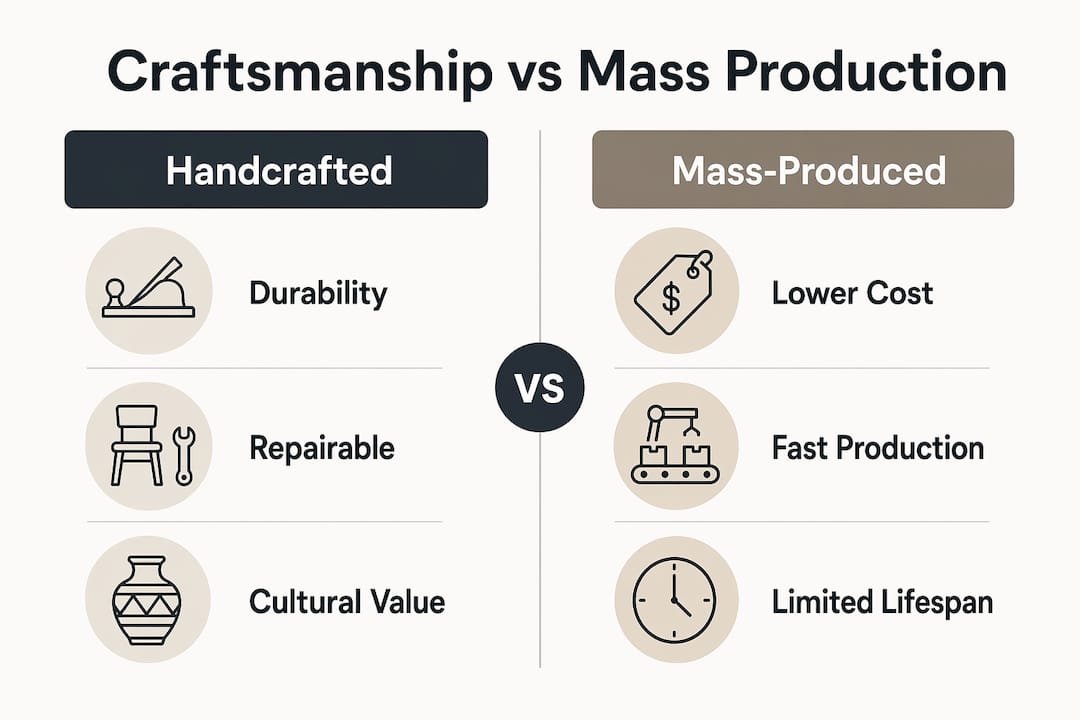
The core difference between handcrafted and mass-produced furniture is not aesthetic. It is structural, material, and temporal. Mass-produced pieces can look identical to handcrafted ones in a showroom. The divergence appears over time, under use, and at the moment something needs repair.
| Feature | Handcrafted furniture | Mass-produced furniture |
|---|---|---|
| Durability | Built for decades with traditional joinery and solid materials | Designed for 5 to 10 years of typical use |
| Repairability | Components are separable and serviceable by design | Assemblies are often glued or stapled, making repair impractical |
| Materials | Solid wood, natural finishes, species selected for function | Particleboard, MDF, veneer surfaces, synthetic coatings |
| Cultural significance | Carries maker’s signature, technique, and regional heritage | Standardized, anonymous, interchangeable |
| Long-term value | Often appreciates or becomes a family heirloom | Depreciates rapidly and is typically discarded |
Handcrafted furniture frequently becomes an heirloom. A well-built entryway bench or mud locker from a family workshop does not just hold coats and boots. It holds the story of who made it, how it was made, and why it was worth making well. That narrative adds value that no factory can produce at scale.
The repairability requirement built into crafted objects also changes the economics over time. A $2,000 handcrafted piece that lasts 40 years and can be refinished twice costs far less per year of use than a $600 mass-produced piece replaced every eight years. The math favors craftsmanship when you calculate across a lifetime of ownership.
When you choose home furniture with longevity in mind, the upfront cost becomes a smaller part of the total value equation. What matters more is the quality of the materials, the integrity of the construction, and whether the piece can be maintained.
How to identify and invest in true craftsmanship
Knowing why to prioritize craftsmanship is only useful if you can recognize it when you see it. These steps give you a practical framework for evaluating any furniture purchase.
- Ask about repairability first. Can the joints be re-glued? Can the finish be stripped and reapplied? Can individual components be replaced? A craftsman who builds for longevity will answer these questions without hesitation.
- Look for artisanal signatures. Hand-cut dovetails have slight variations between joints. Machine-cut dovetails are perfectly uniform. Slight variation signals human skill. Perfect uniformity signals automation.
- Examine material choices. Solid wood, quartersawn lumber, and hand-applied oil or wax finishes indicate craftsmanship. Veneer over MDF, spray lacquer, and plastic edge banding indicate mass production.
- Ask about the maker’s training. A craftsman with 10 or 20 years of experience in a specific technique brings accumulated knowledge that shows in the work. Furnituredesigngroup, for example, brings over 20 years of industry experience to every custom piece it produces.
- Evaluate the design for serviceability. Component separability and maintenance possibilities should be factored into the design from the start, not treated as an afterthought.
Pro Tip: Request a sample of the finish material before committing to a custom order. A craftsman confident in their materials will provide one. The texture, depth, and scent of a hand-applied oil finish are immediately distinguishable from a sprayed synthetic coating.
Higher upfront costs translate to greater value when the piece is built with repairability, solid materials, and a maker’s signature. The cost-per-year calculation almost always favors the crafted piece. More importantly, you end up with something worth keeping.
Key takeaways
Craftsmanship delivers durability, repairability, and cultural value that mass production cannot replicate, making it the superior long-term investment for furniture and home design.
| Point | Details |
|---|---|
| Repairability is the core quality marker | Furniture built with separable components and traditional joinery can be maintained for decades. |
| Material science supports traditional technique | Wood modification and hybrid composites confirm that skilled material choices produce measurable structural gains. |
| Cultural knowledge is at stake | Choosing crafted furniture supports artisan lineages and heritage skills that cannot be automated or scaled. |
| Craftsmanship beats mass production over time | A handcrafted piece lasting 40 years costs less per year of use than multiple mass-produced replacements. |
| Identification requires hands-on evaluation | Turn pieces over, ask about repair pathways, and examine joinery to distinguish true craftsmanship from imitation. |
What 20 years of watching furniture age taught me
I have spent two decades watching furniture age in real homes, and the pattern is consistent. The pieces that survive, that get passed down, that still look right in a room 30 years later, are always the ones where someone made deliberate decisions about joinery, material, and finish. Not the most expensive pieces. The most considered ones.
What surprises most people is how quickly the gap between crafted and mass-produced furniture becomes visible. Within three years of daily use, a mass-produced entryway piece shows stress at the joints, finish wear at contact points, and drawer fit problems from humidity cycling. A well-built piece from a craftsman who understood those stresses in advance shows none of that. The investment in custom furniture craftsmanship pays off faster than most people expect.
The cultural argument matters to me personally as well. When I recommend a craftsman to a client, I am recommending a knowledge system that took years to build. That system disappears if nobody supports it. Buying a handcrafted mud locker from a Maryland workshop is not a sentimental choice. It is a practical one that also happens to keep a valuable skill alive in the world.
My honest advice: stop treating the upfront price as the primary variable. Calculate cost per year of use, factor in repair costs you will never pay, and consider what you want in your home in 20 years. The answer almost always points toward craftsmanship.
— Donovan
See craftsmanship in action at Furnituredesigngroup

Furnituredesigngroup has spent over 20 years building custom entryway furniture for Maryland homeowners who want pieces that last. Every mud locker, bench, and storage unit the company produces is built with the repairability, material integrity, and artisanal technique this article describes. You are not buying a product off a shelf. You are commissioning a piece designed for your space, built by hand, and constructed to be maintained for decades. Explore the full range of handcrafted custom furniture from Furnituredesigngroup, or visit the showroom to see the joinery and finishes in person before you decide.
FAQ
What does it mean to prioritize craftsmanship in furniture?
Prioritizing craftsmanship means selecting furniture built through trained human skill, quality materials, and traditional techniques rather than optimizing for the lowest price or fastest production. It means valuing repairability, structural integrity, and the maker’s knowledge over surface appearance alone.
How does craftsmanship affect furniture durability?
Craftsmanship produces measurable structural advantages through joinery design, material selection, and finish application. Research confirms that engineering choices in joint design and material processing produce durability gains that mass production methods cannot replicate.
Is handcrafted furniture worth the higher price?
A handcrafted piece built to last 40 years with two refinishing cycles costs significantly less per year of use than a mass-produced piece replaced every eight years. The economics favor craftsmanship when calculated across a full ownership period.
How can I tell if furniture is truly handcrafted?
Examine the joinery on the underside and inside corners. Hand-cut dovetails show slight variation between joints, while machine-cut joints are perfectly uniform. Ask the maker directly about repair pathways and component separability, since a genuine craftsman will answer both questions in detail.
Why does craftsmanship matter beyond the individual piece?
Craftsmanship preserves cultural knowledge and artisan skills that cannot be automated or scaled. Supporting craftsmen keeps heritage techniques alive in communities and produces objects with lower long-term environmental impact than furniture designed for disposal.